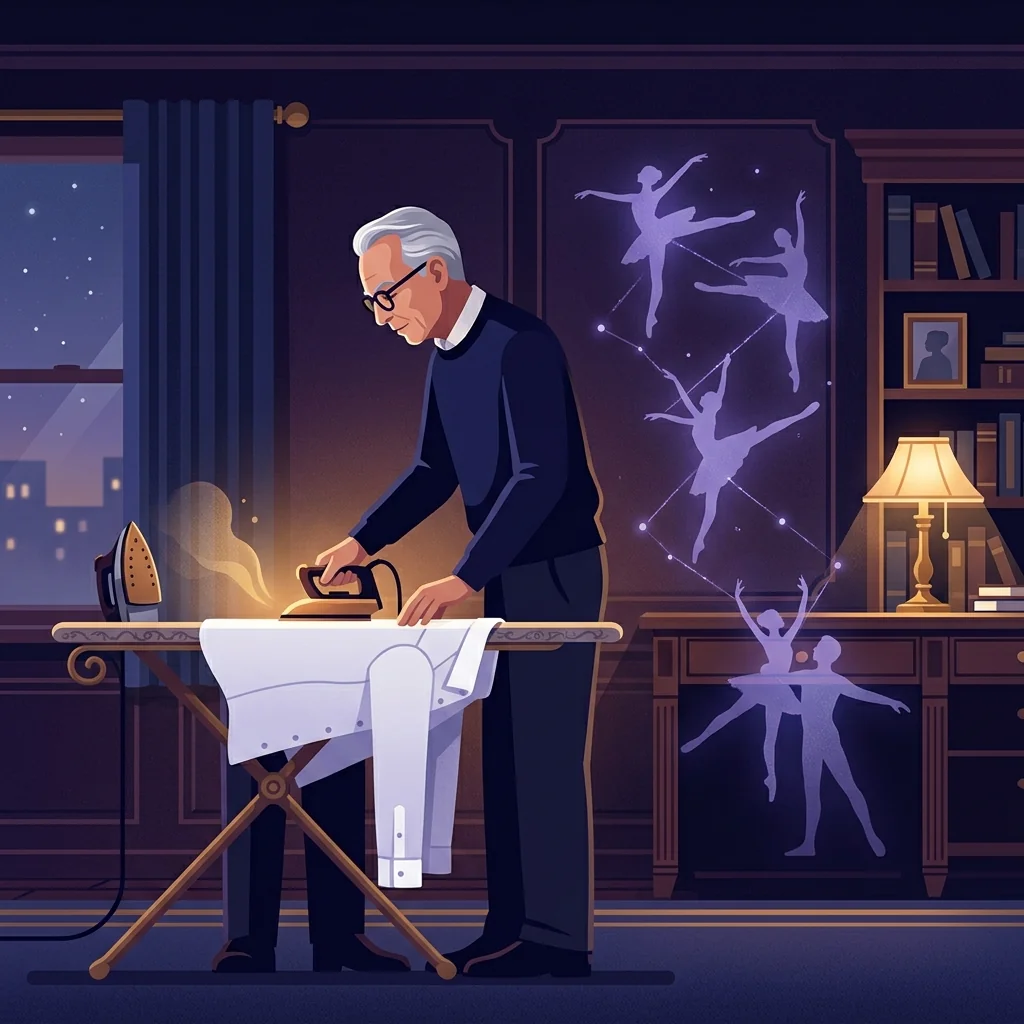
“I don’t sit down and force myself to choreograph. When I iron or sweep the floor, that’s when the dancers start moving before my eyes.” 🧺
George Balanchine (1904–1983), co-founder of the New York City Ballet (NYCB) and the master choreographer who laid the foundation for 20th-century neoclassic ballet. Renowned for revolutionizing the performing arts with geometric and innovative works such as ‘Apollo’, ‘Agon’, and ‘Jewels’, he possessed an unrivaled genius for visualizing music into movement. Yet, even for a creator of his stature tasked with endless artistic output, severe periods of creative stagnation were inevitable. However, Balanchine never sat paralyzed in a room wringing his hands. Whenever he hit a wall, he would immediately stand up, set up his iron and ironing board to neatly press shirts or handkerchiefs, or mop the floor.
Neuroscientifically, this ordinary household chore routine was a remarkable ‘unconscious ideation method’ that relieved cognitive pressure and reignited the spark of creativity. When faced with tough problems or staring at a blank document, we often lock ourselves to our desks, staring intensely at monitors and forcing our brains to work. However, this obsessive hyper-focus often backfires. A forced brain experiences high stress, narrowing its vision and relying only on conventional, uninspired solutions. In moments requiring true breakthrough creativity, we need a way to loosen the rigid grip of the prefrontal cortex.
In today’s post, we examine how George Balanchine’s routine of simple motor tasks relaxes the brain’s analytical regions, and present a 3-step practical guide for modern individuals to escape creative deadlocks and harness unconscious insights.
Historical & Academic Evidence
This content is based on Historical Verification from George Balanchine's Biography *By George Balanchine* & Cognitive Neuroscience Research.
 BuildSelf
Inspired by historical greats? Make it your daily habit!
BuildSelf
Inspired by historical greats? Make it your daily habit!

















1. Relaxation of Prefrontal Censorship and Activation of DMN Associative Circuits
When we focus intensely to solve a problem, the brain’s prefrontal cortex strongly activates top-down analytical control, mercilessly filtering out unconventional ideas that seem illogical. This ‘prefrontal censorship’ traps creativity. Conversely, performing simple, monotonous motor tasks like ironing or cleaning relaxes prefrontal hyper-activity. Taking advantage of this gap, the brain’s Default Mode Network (DMN) switches on, allowing diverse memory fragments scattered in the subconscious to freely and unexpectedly recombine (Combinatorial Play). As a result, blocked choreographic movements naturally emerge amid the repetitive rhythm of the iron.
2. 3-Step Practical Routine for Modern Professionals
Step 1: Selecting Simple, Repetitive Chores Free of Cognitive Load
Designate activities that the brain can perform reflexively without thinking about manuals or instructions, such as washing dishes, ironing, folding laundry, or wiping windows.
Step 2: 15 Minutes of Rhythmic Physical Immersion & Mind-Wandering
Turn off your smartphone and all noise, focusing entirely on the steady rhythm of the iron or broom and your physical movements for 15 minutes while allowing your thoughts to roam freely.
Step 3: Capturing Sudden Ideas & Returning Immediately to Main Tasks
Jot down planning ideas or key words that suddenly emerge from the subconscious during simple labor so as not to forget them, then return immediately to your main workspace to build momentum.
3. Caution & Tips: Excluding Cognitively Demanding Activities
When clearing your mind using light chores or body movements, avoid activities that demand high attention or cognitive processing. For instance, attempting to cook a complex recipe or listening to financial news while cleaning constitutes ‘multitasking’, which prevents the brain from entering the DMN state and only increases cognitive fatigue. The key is to loosely rest your attention solely on the touch of your hands and the rhythmic motion of your body, allowing your mind to wander freely.
📌 Frequently Asked Questions (FAQ)
Besides household chores like ironing or washing dishes, does walking provide a similar DMN activation effect? ▼
Yes, walking is also a wonderful tool for boosting creativity. However, when walking, the brain must continuously consume a certain level of visual and cognitive attention to navigate surroundings or avoid crowds. On the other hand, ironing or washing dishes involves limited, fully controlled physical actions within a familiar indoor environment, so prefrontal cognitive consumption is much lower than during a walk, offering a unique advantage in more stably inducing a quiet, meditative state (DMN activation).