“It is in darkness and quiet that ideas finally begin to take definite shape.” 🌌
Alexander Graham Bell (1847–1922) was a legendary inventor and scientist who revolutionized global communication by inventing the first practical telephone and dedicated much of his life to educating the deaf. Beyond the telephone, his pioneering spirit birthed forward-thinking inventions like the photophone, metal detector, and hydrofoil. But under what conditions did his unique creative breakthroughs originate?
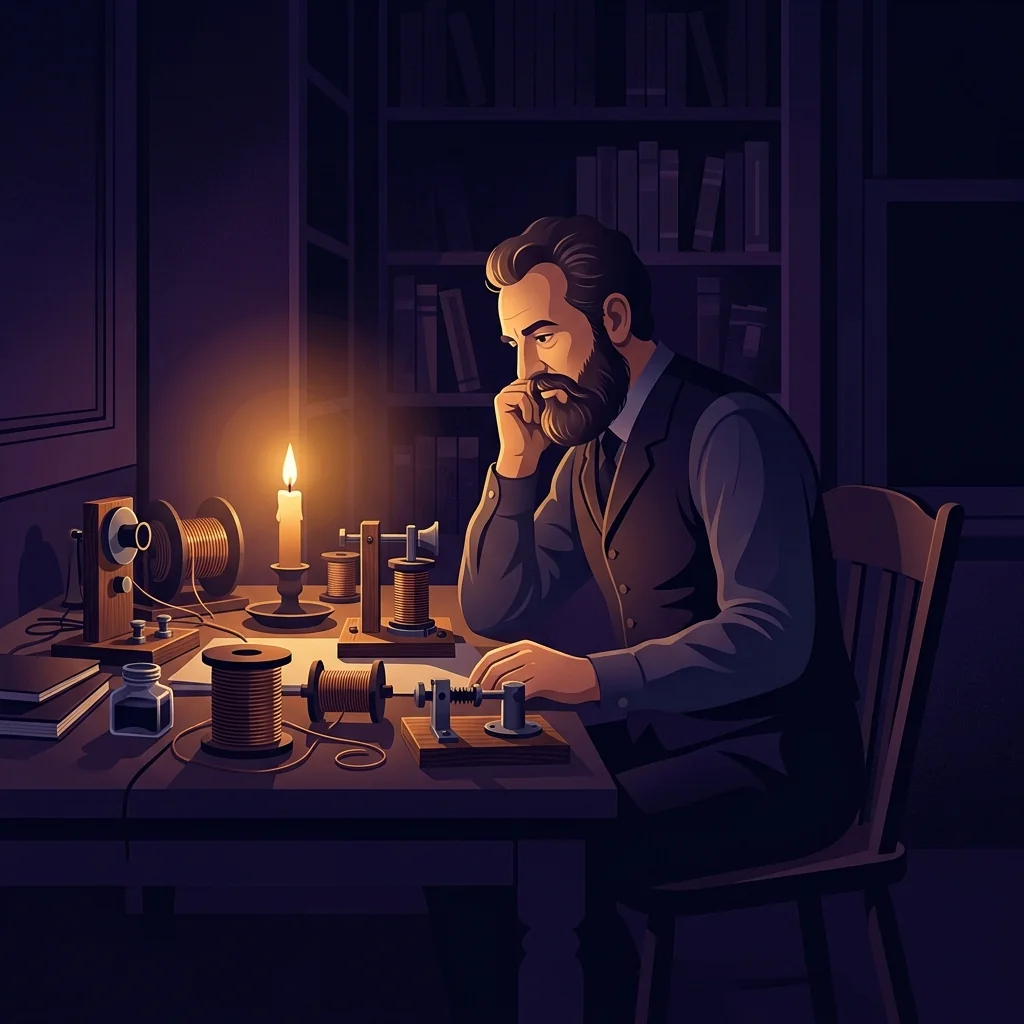
During the day, Bell suffered from severe sensory overload and cognitive fatigue stemming from humanitarian teaching, business negotiations, and intricate experimental work. To overcome this and restore his brain’s higher-level reasoning capacity, he designated 10 PM to 2 AM as his personal ‘Sensory Deprivation Time in Darkness’. Extinguishing all candles in his room to create absolute silence and darkness, he reclined or sat upright to mentally visualize the complex mechanics of inventions and sound wave oscillations. This distinctive deep work routine of cutting off external visual and auditory stimuli served as the driving engine behind his lifelong scientific achievements.
In today’s post, we examine the brain science underlying Alexander Graham Bell’s ‘Sensory Deprivation’ routine and present a 3-step practical action plan for modern individuals to escape sensory overload and maximize visuospatial executive functions.
Historical & Academic Evidence
This content is based on Historical Verification from Robert V. Bruce's Biography *Bell: Alexander Graham Bell and the Conquest of Solitude* & Cognitive Neuroscience Research.
 BuildSelf
Inspired by historical greats? Make it your daily habit!
BuildSelf
Inspired by historical greats? Make it your daily habit!

















1. Activation of Visuospatial Sketchpad Circuits via Visual and Auditory Deprivation
Neuroscientifically, temporarily cutting off external visual and auditory stimuli entering the eyes and ears allows the brain to reallocate attention previously spent on sensory receptors toward high-order association cortices. This Sensory Deprivation state suppresses amygdalar anxietyand strongly activates the ‘Visuospatial Sketchpad’ circuit essential to working memory. Consequently, the prefrontal cortex’s executive control functions—which mentally visualize and assemble complex structures or ideas in 3D—improve dramatically.
2. 3-Step Practical Routine for Modern Professionals
Step 1: Total Blackout of Light and Visual Stimuli in Your Space
When planning a new project or facing mental clutter, turn off all room lights and close blackout curtains to completely block visible light. The key is blocking even minute LED lights from smartphones or monitors.
Step 2: Blocking Auditory Stimuli Using Noise Cancellation
Insert earplugs deeply or wear noise-canceling headphones without playing audio to physically block ambient environmental sound. This minimizes the intensity of external sensory signals entering the brain.
Step 3: 20 Minutes of Mental Visuospatial Structuring and Visualization
Sit silently in total darkness for 20 minutes to mentally visualize blueprints, structural concepts, or workflow paths in 3D. Free from external interference, the parietal and prefrontal association circuits operate to enable far clearer, highly sophisticated design.
3. Caution & Tips: Preventing Transition into Sleep in Total Darkness
Lying down in complete darkness easily prompts the cerebrum to recognize a sleep environment, transitioning into slow-wave sleep. Therefore, when practicing this sensory deprivation routine, sit upright in a chair with back support instead of lying in bed. If drowsiness sets in, maintain cognitive alertness through light tactile exercises like firmly squeezing and releasing your fingertips.
📌 Frequently Asked Questions (FAQ)
Does this sensory deprivation routine only work if practiced at a fixed time daily? ▼
Practicing at the same time daily conditions the brain to recognize that period as a timing for sensory pause and deep work, accelerating cognitive switching. However, even without a fixed schedule, applying it as an emergency brain-rest and conceptual tool during periods of acute stress or cognitive overload yields significant benefits.
How should I handle environments where surrounding noise cannot be completely eliminated? ▼
If achieving absolute physical silence is difficult, we recommend a masking technique: play low-volume ambient sound with consistent frequencies, such as lyricless white noise or rain sounds, to cover external noise. This prevents the brain from reacting to real-time changes in external stimuli, producing a comparable sensory isolation effect.