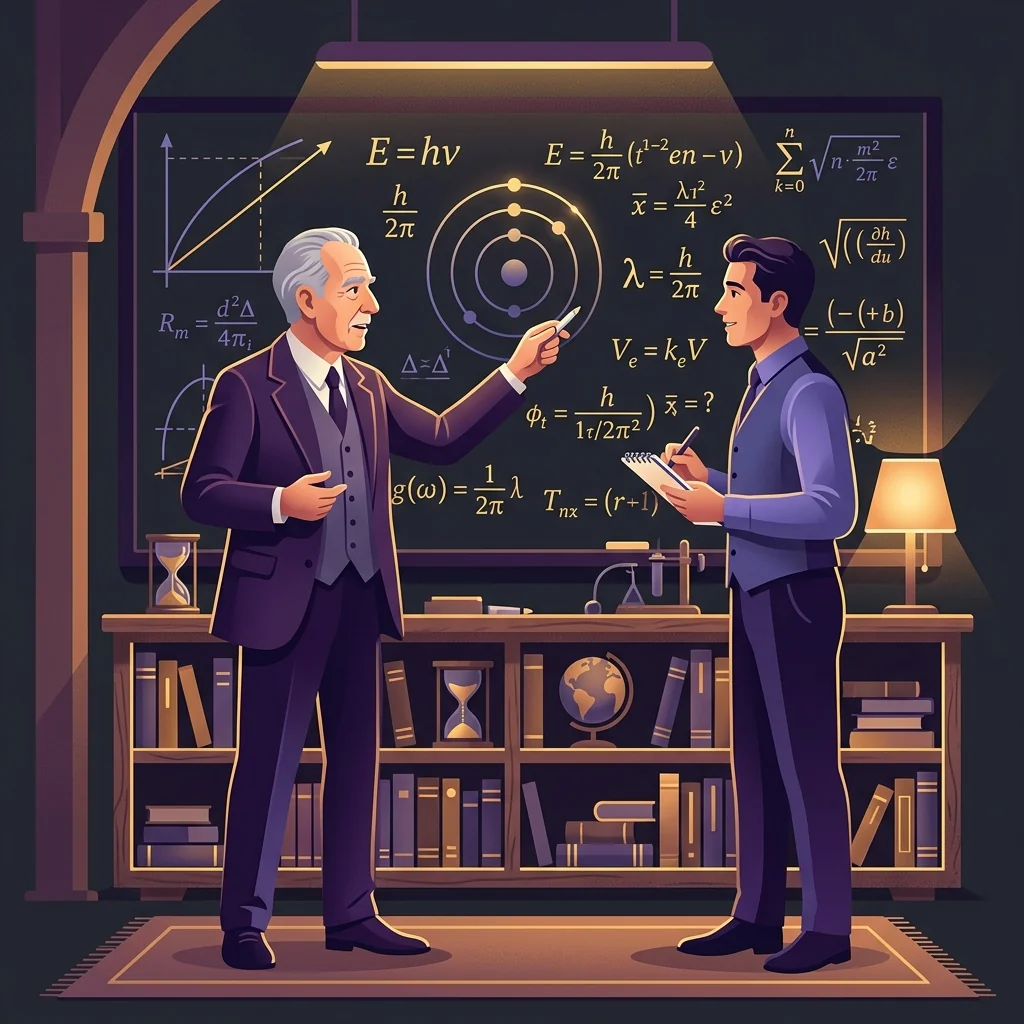
“We only discover what we were truly thinking through the process of casually speaking our thoughts aloud to others.” 🗣️
Niels Bohr (1885–1962) was a legendary Danish physicist who unlocked the secrets of atomic structure to win the 1922 Nobel Prize in Physics and established the Copenhagen interpretation, laying the foundation for modern quantum mechanics. As founder of the Institute for Theoretical Physics in Copenhagen, he gathered brilliant minds like Werner Heisenberg and Wolfgang Pauli. Yet, despite possessing unmatched scientific intuition, he found sitting alone in a quiet room writing prose on paper extremely painful.
Bohr utilized a unique contemplation routine to draw out complex, intuitive physics concepts locked in his head. Instead of writing in solitude, he placed a sounding board in the room—his devoted wife Margrethe, or colleagues and disciples like Heisenberg and Pauli. Pacing around the room while muttering concepts aloud, he stimulated intense debate, continuously polishing sentences until his listener fully grasped them, at which point he dictated the final phrasing to be written down. For Bohr, dialogue was not mere social interaction, but a cognitive engine that converted vague mental models into precise linguistic reality.
In today’s post, we examine the brain science underlying Niels Bohr’s ‘dialogue-driven dictation’ method and present a 3-step practical action plan for modern individuals to solidify ambiguous ideas and activate metacognition.
Historical & Academic Evidence
This content is based on Historical Verification from Abraham Pais's Biography *Niels Bohr's Times: In Physics, Philosophy, and Polity* & Cognitive Neuroscience Research.
 BuildSelf
Inspired by historical greats? Make it your daily habit!
BuildSelf
Inspired by historical greats? Make it your daily habit!

















1. Neural Mechanisms of Internal Speech Externalization and Metacognition Activation
Mental ‘Inner Speech’ often conceals logical leaps and ambiguities, easily creating illusions of understanding when solving complex problems. The moment this is converted into spoken ‘External Speech’, the brain activates metacognitive circuits, allowing it to objectively listen to and process its own ideas from a third-person perspective. Furthermore, pairing speech with interactive social stimuli—such as a listener’s immediate feedback and questions, as Bohr did—strongly engages the language cortex and executive control networks across both hemispheres, effectively recombining scattered intuitive fragments into explicit, logical frameworks.
2. 3-Step Practical Routine for Modern Professionals
Step 1: Designating a Listening Partner for Dictation
Designate a trusted colleague or learning partner who will listen attentively and ask clarifying questions, or launch a conversational AI assistant.
Step 2: Stating the Core Question & Explaining Ideas Aloud
State the single core question you wish to resolve to your partner, then begin casually explaining your thoughts aloud as if drawing on an imaginary chalkboard.
Step 3: Refining Contradictions via Questions & Transcribing Key Phrasings
Fix logical flaws or contradictions exposed through your partner's questions or your own speaking process, and immediately write down or dictate refined sentences and key concepts into notes.
3. Caution & Tips: Guarding Against Aimless Chatter & Setting Structured Time Limits
The biggest pitfall when applying a dictation-dialogue routine is devolving into aimless chatter. Starting a discussion without a clear question guideline consumes cognitive energy and time while derailing the objective of solidifying ideas. Before speaking, explicitly state a ‘single clear question’ you aim to solve to your partner, and enforce a focused time block of 15 to 20 minutes to maintain constructive cognitive tension.
📌 Frequently Asked Questions (FAQ)
How can I practice this routine in a solo environment without a partner? ▼
You can substitute by turning on a smartphone voice memo or AI recorder app and speaking aloud as if explaining to an imaginary listener. The crucial factor is not the physical presence of a listener, but the cognitive stimulation process of converting inner thoughts into external spoken language and re-auditing them.
How can I translate the output of oral discussion into productive written documentation? ▼
We recommend immediately jotting down sudden insights as keywords during speech, or utilizing Speech-to-Text (STT) tools to automatically transcribe the session, and then re-structuring the raw text into a core outline during deep work.