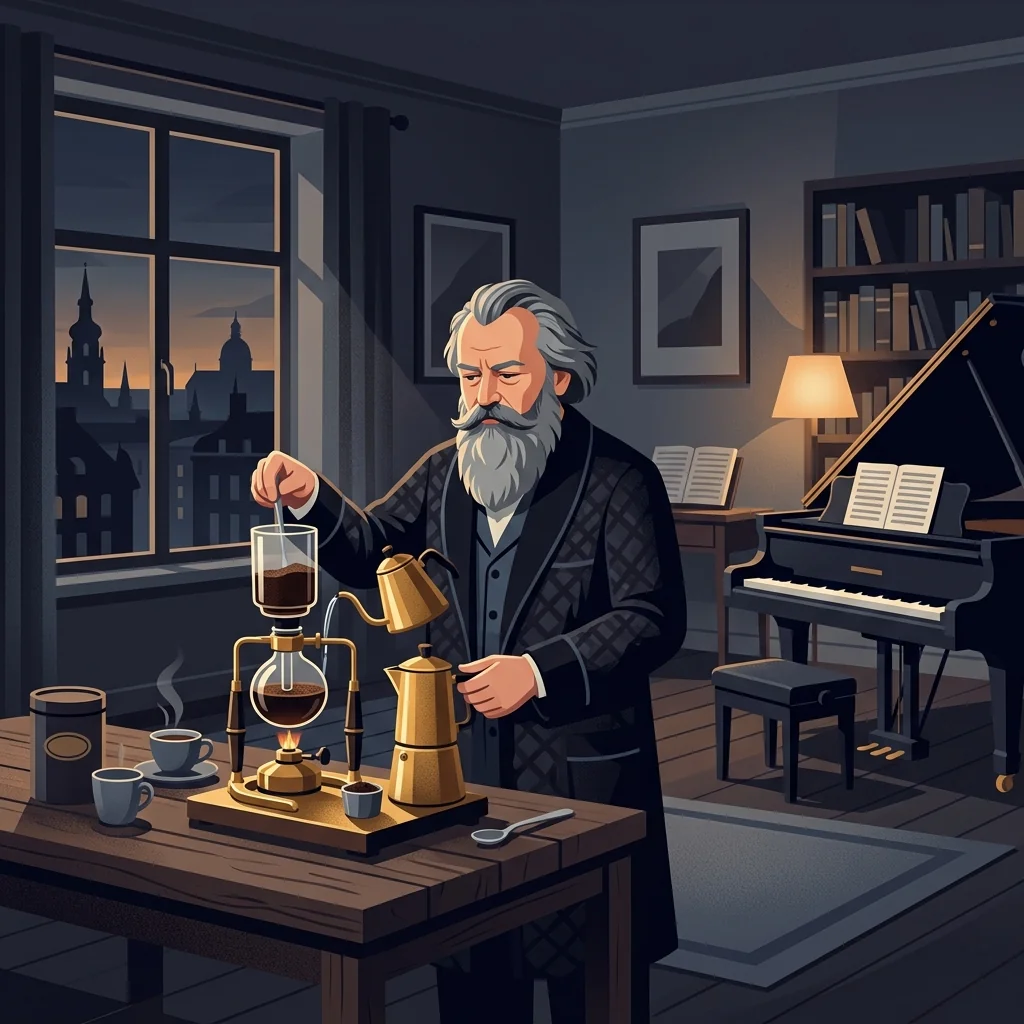
“The rich aroma of morning coffee and the fresh air of the morning woods finally awaken the musical ideas in my head.” ☕
Johannes Brahms (1833–1897) was a titan of German classical music who, along with J.S. Bach and Ludwig van Beethoven, formed the legendary ‘Three Bs’. Renowned for seamlessly fusing Classical rigor with Romantic lyricism, he authored four monumental symphonies, a violin concerto, and ‘A German Requiem’. His dense, intricate counterpoint compositions were birthed out of a meticulously structured morning arousal ritual.
Every morning at 5 AM without an alarm, Brahms woke up instantly. Heading straight to the kitchen, he personally ground roasted beans and brewed a dark, concentrated black coffee without relying on anyone else. Immediately following this coffee ritual, he stepped out into the crisp morning air to walk briskly through the parks and forest paths near Vienna. As he walked, he translated nature’s rhythms into melodies and mapped out complex contrapuntal structures in his head. The core inspiration and architectural depth of Brahms’s masterworks were forged directly along this early-morning synergy of caffeine and aerobic walking.
In today’s post, we analyze the brain science underlying Johannes Brahms’s ‘dawn coffee and conceptual walk’ routine and present a 3-step morning protocol for modern individuals to maximize working memory capacity and mental focus.
Historical & Academic Evidence
This content is based on Historical Verification from Max Kalbeck's Biography *Johannes Brahms* & Cognitive Neuroscience Research.
 BuildSelf
Inspired by historical greats? Make it your daily habit!
BuildSelf
Inspired by historical greats? Make it your daily habit!

















1. Cognitive Synergy of Caffeine Arousal, Post-Exercise BDNF Release, and Working Memory
Caffeine in morning coffee blocks adenosine receptor binding, cutting off brain fatigue signals while stimulating norepinephrine and dopamine release to promote alertness. When brisk walking immediately follows this physiological activation, cerebral blood flow increases and Brain-Derived Neurotrophic Factor (BDNF) is released. BDNF protects neurons and reinforces synaptic neuroplasticity. Consequently, Brahms’s dawn routine combined central nervous system stimulation from caffeine with increased oxygen delivery from walking, artificially elevating working memory capacity and creative planning to their absolute peaks.
2. 3-Step Practical Routine for Modern Professionals
Step 1: Hydration After Waking & 30 Minutes of Clearing Sleep Inertia
Drink a glass of lukewarm water immediately upon waking to restore hydration, and allow 30 minutes for sleep inertia to dissipate as natural cortisol peaks subside.
Step 2: Caffeine Administration via Carefully Brewed Black Coffee
Brew and savor a cup of unsweetened black coffee or espresso. It takes approximately 15 to 20 minutes for caffeine to be absorbed and reach brain receptors.
Step 3: Executing 15-20 Minutes of Brisk Conceptual Walking
After coffee, head outside for a brisk 15-to-20-minute walk at a slightly elevated pace. As blood flow and BDNF surge, mentally outline the cognitive framework for your day's primary tasks.
3. Caution & Tips: Considering Cortisol Rhythms and Coffee Timing After Waking
If caffeine is consumed immediately upon waking when cortisol levels are naturally at their peak, its stimulating effect is reduced and gastrointestinal discomfort can occur. Hydrate first with lukewarm water upon waking and wait 30 minutes to an hour before drinking coffee, absorbing caffeine as natural cortisol levels subside—a approach that is healthier and more effective for cognitive anchoring.
📌 Frequently Asked Questions (FAQ)
Why did Brahms stubbornly insist on personally brewing his coffee instead of letting others do it? ▼
Brahms was a perfectionist who believed coffee strength directly impacted his morning state of alertness. The fine motor activity of grinding beans and manually brewing acted as a powerful mental anchor, focusing his brain's attention for the day ahead.
How specifically does morning walking contribute to brain stimulation and creativity? ▼
Rhythmic foot strikes during walking send pressure waves that physically boost cerebral blood flow. Furthermore, aerobic exertion stimulates BDNF release, enhancing synaptic plasticity between neurons and maximizing higher-order information structuring and creative problem-solving.