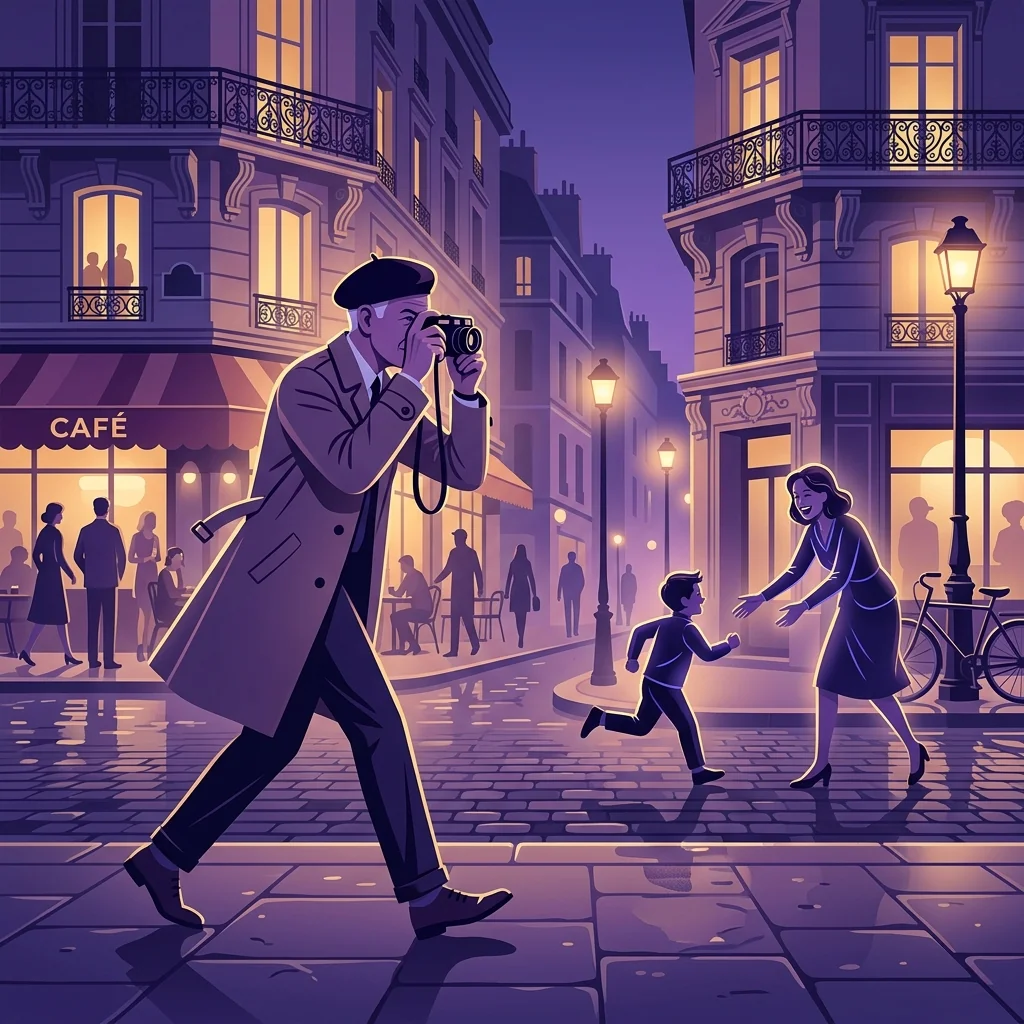
“To take a photograph is to align the head, the eye and the heart along the same line of sight.” 📷
Henri Cartier-Bresson (1908–2004) was a master of modern photography, co-founder of Magnum Photos, and the pioneer who elevated candid street photography into a fine art. Famous for iconic shots like the man leaping over a puddle—catching the exact millisecond before his heel touches the water—his incisive gaze sliced through the noise of daily life to permanently redefine 20th-century visual culture.
Rejecting bulky studio cameras, Cartier-Bresson covered the shiny chrome of his compact Leica camera with black tape to avoid drawing attention, roaming urban streets like an invisible observer. Instead of firing off continuous shots, he waited with held breath, his eye glued to the viewfinder, until the human movement, light, shadow, and architectural lines coalesced into a single frame of perfect geometric balance—what he termed ‘The Decisive Moment’. This intense visual focus and patient observation silenced stray thoughts, sharply synchronizing his sensory cortex with prefrontal attentional networks.
In today’s post, we analyze the brain science underlying Henri Cartier-Bresson’s ‘geometric harmony and instant observation’ routine and present a 3-step practical guide for modern individuals to escape routine cognitive fatigue and cultivate heightened observational focus.
Historical & Academic Evidence
This content is based on Historical Verification from Henri Cartier-Bresson's Photobook *Images à la sauvette / The Decisive Moment* & Cognitive Neuroscience Research.
 BuildSelf
Inspired by historical greats? Make it your daily habit!
BuildSelf
Inspired by historical greats? Make it your daily habit!

















1. Overriding Predictive Coding Filters and Activating Visual Cortex Attentional Networks
Familiar everyday streets are largely filtered out by the brain’s ‘Predictive Coding’ system to conserve energy, rendering ambient details invisible. Actively tracking geometric patterning, spatial alignments, and shifting light contrast—as Cartier-Bresson did—overrides this predictive filter. This process stimulates the visual cortex and prefrontal attentional control networks, dramatically increasing sensory resolution, silencing cognitive noise, and activating creative association circuits.
2. 3-Step Practical Routine for Modern Professionals
Step 1: Switching to Camera Mode & Scanning Geometric Patterns While Walking
Keep your smartphone camera app open while walking, actively scanning surrounding geometric design elements such as architectural straight lines, corner shadows, street patterns, and light reflections.
Step 2: Locking Frame Composition & Observing Dynamic Element Convergence
Lock your composition around a specific window frame, beam of light, or street corner, remaining motionless with your finger resting lightly on the shutter, focusing intently until a subject (a walking person, a bird in flight) enters the precise intersection of the frame.
Step 3: Single Intentional Shutter Press & Preserving Unedited Reality
The millisecond your brain perceives absolute geometric harmony, press the shutter just once. Avoid continuous burst shots or post-cropping, verifying the perfection of your observational focus in a single, untouched snapshot.
3. Caution & Tips: Focusing on Cognitive Synchronization with the Moment, Not Mere Recording
The goal of this observation exercise is not stockpiling pretty photos for social media. It is training ‘Delayed Attention’—aligning the geometric architecture in front of you with inner mental composure. Resist the urge to continuously burst-click shutters. Instead, practice sustained stillness, holding your breath for 5 seconds or more until visual elements merge into perfect alignment before taking a single shot.
📌 Frequently Asked Questions (FAQ)
Must human figures be included in the frame during visual observation training? ▼
No. Observing inanimate geometric shapes and light boundaries—such as telegraph pole shadows cast on a wall or light rays passing through a glass cup on a desk—is equally effective for activating the visual cortex.
Is it okay to crop or apply digital filters to the photos after shooting? ▼
Cartier-Bresson strictly avoided cropping and artificial editing. Forcing yourself to perfect composition at the exact moment of shooting is precisely what trains spatial judgment and instantaneous cognition, so preserving untouched raw photos is strongly recommended.