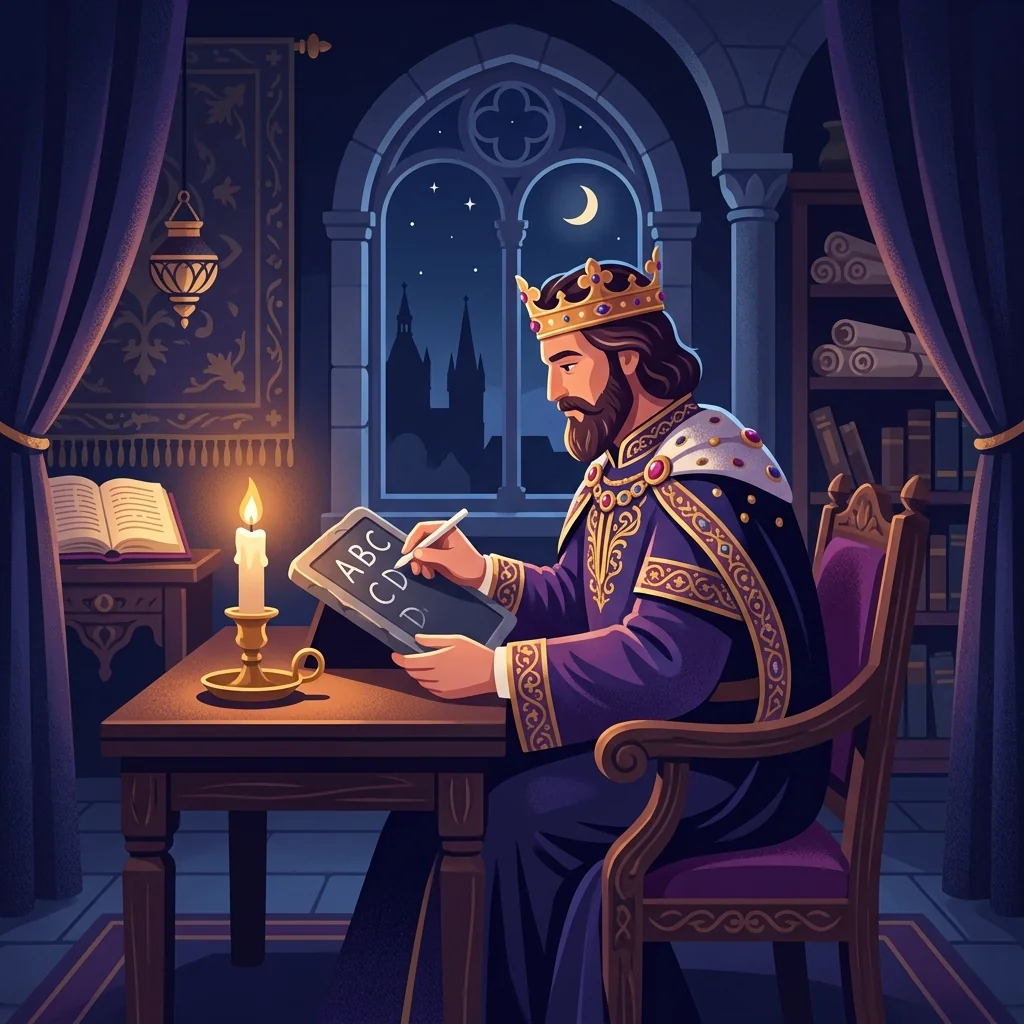
“To have knowledge is good, but to practice it and weave it into life is far greater.” 👑
Charlemagne (747–814), crowned Emperor of the Romans by Pope Leo III in 800 AD, laid the geopolitical and cultural foundations of Western Europe. By reviving scholarship and literature, he catalyzed the ‘Carolingian Renaissance’. Yet during the 8th-century Dark Ages, when literacy was extremely rare even among royalty, how did a ruler constantly occupied with military campaigns and imperial governance manage to relentlessly pursue writing and intellectual study?
Driven by an unquenchable thirst for knowledge, Charlemagne sought to master penmanship later in life despite finding the physical art of writing difficult. To accomplish this, he established a unique bedroom environment: keeping wax tablets and a metal stylus permanently under his pillow or on a bedside table. Right before falling asleep or whenever he awakened during the night, he sat up by candlelight to practice tracing letters and Latin prose. This lifelong devotion provided the intellectual engine to restore imperial education and Latin culture. His bedside tablet was a frictionless setup that turned sleeping hours into an active memory-encoding window.
In today’s post, we analyze the brain science underlying Charlemagne’s ‘bedside writing’ routine—exploring sleep-dependent memory consolidation—and present a 3-step practical guide for modern individuals to leverage sleep mechanisms and permanently archive daily learning into long-term memory.
Historical & Academic Evidence
This content is based on Historical Verification from Einhard's Biography *Vita Karoli Magni (Life of Charlemagne)* & Cognitive Neuroscience Research.
 BuildSelf
Inspired by historical greats? Make it your daily habit!
BuildSelf
Inspired by historical greats? Make it your daily habit!

















1. Mechanism of Sleep-Dependent Memory Consolidation During Slow-Wave Sleep
Neurophysiologically, short-term information gathered during the day is temporarily buffered in the hippocampus. For this raw data to stabilize into permanent knowledge, it must undergo ‘Memory Consolidation’—a systemic transfer from the hippocampus to the neocortex. This process peaks during Slow-Wave Sleep (NREM Stage 3). Charlemagne’s routine of writing and studying immediately before sleep acts as a ‘pre-sleep loading’ strategy that charges the hippocampus with high-density target data. Once sleep ensues, non-REM oscillations and hippocampal sharp-wave ripples replay and transfer these newly encoded traces into the cortical long-term memory architecture.
2. 3-Step Practical Routine for Modern Professionals
Step 1: Placing Analog Paper Tools at Bedside & Isolating Smartphones
Before getting into bed, completely remove smartphones from your nightstand. Place only a sturdy hard-cover paper notebook and a pen within arm's reach to eliminate physical friction.
Step 2: Handwriting a 1-Sentence Summary of Key Knowledge Before Sleep
For 2 to 3 minutes right before sleeping, handwrite a 1-sentence summary of the day's most vital concept or tomorrow's top-priority task on paper, then close your eyes to sleep.
Step 3: Immediate Retrieval & Review Upon Waking or Night Awakening
The moment you open your eyes in the morning (or briefly wake at night), scan the notebook page to actively retrieve yesterday's recorded sentence, finalizing hippocampal long-term memory trace fixing.
3. Caution & Tips: Blocking Smartphones/IT Devices & Protecting Melatonin Sleep Hygiene
Structuring a bedside environment with blue-light-emitting digital devices (smartphones, tablets) suppresses melatonin secretion, delaying sleep onset and disrupting slow-wave sleep. Bedside writing setups must be strictly restricted to ‘blue-light-free analog paper and pen’. Unlocking a smartphone screen if you awaken at night activates dopaminergic reward pathways and shatters sleep architecture; thus, strictly maintain the rule of using only analog tools under dim, warm lighting.
📌 Frequently Asked Questions (FAQ)
Won't keeping paper notebooks under a pillow or bedside get crumpled or damaged during sleep? ▼
For modern practice, avoid loose thin paper. Instead, place a rigid hard-cover mini notebook on your nightstand, or mount a small wooden clipboard to a bedside shelf. This prevents damage while keeping the access loop friction-free.
Will writing in dim lighting during night awakenings strain my eyes? ▼
Nighttime writing involves brief jottings lasting 1 to 2 minutes, minimizing eye strain. The key is using a warm, amber-toned low-luminescence nightlight. This provides just enough light to trace letters without suppressing melatonin or triggering daytime arousal states.