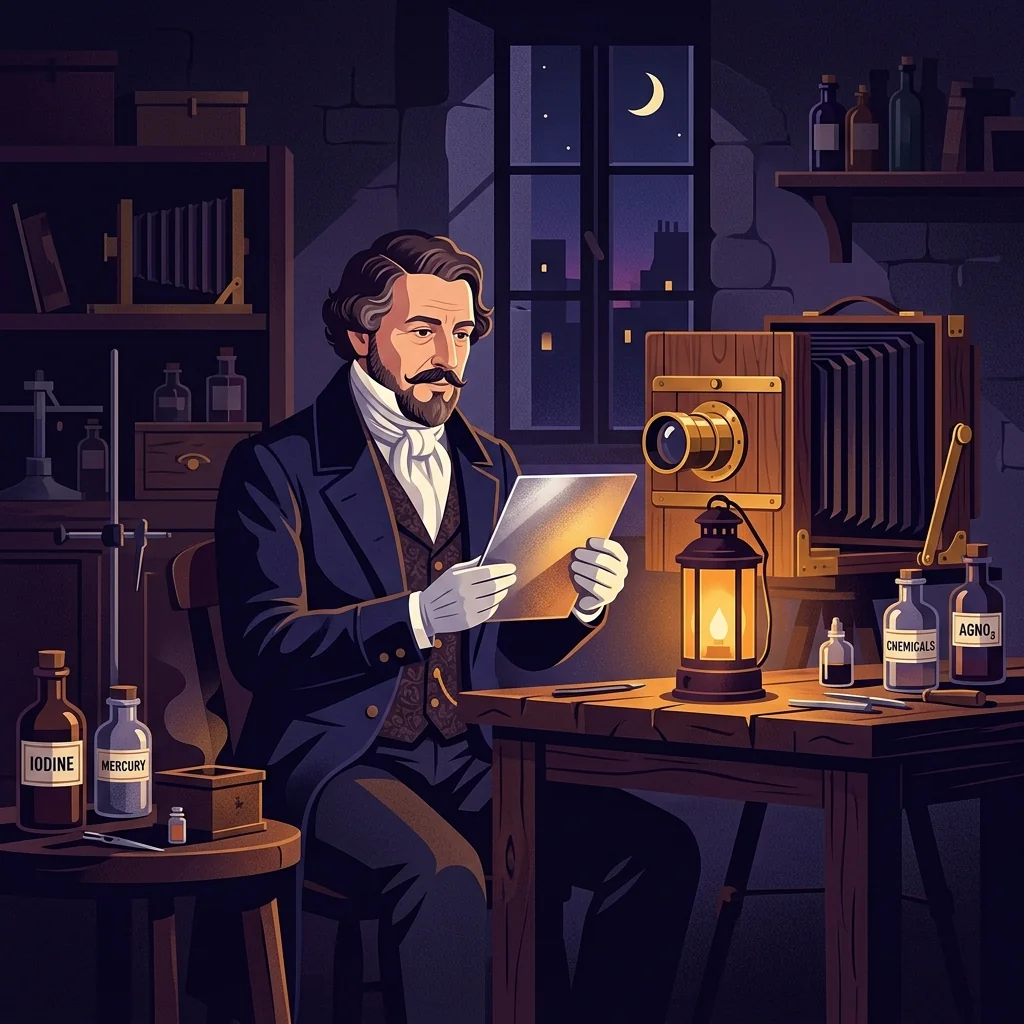
“Light is the brush that paints, and the silver plate is the eternal vessel holding that single instant.” 📷
Louis Daguerre (1787–1851) was a French artist and chemist who revolutionized modern culture by inventing the Daguerreotype—the world’s first commercially viable photographic process. By capturing fleeting rays of light on a physical medium, he fundamentally altered how humanity records history and visual truth.
Originally a painter of grand dioramas in Paris, Daguerre was consumed by a desire to permanently freeze the transient optical images projected inside a camera obscura. He spent years refining a painstaking chemical protocol: polishing silver-plated copper sheets, sensitizing them with iodine vapor, exposing them to light, and developing latent images with mercury fumes. This process required intense, uninterrupted temporal awareness. Neuroscientifically, his habit of fixing fleeting light onto physical plates mirrors how the brain locks momentary insights into the occipital visual cortex and hippocampus, preventing the rapid decay of creative sparks.
In today’s post, we analyze the brain science underlying Louis Daguerre’s ‘silver plate exposure and visual fixation’ routine and present a 3-step practical guide for modern individuals to capture fleeting ideas and lock them into long-term memory.
Historical & Academic Evidence
This content is based on Historical Verification from Louis Daguerre's *Historique et description des procédés du Daguerréotype (History and Practice of the Daguerreotype)* & Cognitive Neuroscience Research.
 BuildSelf
Inspired by historical greats? Make it your daily habit!
BuildSelf
Inspired by historical greats? Make it your daily habit!

















1. How Instant Visual Fixation Imprints Fleeting Ideas into Long-Term Memory
Neuropsychological research demonstrates that mentally framing a fleeting insight and exposing it for 3 full seconds creates a strong neural anchor across the occipital visual cortex and the hippocampus. This 3-second ‘exposure window’ stabilizes raw, volatile working memory representations before they degrade. By visually imprinting the mental snapshot, the brain seals memory traces against cognitive decay, ensuring vivid context retrieval even long after the initial spark.
2. 3-Step Practical Routine for Modern Professionals
Step 1: Freezing Fleeting Insights in a Mental Visual Frame
The instant a creative insight or idea strikes, pause active behavior for 1 second and freeze that concept or image within an internal mental frame like a camera snapshot.
Step 2: 3-Second Exposure & Occipital Visual Imprinting
Focus intently on the core keyword or spatial visual structure of the idea for 3 full seconds with eyes lowered, strongly exposing the visual cortex to imprint the neural trace.
Step 3: Immediate Text/Sketch Recording for Permanent Preservation
Immediately transfer the concept fixed in your mental frame to a physical notebook or note app as a 1-line summary or brief sketch, completing the externalized storage loop.
3. Caution & Tips: Instant Exposure Timing & Preventing Procrastination
Do not postpone recording an emerging insight. Fleeting creative sparks decay rapidly within seconds in working memory networks. The moment an idea strikes, immediately freeze it like a mental snapshot within your internal frame, expose it clearly for 3 seconds, and immediately bridge that fixation into a written note or audio recording.
📌 Frequently Asked Questions (FAQ)
How does Daguerre's 3-second visual exposure method differ from standard note-taking? ▼
Standard note-taking passively captures text or words. In contrast, Daguerre's method actively 'exposes' the idea inside the visual cortex for 3 seconds before writing. This creates a high-density sensory snapshot so that reviewing even a short keyword later immediately reconstructs the original, vivid context and emotional frequency.
What should I do if I am walking or driving and cannot physically write or sketch immediately? ▼
Execute the 3-second internal visual fixation first to imprint the image onto your occipital cortex, then record a quick voice memo on your smartphone. Because the 3-second exposure process was completed beforehand, even a brief 5-second audio snippet will preserve the full cognitive context.