“Inspiration is a very fragile guest; if you are not ready to welcome it, it vanishes without a trace.” 📝
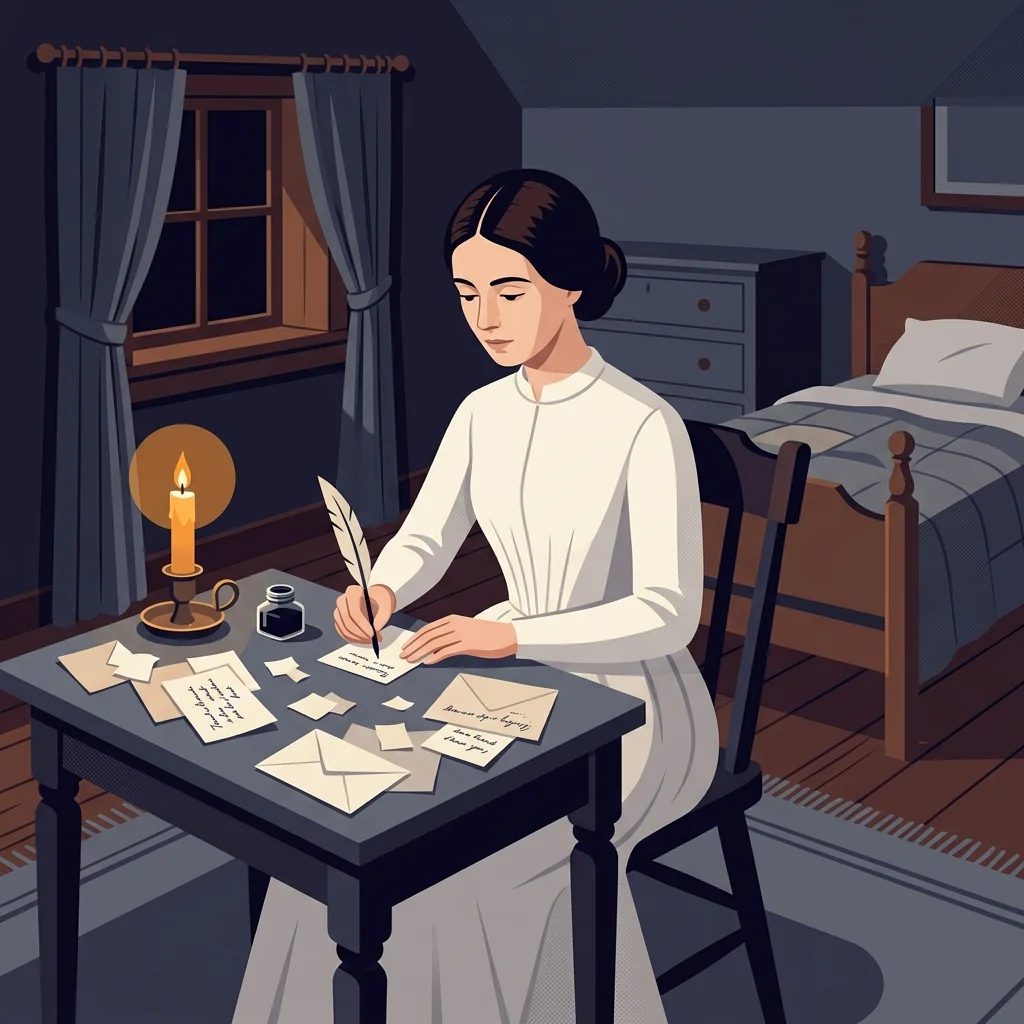
Emily Dickinson (1830–1886) is celebrated as one of the most original and enigmatic literary geniuses in 19th-century American history. Choosing a life of voluntary seclusion, she rarely left her family home in Amherst, Massachusetts, yet secretly composed nearly 1,800 astonishing poems. Where did this reclusive poet harvest and record her brilliant artistic inspirations? Her primary creative sanctuary was, surprisingly, the night kitchen.
Dickinson baked bread for her family every evening. While kneading dough and smelling baking bread at the kitchen table, whenever poetic inspiration struck, she did not search for formal stationary. Instead, she grabbed whatever scrap was immediately within reach—the back of a chocolate wrapper, the corner of a magazine advertisement, a grocery receipt, or a torn envelope—and hastily scribbled verses in pencil. These extraordinary ‘scrap writings’ were discovered bundled in her drawers only after her death, finally revealing her genius to the world.
In today’s post, we analyze the brain science underlying Emily Dickinson’s ‘receipt scrap writing’ routine—exploring the Incubation Effect and working memory preservation—and present a 3-step practical action plan for modern individuals to capture fleeting creativity.
Historical & Academic Evidence
This content is based on Historical Verification from Richard B. Sewall's Biography *The Life of Emily Dickinson* & Cognitive Neuroscience Research.
 BuildSelf
Inspired by historical greats? Make it your daily habit!
BuildSelf
Inspired by historical greats? Make it your daily habit!

















1. Incubation Relaxation via Physical Repetition and Default Mode Network (DMN) Activation
Creativity is highly stifled when the brain forces complex logical generation while sitting statically at a desk. In contrast, engaging in analog, physically repetitive tasks—such as kneading dough or washing dishes—dramatically enhances creative synthesis. Cognitive neuroscience calls this the ‘Incubation Effect’. By momentarily releasing the prefrontal cortex’s heavy Cognitive Control, the brain shifts into the Default Mode Network (DMN). In this relaxed state, fragmented memories and subconscious linguistic elements fuse freely, surfacing as sudden poetic imagery or brilliant solutions. Because insights generated this way degrade from Working Memory within seconds, searching for a perfect notebook guarantees their loss. Dickinson’s habit of instantly externalizing thoughts onto the nearest scrap of paper perfectly counteracts memory volatility, locking down insights before they evaporate.
2. 3-Step Practical Routine for Modern Professionals
Step 1: Engaging in Repetitive Physical Tasks to Relax Cognitive Control
Engage in analog, low-complexity physical chores—such as prepping ingredients, sweeping, washing dishes, or folding laundry—that require minimal executive processing, allowing the brain to drift into the incubation state.
Step 2: Immediate Raw Capture of Sparks onto Nearby Scraps
When a brilliant insight or solution surfaces during chores, do not walk away to find a proper laptop or notebook. Immediately grab a receipt, scrap paper, or the back of an envelope and roughly scribble the core concept in pencil.
Step 3: Weekend Collection of Scraps and Elevation to Primary Knowledge Base
At the end of the week, gather all the scattered paper scraps and receipts accumulated around the house. Review them collectively and digitize or transcribe the most valuable insights into your primary planner or knowledge management tool (e.g., Notion) for structured execution.
3. Caution & Tips: Rejecting Perfectionism & Preserving Ideas in Their Raw State
The absolute core of capturing creative sparks is ‘rapid preservation in a raw state’, not neat organization. If you delay recording to search for a beautiful diary or open a neatly formatted digital app, the delicate creative cues residing in your working memory will permanently evaporate. Whether it’s a torn receipt, a coffee coaster, or the back of your hand, you must frantically scribble down at least one anchoring keyword the exact second the inspiration hits.
📌 Frequently Asked Questions (FAQ)
Isn't opening a smartphone memo app much faster than looking for scrap paper and a pencil? ▼
While the digital action may seem faster, unlocking a screen, locating an app, and accidentally glimpsing push notifications forces your brain to process new stimuli. This completely overwrites the fragile incubated idea in your working memory, causing it to evaporate. A physical pencil and a scrap of paper create zero cognitive friction, allowing pure, unfiltered translation of thought.
Isn't it better for efficiency and creativity to hyper-focus and execute household chores meticulously? ▼
From the perspective of creativity, no. The Incubation Effect is maximized precisely when the prefrontal cortex temporarily suspends logical judgment and slips into a 'mind-wandering, semi-subconscious state' (DMN activation). Therefore, rather than tackling a highly complex recipe requiring intense focus, performing routine, auto-piloted physical chores—like washing dishes or sweeping—yields the highest rate of novel breakthroughs.