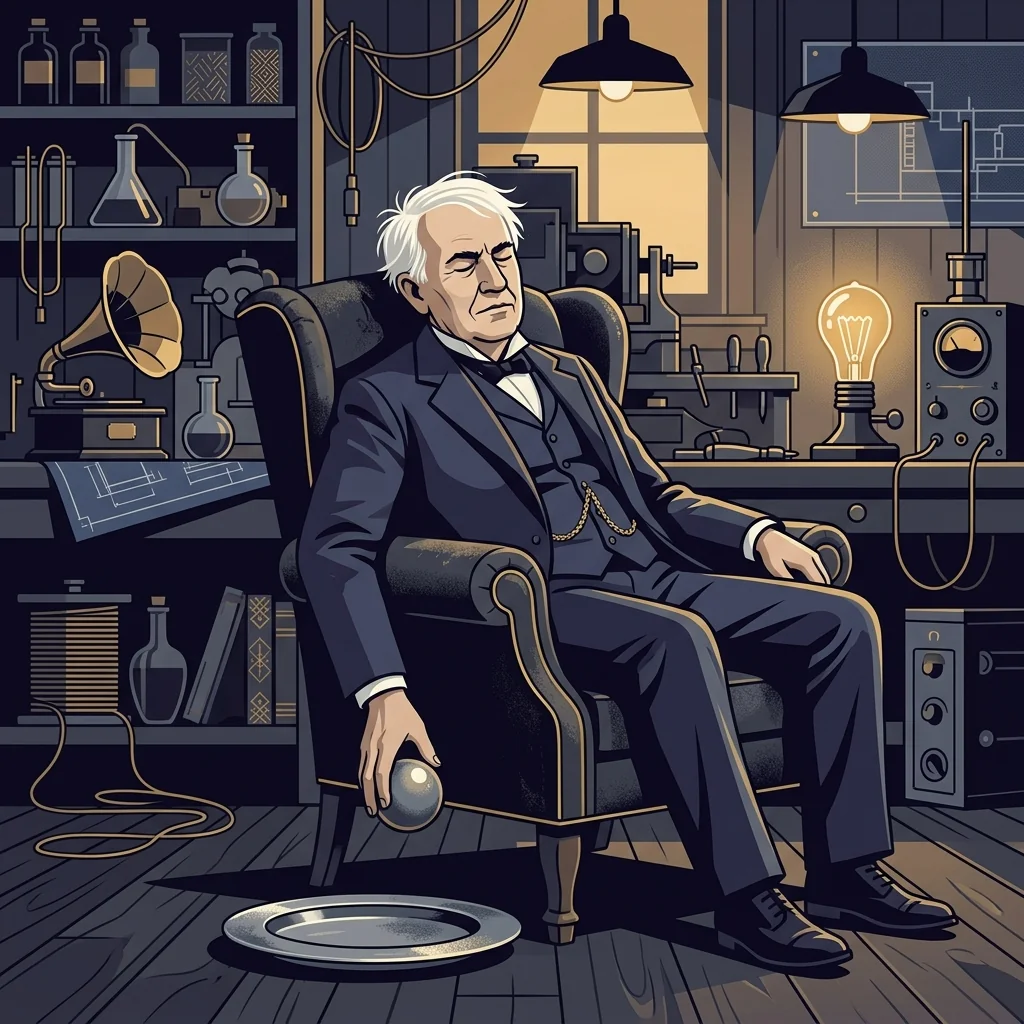
“Sleep is a waste of time, but the boundary of the subconscious is humanity’s most powerful tool of invention.” 💤
Thomas Alva Edison (1847–1931) was the undisputed ‘Wizard of Menlo Park’ who shaped modern civilization by holding a staggering 1,093 US patents, including the incandescent light bulb, phonograph, motion picture camera, and alkaline storage battery. When confronted with grueling technical bottlenecks or creative deadlocks during overnight experiments, how did Edison bypass mental fatigue to unlock breakthrough solutions?
Edison devised a precise physical ritual: resting comfortably in an armchair, he held heavy steel balls (or metal keys) loosely in his hands, placing a metal plate directly on the floor below. As he drifted into sleep, his muscles naturally relaxed, causing the steel balls to crash onto the metal plate with a sharp clatter. Instantly startled awake at the exact threshold of sleep onset, Edison immediately grabbed a notebook and frantically wrote down the vivid, uninhibited creative insights floating in his mind.
In today’s post, we analyze the cognitive neuroscience underlying Thomas Edison’s ‘hypnagogia nap’ routine and provide a practical step-by-step guide to harnessing semi-sleep state for creative problem-solving.
Historical & Academic Evidence
This content is based on Historical Verification from Paul Israel's Biography *Edison: A Life of Invention*, Thomas Edison National Historical Park Archives & Cognitive Neuroscience Research.
 BuildSelf
Inspired by historical greats? Make it your daily habit!
BuildSelf
Inspired by historical greats? Make it your daily habit!

















1. Unlocking Eureka Insights via Hypnagogia and the Steel Ball Drop Technique
Entering the hypnagogic state—the boundary between wakefulness and N1 NREM sleep—causes brainwaves to shift into theta waves (4-8 Hz). This lowers executive control from the prefrontal cortex, allowing stored memory fragments and abstract concepts to combine freely. The steel ball drop technique acted as a precise neurological switch: it abruptly interrupted the brain just before entering deeper N2 sleep and suffering from sleep inertia, allowing Edison to instantly capture transient eureka insights before they vanished.
2. 3-Step Practical Routine for Modern Professionals
Step 1: Preparing Steel Balls and Metal Dish & Sitting in Relaxed Posture
Sit comfortably in a chair, holding a heavy steel ball (or metal keys) loosely in one hand, and place a clattering metal plate or tray on the floor directly beneath your hand.
Step 2: Inducing Light Semi-Sleep (N1 Stage) While Holding the Steel Ball
Close your eyes, slow your breathing, and gently drift toward sleep. Relax your conscious mind until muscle tone decreases and your grip naturally loosens.
Step 3: Immediate Recording of Hypnagogic Imagery Upon Drop Impact
Waking immediately from the clattering impact sound, capture the fleeting creative insights or problem solutions that passed through your semi-conscious mind, writing them down within 5 seconds.
3. Caution & Protocol: Instant Transition to Recording Post-Awakening
You must train an immediate behavioral sequence: write down hypnagogic imagery on a nearby notepad the very second you are startled awake. Hesitating for even a few seconds allows transient semi-sleep insights to vanish completely from short-term working memory.
📌 Frequently Asked Questions (FAQ)
Why did Thomas Edison nap while holding steel balls in his hand? ▼
As he fell asleep, muscle relaxation caused the heavy balls to drop, waking him instantly with the clatter so he could capture fleeting insights from the hypnagogic state before drifting into deep sleep.
Are there alternatives to Edison's nap technique for office environments where noise is restricted? ▼
Yes. You can place a soft towel underneath to muffle the sound, or set a short 1-to-3 minute smartphone timer alarm to wake you during light N1 sleep before transitioning into deep sleep.