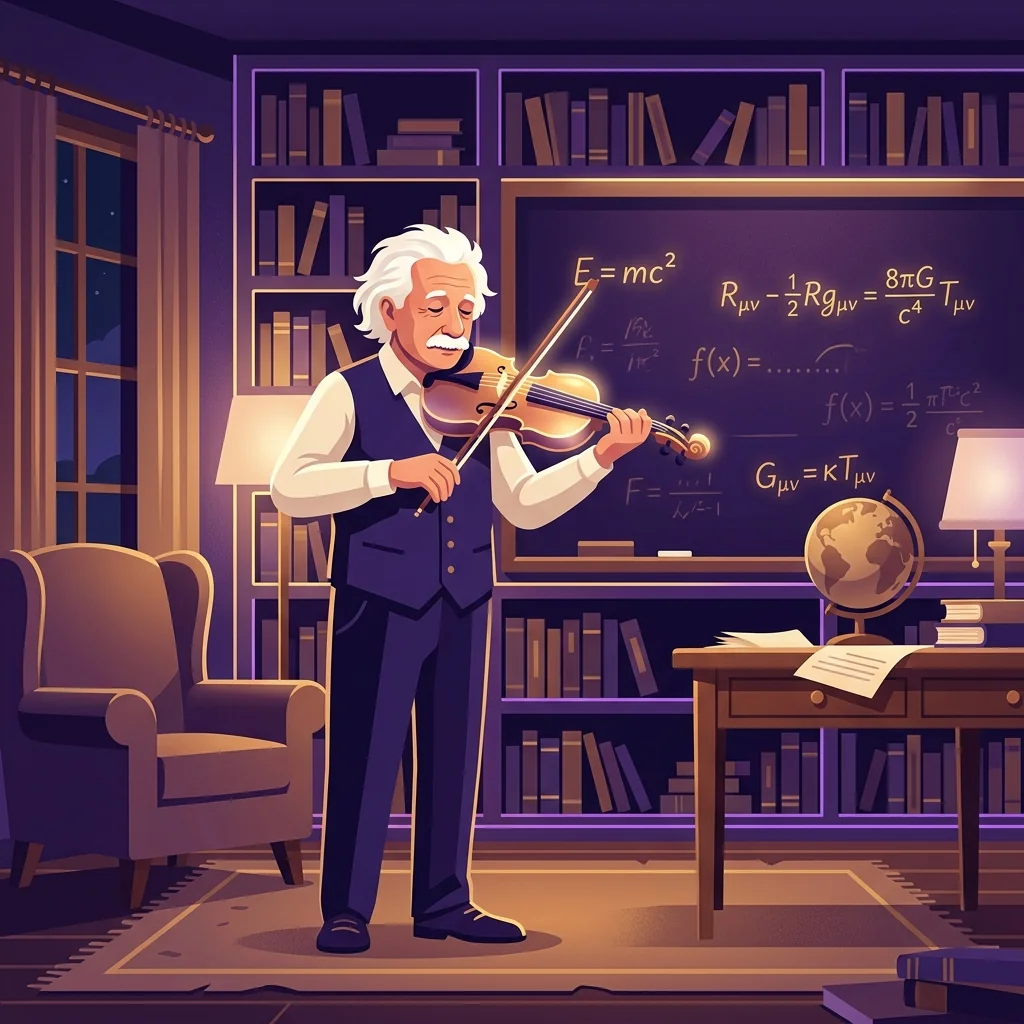
“Life without playing music is inconceivable for me. I live my daydreams in music.” 🎻
Albert Einstein (1879–1955) was the 1921 Nobel laureate in Physics who fundamentally revolutionized humanity’s understanding of time, space, and the universe through his theories of Special and General Relativity. When navigating grueling mathematical equations and thought experiments during intense research, where did he find the spark for his astonishing creative breakthroughs?
Whenever Einstein hit a mental wall or experienced a creative deadlock in his research, instead of forcing himself to stay at his desk, he picked up his violin bow. He played ‘Lina’, his beloved violin inherited from his pianist mother, Pauline. While playing pieces by Mozart or Bach, Einstein completely set aside complex physics formulas and immersed himself in musical melody and rhythm. Remarkably, during or immediately after playing, breakthrough solutions to unsolved physics problems would suddenly flash into his mind like a lightning bolt.
In today’s post, we analyze the cognitive neuroscience underlying Albert Einstein’s ‘violin reset’ routine and present a practical 3-step action plan to help modern professionals reset their brains and unlock creative solutions.
Historical & Academic Evidence
This content is based on Historical Verification from Albert Einstein's Essay Collection *Out of My Later Years*, Walter Isaacson's Biography *Einstein: His Life and Universe* & Cognitive Neuroscience Research.
 BuildSelf
Inspired by historical greats? Make it your daily habit!
BuildSelf
Inspired by historical greats? Make it your daily habit!

















1. Awakening Distinct Brain Regions via ‘Cognitive Shifting’ and the Default Mode Network
When we hyper-focus on a complex problem, the brain gets trapped in a cognitive loop, repeatedly activating the exact same neural pathways—a state cognitive psychology calls ‘Tunnel Vision’ or cognitive overload. Einstein’s violin playing served as a perfect tool for ‘Cognitive Shifting’, immediately disengaging overstimulated neural circuits and activating dormant brain areas. Playing a musical instrument engages visual, auditory, and motor sensory inputs simultaneously, heavily stimulating the corpus callosum that connects the left and right hemispheres. Stepping back physically and mentally to immerse in music shifts the brain into its Default Mode Network (DMN), allowing unconscious processing to recombine scattered information and induce an ‘Aha! Moment’.
2. 3-Step Practical Routine for Modern Professionals
Step 1: Forced Mental Pause & Screen Disconnection
The instant your ideas stall or stress builds up during work or study, take your hands off the keyboard immediately and step away to a space free of smartphone or monitor screens. Blocking incoming visual clutter is the top priority.
Step 2: 5-Minute Auditory & Rhythmic Focus Ritual
Play a simple hand instrument (kalimba, recorder, ukulele, or finger drum) freely for 5 minutes. If no instrument is available, play instrumental classical or jazz music, close your eyes, immerse your senses in the melody and rhythm, and tap gently with your fingers.
Step 3: Immediate Externalization of Post-Relaxation Insights
Right after the 5-minute reset, gently redirect your attention back to your original problem. As your brain releases tension, capture the subtle hints or keywords refined by your unconscious mind and write them down on a notepad.
3. Knowing How to Let Go Unlocks Fresh Insights
Einstein was not only a brilliant physicist, but also an accomplished violinist. To him, music was not an unrelated hobby, but the most powerful cognitive lubricant to prevent mental fatigue and ignite creative inspiration. When your ideas stall, rather than forcing yourself to obsess further, change your sensory stimulus entirely like Einstein to give your brain a true reset opportunity.
📌 Frequently Asked Questions (FAQ)
Did Albert Einstein reset his brain using other methods besides playing the violin? ▼
Yes. Einstein regularly went sailing on a yacht to feel the wind and meditate during research breaks. He also prioritized sleeping over 10 hours a day to let his subconscious organize and solve complex problems.
Can people who do not play any musical instrument practice this routine? ▼
Absolutely. Instead of playing an instrument, listening attentively to classical music while finger-tapping the rhythm or closing your eyes for 5 minutes of deep breathing delivers the exact same cognitive shifting benefits.