“I have two kinds of problems, the urgent and the important. The urgent are not important, and the important are never urgent.” 📊
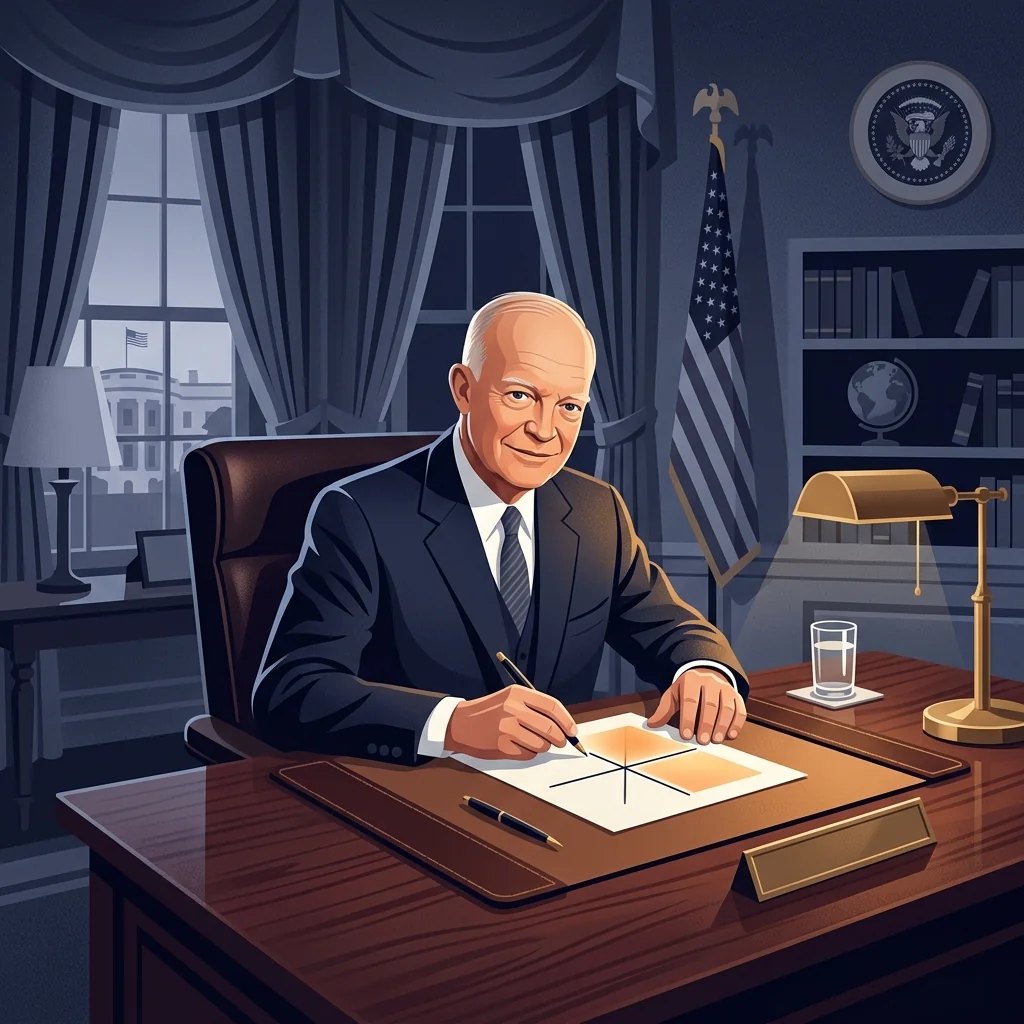
Dwight D. Eisenhower (1890–1969) was the Supreme Commander of the Allied Expeditionary Force in World War II who orchestrated the D-Day Normandy invasion, first Supreme Commander of NATO, and the 34th President of the United States. Tasked with managing continental-scale military operations, cold-war diplomacy, and monumental domestic projects like the Interstate Highway System, he bore one of the heaviest decision-making burdens in human history. To navigate this relentless torrent of administrative and strategic demands, Eisenhower practiced a deceptively simple ritual: every morning at his desk, he drew a large cross (+), dividing a sheet of paper into four distinct quadrants. He constantly asked himself: ‘Is this task truly important, or merely urgent?’ In today’s post, we unpack the psychological and cognitive principles behind the Eisenhower Matrix that liberate the brain from the trap of urgency to focus on what truly drives long-term success.
Historical & Academic Evidence
This content is based on Historical Verification from Dwight D. Eisenhower's Autobiography *At Ease: Stories I Tell to Friends* & Cognitive Neuroscience Research.
 BuildSelf
Inspired by historical greats? Make it your daily habit!
BuildSelf
Inspired by historical greats? Make it your daily habit!
















1. Preventing Decision Fatigue and Optimizing Prefrontal Cognitive Control
The human prefrontal cortex governs executive functions, planning, and decision-making, but its daily energy pool—known as cognitive bandwidth—is strictly limited. Repeated exposure to trivial yet urgent tasks plunges the brain into ‘decision fatigue’, severely draining executive functioning and compromising high-level judgment. The Eisenhower Matrix visually organizes priorities, dramatically reducing choice paralysis and cognitive load. By structuring tasks into clear categories, it preserves prefrontal energy, allowing the brain to maintain a state of relaxed focus and execute high-level strategic thinking without cognitive exhaustion.
2. 3-Step Practical Routine for Modern Professionals
Step 1: Creating a 4-Quadrant Canvas via a Cross Grid
Every morning before starting your routine, draw a large cross (+) on a sheet of paper or blank notebook to divide it into four sections. Clearly label 'Important / Not Important' across the top axis and 'Urgent / Not Urgent' down the left axis.
Step 2: Task Filtering and Matrix Placement
Dispassionately review your entire to-do list for the day. Stripping away emotional pressure or external expectations, categorize every task into one of the four quadrants based strictly on long-term value (importance) and immediate deadline (urgency).
Step 3: Systematic Execution of Quadrant Guidelines
Once categorized, execute rules mechanically: Execute Quadrant 1 tasks immediately; Schedule and block time on your calendar for Quadrant 2; Delegate or automate Quadrant 3 tasks (Urgent & Not Important); and completely Eliminate Quadrant 4 tasks from your daily plan.
3. Protocol for Pre-allocating Time to Quadrant 2 (Important but Not Urgent)
A common mistake when adopting priority classification is spending the entire day reactive in Quadrant 1 (Urgent & Important). Constantly firefighting in Quadrant 1 overstimulates the adrenal cortex, flooding the brain with cortisol and triggering chronic stress and burnout. The core secret is proactively reserving at least 20% of your daily cognitive bandwidth for Quadrant 2 (Not Urgent but Important)—such as strategic planning, learning, health, and relationship building. Prioritizing Quadrant 2 guarantees sustainable long-term growth and fundamentally prevents future crises from exploding in Quadrant 1.
📌 Frequently Asked Questions (FAQ)
How can I protect Quadrant 2 (Important but Not Urgent) when urgent work constantly pours in at my job? ▼
If everything feels urgent, it means external demands are overriding your internal priorities. Create a strict 'Do Not Disturb' block for the first 30 minutes of your workday without checking emails or messaging apps, devoting that window exclusively to Quadrant 2 strategy or learning. Securing this small focus window acts as a catalyst to prevent future firefighting.
What is the objective standard for distinguishing between 'Important' and 'Urgent' tasks? ▼
'Urgent tasks' are driven by external demands requiring immediate reaction (emails, messaging alerts, impending deadlines). Conversely, 'Important tasks' directly align with your long-term goals, core values, and capability building, regardless of external pressure. Ask yourself: 'Will ignoring this task significantly impact my life 1 year from now?' If yes, it is Important.