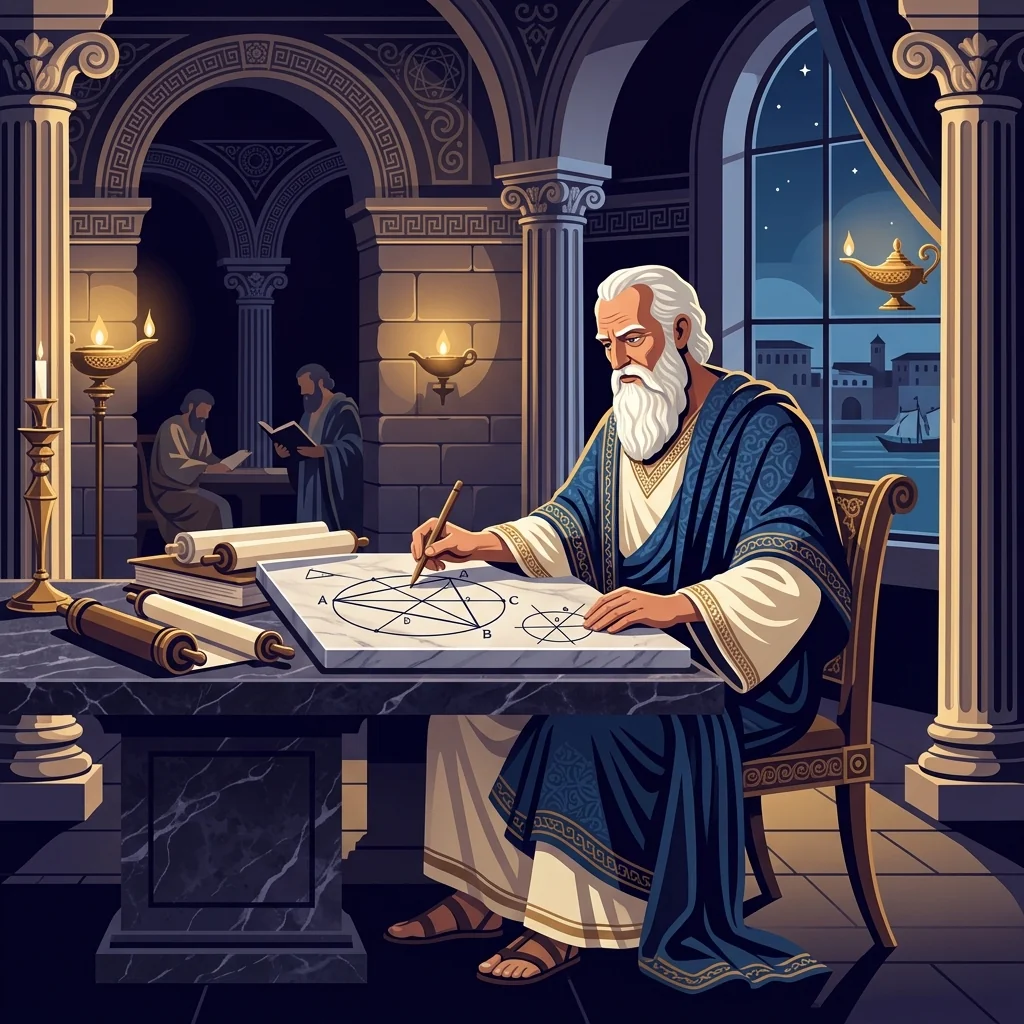
“There is no royal road to geometry.” 📐
Euclid of Alexandria (c. 325–265 BC), reverently known as the ‘Father of Geometry’, led the mathematical school at the Musaeum of Alexandria in the 3rd century BC. Carrying forward the spirit of Plato’s Academy, he compiled the 13 volumes of the Elements—a monumental masterwork that stands as the most widely read textbook in human history after the Bible.
When King Ptolemy I Soter asked if there was a shorter, easier shortcut to master geometry, Euclid immortalized the phrase: “There is no royal road to geometry.” Euclid’s genius lay in his unwavering habit of axiomatic deconstruction: no matter how complex the mathematical paradox, he refused to rely on unverified intuition or subjective assertions.
Instead, he wiped away uncertain assumptions, establishing just five undeniable, foundational axioms (such as ‘a straight line segment can be drawn joining any two points’) as his sole starting points. From these self-evident truths, he systematically built unbreakable chains of deductive logic, proving everything from the Pythagorean theorem to the five Platonic solids. In today’s post, we explore the cognitive neuroscience behind Euclid’s axiomatic reasoning and present a modern framework to dissolve decision paralysis.
Historical & Academic Evidence
This content is based on Historical Verification from Euclid's *Elements*, Proclus's *Commentary on Euclid's Elements* & Cognitive Neuroscience Research.
 BuildSelf
Inspired by historical greats? Make it your daily habit!
BuildSelf
Inspired by historical greats? Make it your daily habit!
















1. Why Axiomatic Recombination Prevents Cognitive Overload and Heuristic Biases
According to cognitive psychology, the human brain easily falls prey to judgment errors when polluted by convention or mental shortcuts (heuristics). Euclid’s axiomatic thinking extracts irreducible ‘First Principles’ and self-evident facts (axioms) to serve as the sole baseline for reasoning. This axiomatic recombination mechanism strips away uncertain assumptions beforehand, immediately reducing cognitive load on the Prefrontal Cortex (PFC). Furthermore, it optimizes the parietal lobe’s visuospatial sketchpad and logical computation circuits, helping structure complex dilemmas coherently from their core fundamentals.
2. 3-Step Practical Routine for Modern Professionals
Step 1: Total Deconstruction of Existing Assumptions and Stereotypes
Ruthlessly strip away unverified rumors, vague anxieties, and conventional beliefs surrounding your problem, resetting your baseline to zero.
Step 2: Establishing 3 Undeniable Baseline Axioms
Write down 3 objective, indisputable facts in your notebook. Allocate prefrontal cognitive bandwidth strictly to essential baseline facts—such as verified data and physical constraints.
Step 3: Step-by-Step Construction of Deductive Logical Chains
Starting from the 3 established axioms, deductively derive your next action plan and breakthrough step by step based on strict logical causality to construct an optimal conclusion.
3. Caution: Never Mistake Unverified Assumptions for True Axioms
You must never mistake unproven personal experiences or external assertions for foundational facts. Before formulating solutions, strictly isolate 100% indisputable, fundamental truths (axioms). Remember that if your starting premises are flawed, every subsequent deductive conclusion will collapse like a house of cards.
📌 Frequently Asked Questions (FAQ)
How can I apply axiomatic thinking to business or complex decision-making? ▼
First define 3 'irreducible baseline facts'—such as physical project constraints, actual budget, and core user needs. Then, redesign your strategy from scratch strictly on top of that foundational baseline.
What is the difference between conventional logical thinking and Euclid's First-Principles axiomatic reasoning? ▼
Conventional logic usually relies on precedents or past analogies as starting assumptions. In contrast, First-Principles axiomatic thinking resets all assumptions to zero, building logical chains deductively from self-evident, irreducible truths.