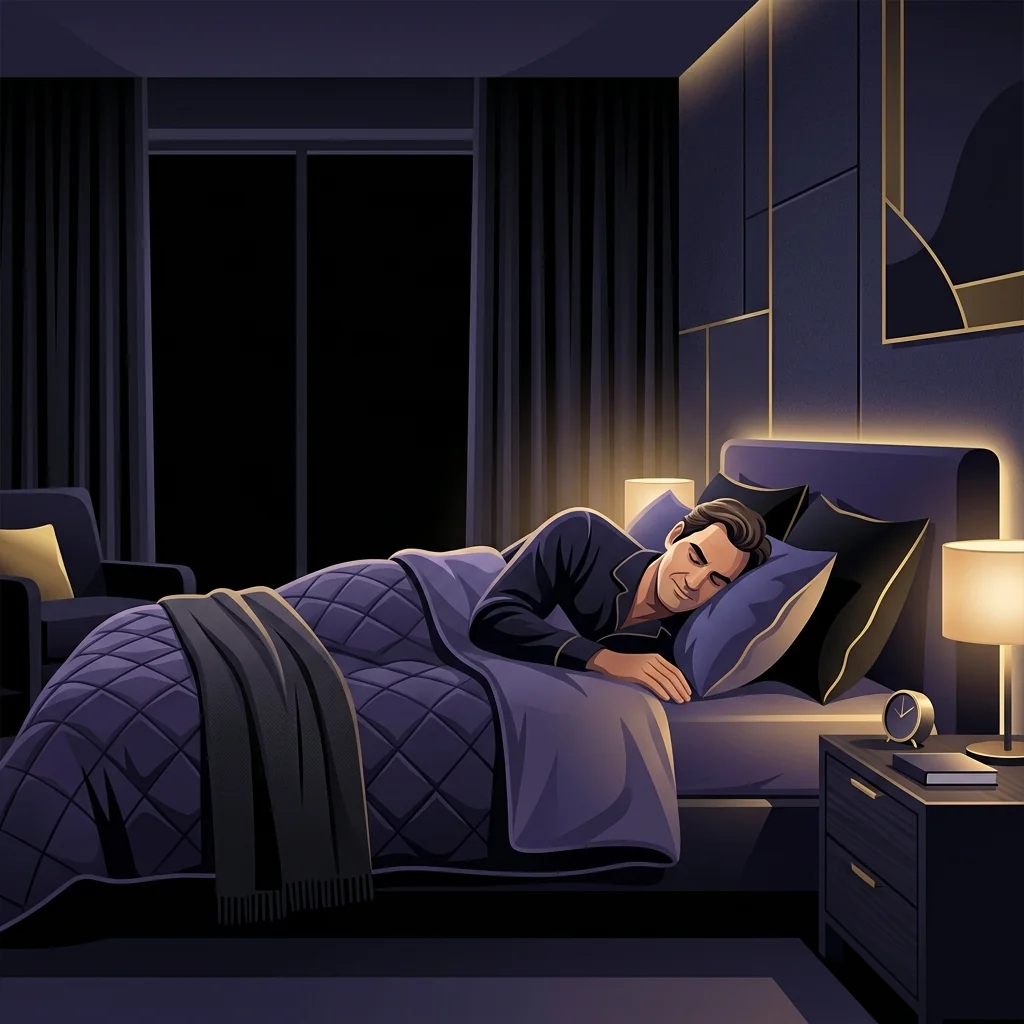
“If I don’t sleep 11 to 12 hours a day, I can’t play at the highest level.” 🎾
Roger Federer (1981–) redefined tennis history by capturing 20 Grand Slam singles titles, 103 ATP singles trophies, and holding the World No. 1 ranking for 310 weeks—including an unprecedented 237 consecutive weeks. Competing at the absolute zenith of elite sport well into his 40s, what was his ultimate physical and mental recovery secret amidst grueling international travel and high-stakes matches?
Federer treated sleep not as a luxury, but as a non-negotiable performance strategy—the primary engine of neuroplasticity and cellular repair. He strictly prioritized sleeping 10 to 12 hours every single day: 10 hours of deep nocturnal sleep paired with 1 to 2 hours of afternoon napping between training sessions and matches. Shattering the hustle myth of cutting sleep for extra practice, Federer relied on sleep recovery to preserve his razor-sharp visual reaction speeds, court agility, and cognitive endurance.
In today’s post, we examine the brain science behind Roger Federer’s ‘12-hour sleep recovery’ routine and present a 3-step actionable framework to optimize sleep architecture and restore cognitive sharpness.
Historical & Academic Evidence
This content is based on Historical Verification from Chris Bowers's Biography *Roger Federer: The Greatest*, ATP Official Archives & Cognitive Neuroscience Research.
 BuildSelf
Inspired by historical greats? Make it your daily habit!
BuildSelf
Inspired by historical greats? Make it your daily habit!

















1. Glymphatic Brain Cleansing and REM Sleep Neuroplasticity Recovery Mechanisms
During deep slow-wave sleep, the brain’s Glymphatic System activates, expanding interstitial space by up to 60% to flush out neurotoxic metabolic waste—such as beta-amyloid—accumulated during waking hours. Furthermore, REM sleep in late sleep cycles drives neuroplasticity, consolidating complex motor sequences and fine-tuning visual-cognitive processing speeds. Securing 10 to 12 hours of sleep downregulates stress hormones like cortisol while maximizing growth hormone release, fully restoring physical muscle tissue and executive brain focus to peak capacity.
2. 3-Step Practical Routine for Modern Professionals
Step 1: 1-Hour Pre-Bed Environment Setup (Blackout & Cooling)
Disconnect from all digital screens 1 hour before sleep. Cool your bedroom temperature to a crisp 18–20°C (64–68°F) and lower blackout curtains to completely block ambient light.
Step 2: Strict Pre-Scheduling of 8+ Hours Main Sleep Window
Treat sleep as an unshakeable primary appointment. Lock in an 8-hour bedtime and wake-up window on your calendar before scheduling work or social obligations.
Step 3: 20-Minute Power Nap Between 1 PM and 3 PM
When circadian alertness dips in the early afternoon, close your eyes for a light 20-minute power nap to purge working memory clutter and reset afternoon cognitive acuity.
3. Caution: Guard Against the Illusion of Sacrificing Sleep for Willpower
Working on restricted sleep impairs executive judgment to a degree equivalent to legally intoxicated driving. As Federer asserted, supreme performance does not come from pushing through sleep-deprived exhaustion, but from the razor-sharp clarity delivered by meticulous sleep recovery.
📌 Frequently Asked Questions (FAQ)
What should I do if I suffer from insomnia and struggle to fall asleep? ▼
Avoid forcing sleep in bed. If you remain awake after 20 minutes, apply Stimulus Control Therapy: get out of bed, move to a dimly lit room, read a physical book under warm lighting, and return to bed only when genuine drowsiness strikes.
Why do I feel groggy and heavy-headed after taking a nap? ▼
This grogginess stems from 'Sleep Inertia', which occurs when a nap exceeds 30 minutes and plunges your brain into deep Slow-Wave Sleep (N3). To prevent sleep inertia, cap your afternoon nap alarm strictly at 15 to 20 minutes.