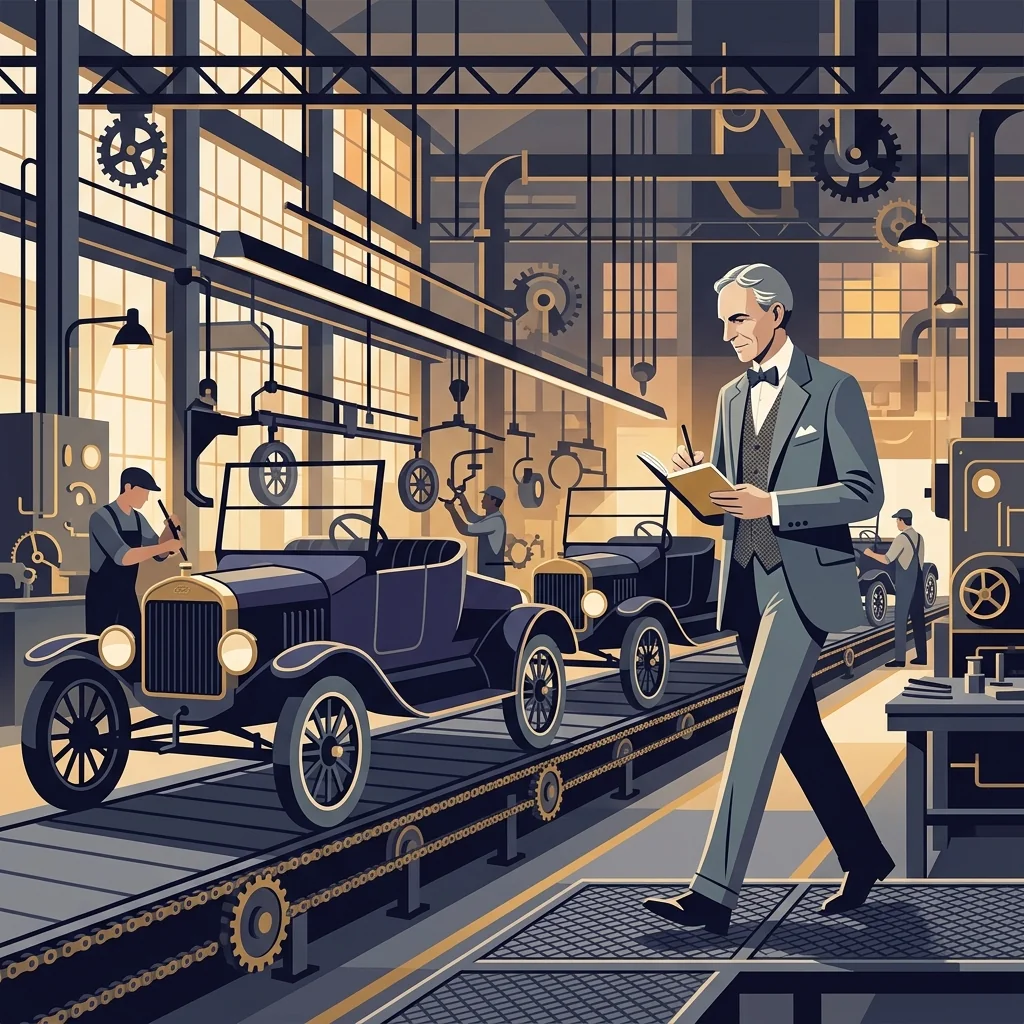
“To reduce waste, one must first trace the physical flow with visual clarity.” 🚗
Henry Ford (1863–1947) was the industrial titan who revolutionized global manufacturing by introducing the Model T in 1908 and constructing the world’s first moving assembly line at the Highland Park Plant in Detroit in 1913. By reducing automobile chassis assembly time from 12 hours and 8 minutes to a mere 93 minutes, Ford fundamentally transformed modern civilization. Where did he find the structural inspiration for such monumental engineering precision?
As documented in his autobiography My Life and Work, Ford maintained an unshakeable morning ritual: spending 30 minutes walking every corner of his vast assembly floor. He walked not to enforce discipline, but to observe the physical cadence of moving parts and mechanical harmony. Whenever he spotted a bottleneck or physical friction, Ford pulled a small notebook from his pocket, sketching the workflow using geometric nodes, arrows, and spatial diagrams. By offloading complex operational calculations onto paper, he preserved cognitive bandwidth and unlocked radical process optimizations.
In today’s post, we analyze the physiological principles behind Henry Ford’s ‘diagrammatic flow sketching’ routine and provide a practical guide for modern cognitive offloading.
Historical & Academic Evidence
This content is based on Historical Verification from Henry Ford's Autobiography *My Life and Work*, Historical Biographies & Cognitive Neuroscience Research.
 BuildSelf
Inspired by historical greats? Make it your daily habit!
BuildSelf
Inspired by historical greats? Make it your daily habit!

















1. Visual Smooth Pursuit and the Neuroscience of Cognitive Offloading
Visually tracking orderly, rhythmic mechanical motion (Smooth Pursuit), such as assembly line components, synchronizes the visual cortex with cerebellar motor-timing circuits, calming neural noise and focusing attention. Furthermore, translating complex multi-step processes from internal mental calculation into physical shapes and arrows—known as Spatial Sketching—triggers powerful Cognitive Offloading. Transferring working memory burdens onto paper protects prefrontal executive capacity, enabling clearer, highly creative strategic decision-making.
2. 3-Step Practical Routine for Modern Professionals
Step 1: Cerebral Awakening via Visual Smooth Pursuit Tracking
Before engaging in intense mental work, walk slowly around your office or room for 10 minutes, letting your eyes smoothly track physical objects, angles, or subtle movements. This warm-up synchronizes the visual cortex and cerebellar motor circuits.
Step 2: Simplifying Core Elements into Geometric Shapes on Paper
Instead of typing text or writing dense prose, draw simple geometric shapes—squares, circles, and triangles—on paper to represent core problem components. This step transforms abstract ideas into tangible spatial entities.
Step 3: Completing Cognitive Offloading via Arrows and Node Connections
Draw arrows and connecting lines between nodes to map causality and workflow direction. As mental calculation is physically offloaded onto paper, prefrontal working memory frees up, making room for precise strategic execution.
3. Caution: Harnessing Tactile Friction Feedback and Analog Focus
Relying on digital touchscreens or tablets when mapping concepts exposes the brain to push notifications, app switching, and blue light scatter. Crucially, frictionless glass surfaces diminish somatosensory feedback to the brain by over 50%. To maximize diagram comprehension, press pencil to paper in a physical notebook; tactile resistance provides real-time sensory feedback that cements conceptual clarity.
📌 Frequently Asked Questions (FAQ)
Is it okay to substitute paper with digital styluses on iPads or tablets? ▼
Digital screens lack physical friction, reducing somatosensory feedback to the brain and exposing you to digital distractions. Physical paper provides tactile pen-tip resistance that stimulates cortical circuits more deeply, achieving superior cognitive offloading. Using real paper is highly recommended.
Is sketching diagrams while sitting still as effective as walking? ▼
Sketching while seated still provides cognitive offloading benefits, but pairing it with physical movement and visual tracking dramatically enhances results. Walking increases cerebral blood flow and oxygenation, while tracking visual motion primes cerebellar circuits to maximize logical spatial reasoning.