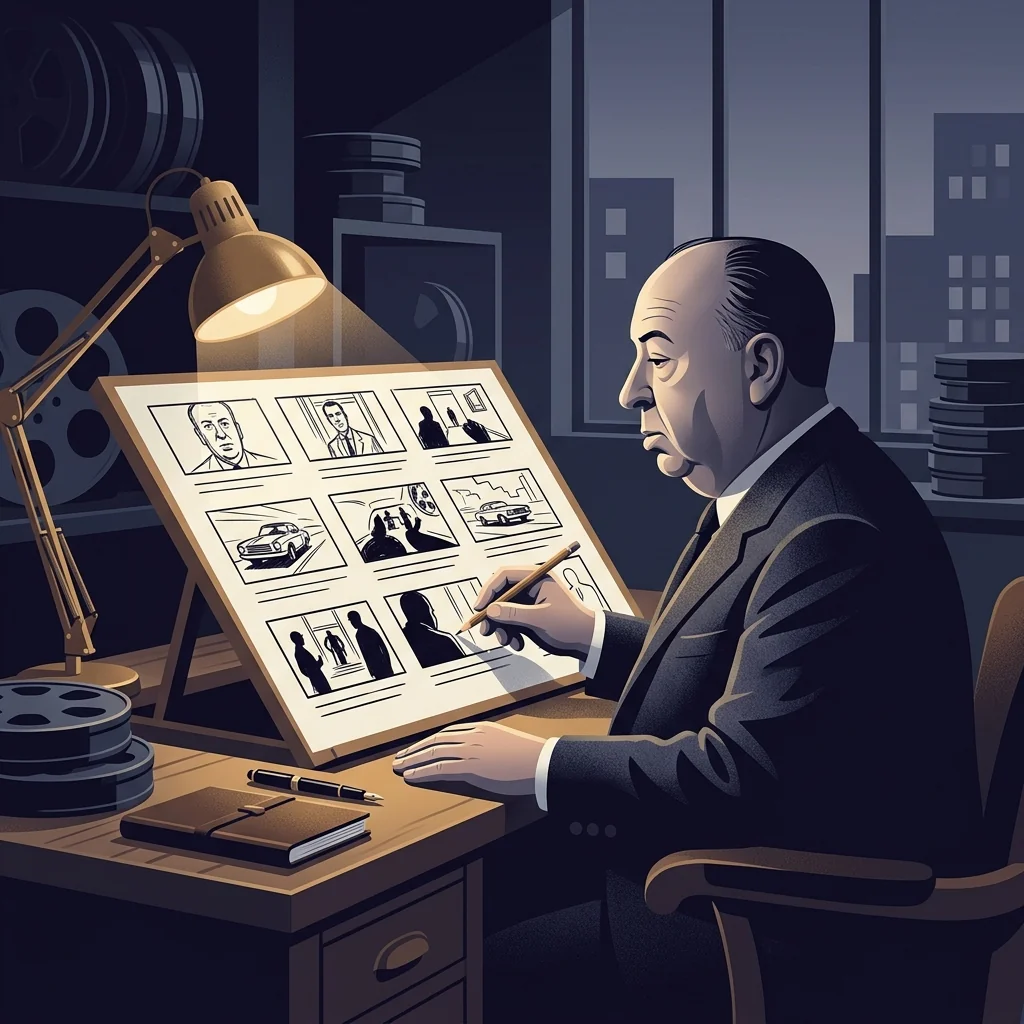
“A movie is not made on the set. It is completed 100% on paper and in the mind before shooting even begins. Going to the set is merely the mechanical execution of copying the blueprint.” 🎬
Alfred Hitchcock (1899–1980) was the legendary ‘Master of Suspense’ who redefined cinematic language through immortal masterpieces such as Psycho, Vertigo, Rear Window, and North by Northwest. On actual film sets, Hitchcock operated with absolute composure and total command, rarely ever displaying hesitation or last-minute improvisations. Where did his unmatched artistic control originate?
As documented in François Truffaut’s iconic 1967 interview book Hitchcock/Truffaut, Hitchcock spent months in his study long before cameras rolled. Collaborating with top artists like Saul Bass, he personally sketched and annotated every camera angle, lens focal length, lighting placement, and actor movement onto detailed storyboard panels. By the time pre-production was finished, Hitchcock considered the film 100% complete in his mind. On set, he rarely needed to look through the camera view-finder because every frame had already been played out in vivid detail inside his head. To Hitchcock, storyboarding was not a mere preliminary outline; it was a rigorous Mental Simulation protocol designed to eliminate operational friction and prefrontal overload on set.
In today’s post, we examine the cognitive neuroscience behind Alfred Hitchcock’s ‘visual storyboarding’ routine and present a practical 3-step action guide to eliminate decision fatigue and execute complex projects with precision.
Historical & Academic Evidence
This content is based on Historical Verification from Alfred Hitchcock Biographies, François Truffaut's *Hitchcock/Truffaut* Interviews & Cognitive Neuroscience Research.
 BuildSelf
Inspired by historical greats? Make it your daily habit!
BuildSelf
Inspired by historical greats? Make it your daily habit!

















1. Motor Execution Network Stimulation and Eliminating Decision Fatigue
Neuroscientific research demonstrates that when the brain mentally simulates or visually maps out a detailed sequence of actions prior to execution, neural circuits across the Motor Execution Network—including the premotor cortex and supplementary motor area—fire identically to actual physical performance. Known as Mental Simulation, Hitchcock’s method of sketching complete storyboards allowed his brain to visually experience operational variables and pre-determine solutions in advance. This pre-computation completely eliminates Decision Fatigue during real-time execution, protecting prefrontal bandwidth and driving swift, error-free results.
2. 3-Step Practical Routine for Modern Professionals
Step 1: Segmenting the Project into 3 to 5 Core Execution Stages
Deconstruct your target work or project into 3 to 5 core sequential flows (e.g., outline drafting, data validation, final report delivery), drawing virtual storyboard boxes for each.
Step 2: Sketching Visual Action Frames & Annotating Obstacle Contingencies
Roughly sketch or summarize the visual action required inside each box. Annotate potential risk factors (e.g., code bugs, fatigue) alongside explicit contingency workarounds.
Step 3: 1-Minute Mental Rehearsal & Immediate Physical Execution
Gaze at your completed storyboard, close your eyes, and spend 1 minute vividly visualizing yourself executing step 1 through completion flawlessly. Then open your eyes and jump directly into real-time physical action.
3. Caution: Transitioning Immediately to Action Without Getting Trapped in Planning Indulgence
Avoid falling into ‘Plan Indulgence’—where storyboarding deteriorates into passive paper doodling that delays actual execution. A storyboard is strictly a cognitive support tool. Limit your visual outline to 3 to 5 rough execution stages to minimize prep time. Immediately following mental simulation, transition directly into the first physical execution step without hesitation.
📌 Frequently Asked Questions (FAQ)
Is it effective to use digital tools if I find it inconvenient to hand-draw storyboards every time? ▼
Yes, absolutely! The core mechanism of storyboarding is not artistic skill, but action structuring and mental simulation. Using tools like Figma, Miro, or simple mind-mapping apps to quickly arrange block shapes and text cards yields identical cognitive psychology benefits.
What should I do if unexpected variables arise during execution that deviate from the storyboard? ▼
A storyboard is a flexible map, not a rigid script. When unexpected obstacles emerge, pause briefly, review the contingency alternative noted on that stage's frame, run a 10-second mental simulation of the new path, and adjust your actions adaptively.