“The universe reveals its expanded horizons only in quiet stillness and precise gaze.” 🌌
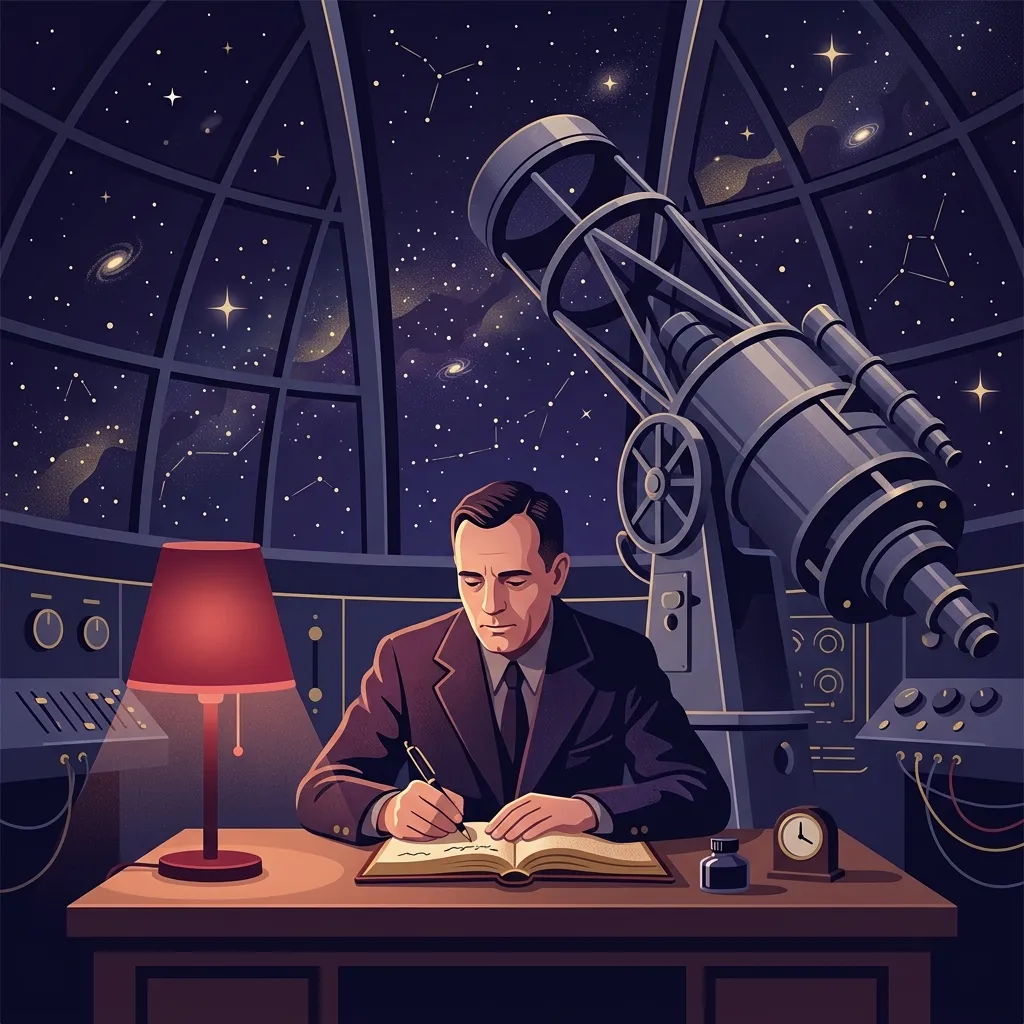
Edwin Hubble, founder of modern extragalactic astronomy who revolutionized humanity’s view of the cosmos by discovering galactic recession speeds and the expansion of the universe, shaped modern science. Observing faint, distant nebulae through the 100-inch Hooker telescope at Mount Wilson Observatory, his meticulous observational data and landmark discoveries were grounded in a quiet 20-minute darkroom routine performed before every night of observation.
Before placing his eyes near the giant telescope lens, Hubble sat alone in a pitch-black room for 20 minutes to adapt his vision fully to the dark. During this time, he blocked out external light, maintained mental tranquility, and maximized visual sensitivity. As the observation progressed, he meticulously transcribed the shapes of faint nebulae and measurements alongside mathematical equations into his logbook by hand.
This routine was a sophisticated neuroscientific observation strategy that boosted biological ocular sensitivity while encoding faint visual stimuli into precise linguistic and mathematical data in the brain. In today’s post, we introduce the cognitive neuroscience principles of Dark Adaptation and Sensory Integration embedded in Hubble’s darkroom adaptation and manual logbook routine.
Historical & Academic Evidence
This content is based on Gale E. Christianson's Biography *Edwin Hubble: Mariner of the Nebulae* (University of Chicago Press), Mount Wilson Observatory Logbooks & Visual Neuroscience Research.
 BuildSelf
Inspired by historical greats? Make it your daily habit!
BuildSelf
Inspired by historical greats? Make it your daily habit!

















1. Biological Dark Adaptation and Data Encoding Through Manual Logbook Recording
Sitting in darkness for 20 minutes before observation completes biological ‘Dark Adaptation’, promoting the resynthesis of ‘Rhodopsin’ in retinal rod cells and boosting visual sensitivity up to 10,000 times.
Furthermore, meticulously handwriting faint visual information alongside mathematical equations in a physical logbook triggers ‘Sensory Registration’ and ‘Working Memory Encoding’. This scientific mechanism anchors faint visual signals into clear mathematical and linguistic symbols, maximizing prefrontal attentional focus and data analysis accuracy.
2. 3-Step Practical Routine for Modern Professionals
Step 1: 20-Minute Darkroom Adaptation Before Observation (Biological Dark Adaptation)
Block out lights for 20 minutes before detailed analysis or observation, resting your eyes and mind in stillness to heighten visual cortex sensitivity.
Step 2: Observing Faint Signals and Sensory Integration
Focus deeply on the subtle nuances and changes of tasks or data in a precise state shielded from external noise.
Step 3: Writing Manual Logbooks with Equations (Cognitive Data Encoding)
Meticulously record observational findings with equations and core text using a pen rather than digital inputs, firmly encoding data into working memory.
3. Modern Cognitive Warm-Up Guide to Avoid Missing Faint Signals
Do not rush recklessly into screens or data analysis when tackling critical tasks. The key is securing a 20-minute warm-up period to rest sensory fatigue and refining observations by hand to elevate cognitive precision.
📌 Frequently Asked Questions (FAQ)
Is the 20-minute darkroom adaptation effective for general office work or study outside astronomy? ▼
Yes, highly effective. Resting your eyes and brain in darkness and stillness for 15 to 20 minutes relieves visual cortical fatigue caused by screen glow and digital overstimulation, significantly sharpening post-rest concentration.
Why record observational logs by hand rather than using computers or digital input devices? ▼
Holding a pen and drawing equations or text by hand simultaneously stimulates the somatosensory cortex and linguistic circuits, engraving observational data into the brain far more precisely than digital typing.