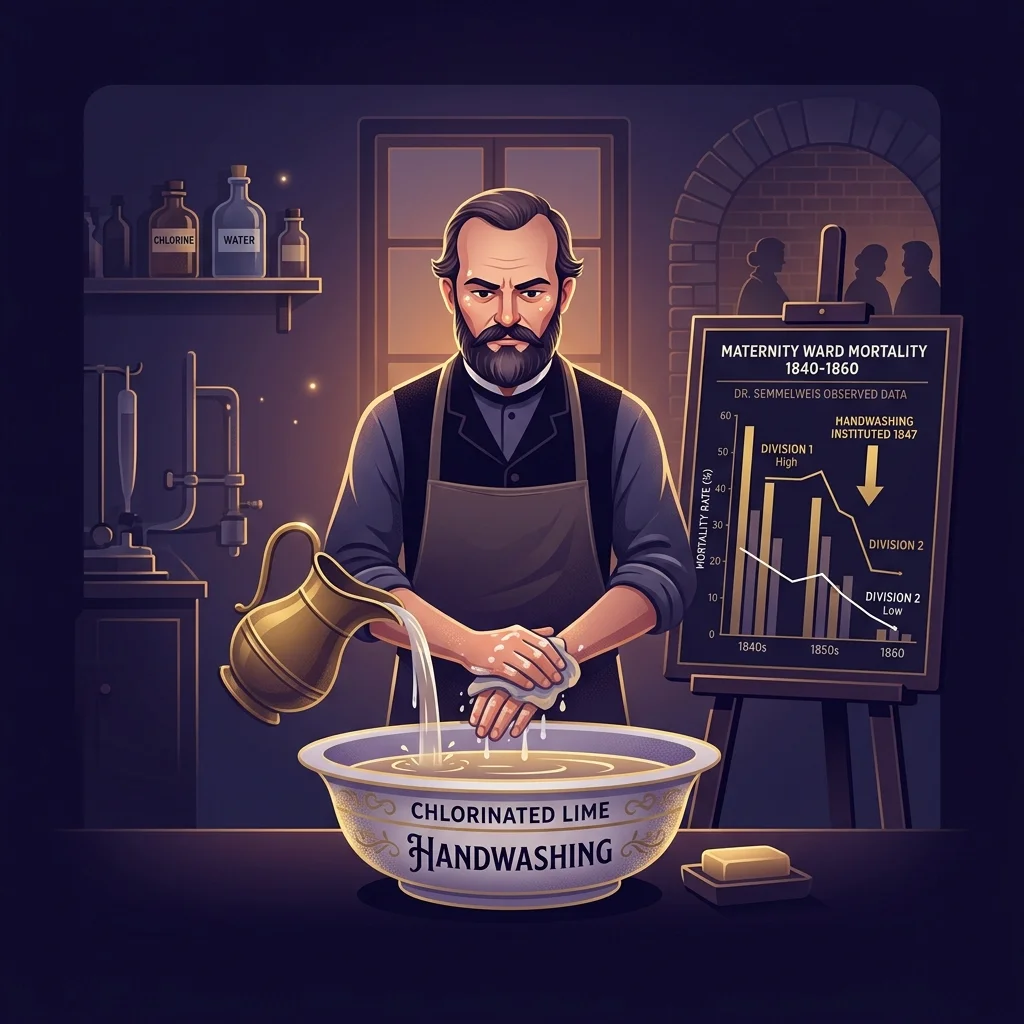
In the mid-19th century, ‘puerperal fever’ (childbed fever) was a terrifying mystery killing mothers shortly after childbirth across European hospitals. Dr. Ignaz Semmelweis (1818–1865), a Hungarian physician at the Vienna General Hospital, transformed medicine through empirical observation, statistical tracking, and strict hygienic protocols, becoming a legendary pioneer of infection control and bacteriology. 🧼📊
Semmelweis noticed a stark discrepancy: First Obstetrics Clinic (trained by medical students and doctors) had a maternal mortality rate of 10–18%, whereas Second Obstetrics Clinic (trained by midwives) maintained a far lower rate of 2–3%. Investigating the root cause, he recognized that doctors and students frequently performed clinical examinations immediately after conducting post-mortem dissections in the autopsy room without washing their hands. Semmelweis hypothesized that invisible ‘cadaveric particles’ were transferred to laboring mothers, causing fatal infection. In May 1847, he installed basins of chlorinated lime solution between the autopsy room and the delivery ward, mandating thorough hand disinfection prior to examinations. Concurrently, he plotted daily mortality statistics on comparative tables. Within months, maternal mortality plummeted from 18% to under 1%—one of the most dramatic breakthroughs in medical history.
In today’s post, we examine how Semmelweis’s hand disinfection and daily statistical tracking routines overcome cognitive inattentional blindness and leverage procedural memory to eliminate system errors.
Historical & Academic Evidence
This content is based on Historical Verification from Ignaz Semmelweis (1861), *The Etiology, Concept, and Prophylaxis of Childbed Fever* & Oxford Academic *Journal of the History of Medicine and Allied Sciences* and Cognitive Neuroscience Research.
 BuildSelf
Inspired by historical greats? Make it your daily habit!
BuildSelf
Inspired by historical greats? Make it your daily habit!

















1. Procedural Memory Automation and Quantitative Feedback Loop Mechanisms
Instituting physical hand disinfection as an indispensable prerequisite establishes a Procedural Memory anchor within the Basal Ganglia. This creates a distinct ‘Cognitive Boundary’ in the brain when transitioning between operational environments, eliminating cognitive residue from prior tasks. Furthermore, logging daily quantitative mortality metrics triggers real-time error-monitoring networks within the Anterior Cingulate Cortex (ACC) and Dorsolateral Prefrontal Cortex (dlPFC), piercing cognitive blindness and replacing intuitive assumptions with empirical precision.
2. 3-Step Practical Routine for Modern Professionals
Step 1: Fixing a Physical Reset Routine Before Critical Task Transitions
Directly before transitioning to a critical task (e.g., patient exam, coding, financial execution), perform a 1-minute physical cleaning or desk reset routine to establish a firm cognitive boundary.
Step 2: Recording Daily Quantitative Key Metrics and Error Tracking Tables
Log core quantitative performance and error metrics (e.g., defect count, task completion rate) in a daily comparison table each evening to track objective trends.
Step 3: Auditing Feedback Loops for Continuous Systemic Optimization
Review statistical trends weekly to identify spike points in errors or quality drops, taking immediate structural corrective measures.
3. Caution: Preventing Complacency and Cursory Ritualization Upon Metric Improvement
When safety or error metrics improve significantly, the brain naturally experiences relief, increasing susceptibility to moral hazard and procedural shortcuts. Even after metrics stabilize, maintain the habit not as a passive ritual, but as a rigid structural boundary anchored within the physical work environment.
📌 Frequently Asked Questions (FAQ)
Can physical reset routines like hand disinfection benefit knowledge work or business? ▼
Yes, tremendously. The power lies in the physical symbolism. Spending 1 minute wiping your desk or washing hands before switching to a high-priority task serves as a strong sensory anchor that signals the brain to reset and enter hyper-focus.
How can I maintain daily statistical tracking without experiencing data logging fatigue? ▼
Simplify your logging to 1 or 2 critical metrics. Semmelweis succeeded because he focused strictly on a single, clear metric—daily maternal deaths per ward—rather than tracking dozens of noisy variables.