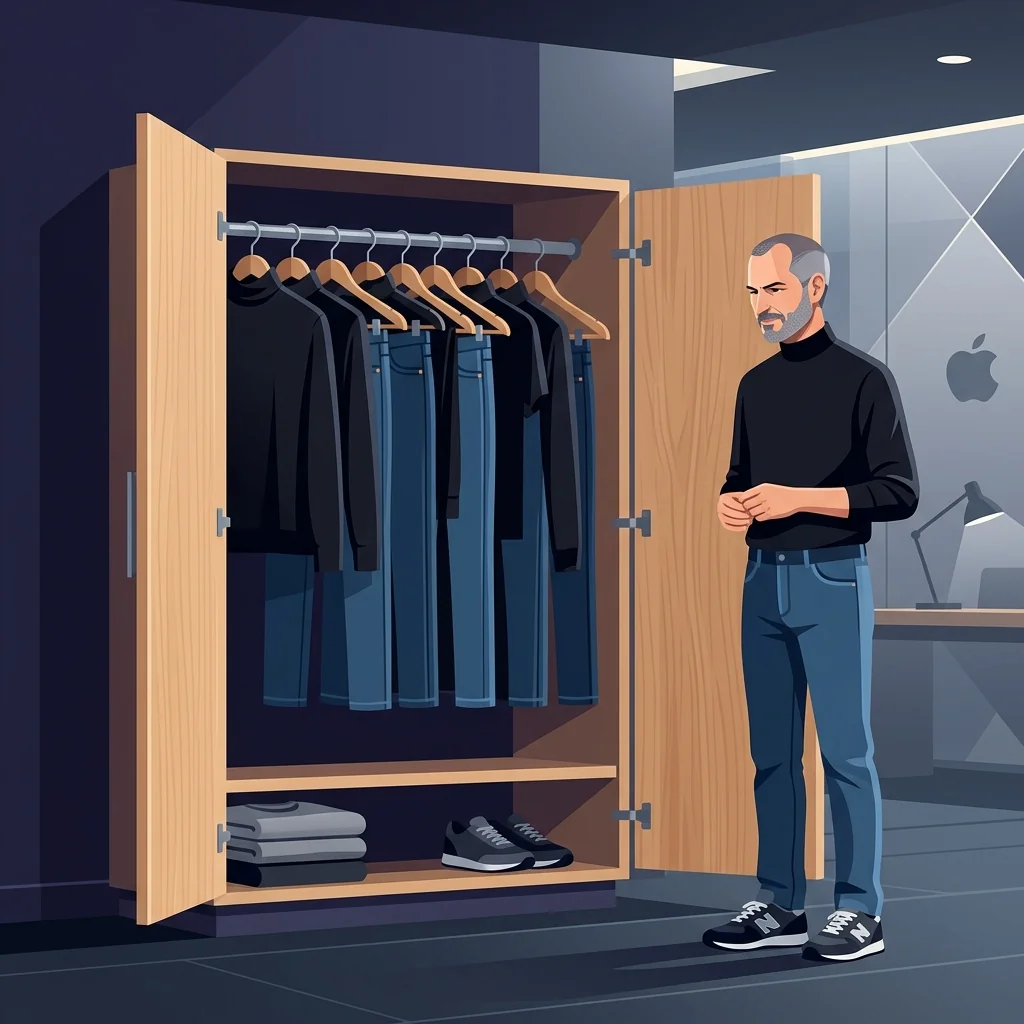
“Deciding what to wear every morning drains a fraction of your brain’s precious willpower. I conserve 100% of my mental capacity exclusively for decisions that actually matter.” 👕
Steve Jobs (1955–2011) was the visionary co-founder of Apple Inc. who reshaped global technology, culture, and personal computing through iconic breakthroughs like the Macintosh, iPod, iPhone, and iPad. Beyond his legendary keynote presentations, Jobs became instantly recognizable worldwide for his unwavering personal daily uniform: a custom black mock turtleneck, Levi’s 501 blue jeans, and gray New Balance 991/992 sneakers.
While many assumed his rigid wardrobe was merely a personal style preference or brand marketing gimmick, Walter Isaacson’s official biography Steve Jobs reveals a far deeper neuroscientific rationale. Inspired by the functional uniforms worn by Sony employees in Japan during the 1980s, Jobs commissioned legendary fashion designer Issey Miyake to craft approximately 100 identical black turtlenecks. Jobs recognized that trivial daily choices—such as selecting clothes or matching outfits—consume finite willpower and trigger Decision Fatigue before the workday even starts. By eliminating morning garment selection entirely, Jobs preserved his prefrontal cortex’s cognitive bandwidth for high-stakes executive judgments, product design, and corporate vision.
In today’s post, we unpack the cognitive psychology and neuroscience behind Steve Jobs’s ‘clothing minimalism’ routine and present a practical 3-step guide to eliminate decision fatigue and maximize daily productivity.
Historical & Academic Evidence
This content is based on Historical Verification from Walter Isaacson's *Steve Jobs* (2011), Apple Archives & Cognitive Psychology and Cognitive Neuroscience Research.
 BuildSelf
Inspired by historical greats? Make it your daily habit!
BuildSelf
Inspired by historical greats? Make it your daily habit!

















1. Elimination of Decision Fatigue and Preservation of Prefrontal Cognitive Resources
Human prefrontal cortex performance relies on a finite daily pool of executive energy. Expending cognitive resources early in the morning selecting and matching clothes induces Decision Fatigue and ego depletion. Steve Jobs’s habit of wearing a fixed uniform of a black turtleneck and jeans physically eliminated trivial morning micro-decisions. By freeing up central executive capacity, he preserved maximum Prefrontal Cortex bandwidth for high-stakes product design, innovation, and strategic corporate leadership.
2. 3-Step Practical Routine for Modern Professionals
Step 1: Establishing a Personal Standard 'Work Uniform' (Capsule Wardrobe)
Designate a comfortable yet professional outfit combination (e.g., a set of 3–4 identical shirts and slacks) as your go-to formula, standardizing garments so you can dress without hesitation.
Step 2: Pre-Setting Garments and Daily Belongings the Night Before
Arrange your clothes and work essentials before going to bed. This physically eliminates the morning decision phase where the brain deliberates over 'what to wear'.
Step 3: Waking Up in a Zero Micro-Decision State to Channel Prefrontal Focus
Change into your prepared clothes without friction immediately upon waking. Direct your fully preserved prefrontal cognitive energy straight into tackling your highest-priority goal for the day.
3. Caution: Converting Daily Choices into Constants to Conserve Prefrontal Energy
The core mechanism of clothing minimalism is not aesthetic monotony, but the systemic elimination of low-stakes micro-decisions. Transforming repetitive daily choices—such as breakfast menus, outfit formulas, or commute routes—into fixed constants conserves prefrontal energy, which is the ultimate key to maximizing performance.
📌 Frequently Asked Questions (FAQ)
Why did Steve Jobs insist on wearing the exact same outfit every day? ▼
Jobs eliminated morning garment selection to prevent Decision Fatigue and conserve prefrontal cortex energy, dedicating 100% of his cognitive capacity to Apple's management and product innovations.
What is a practical alternative if wearing an identical outfit like Jobs feels unrealistic? ▼
You do not need to wear identical clothes. Building a 'Capsule Wardrobe'—fixing your color palette to neutrals (black, navy, gray) or limiting choices to 3 tops and 2 bottoms—delivers identical benefits by drastically reducing decision fatigue.