“Let us learn to dream, gentlemen, then perhaps we shall find the truth.” 🧪
In 1865, August Kekulé revolutionized organic chemistry by proposing the cyclic structure of benzene, inspired by a vision of Ouroboros—a snake biting its own tail. Struggling for a long time with an unsolved chemical riddle, what was his secret to unlocking one of chemistry’s greatest mysteries? 🐍
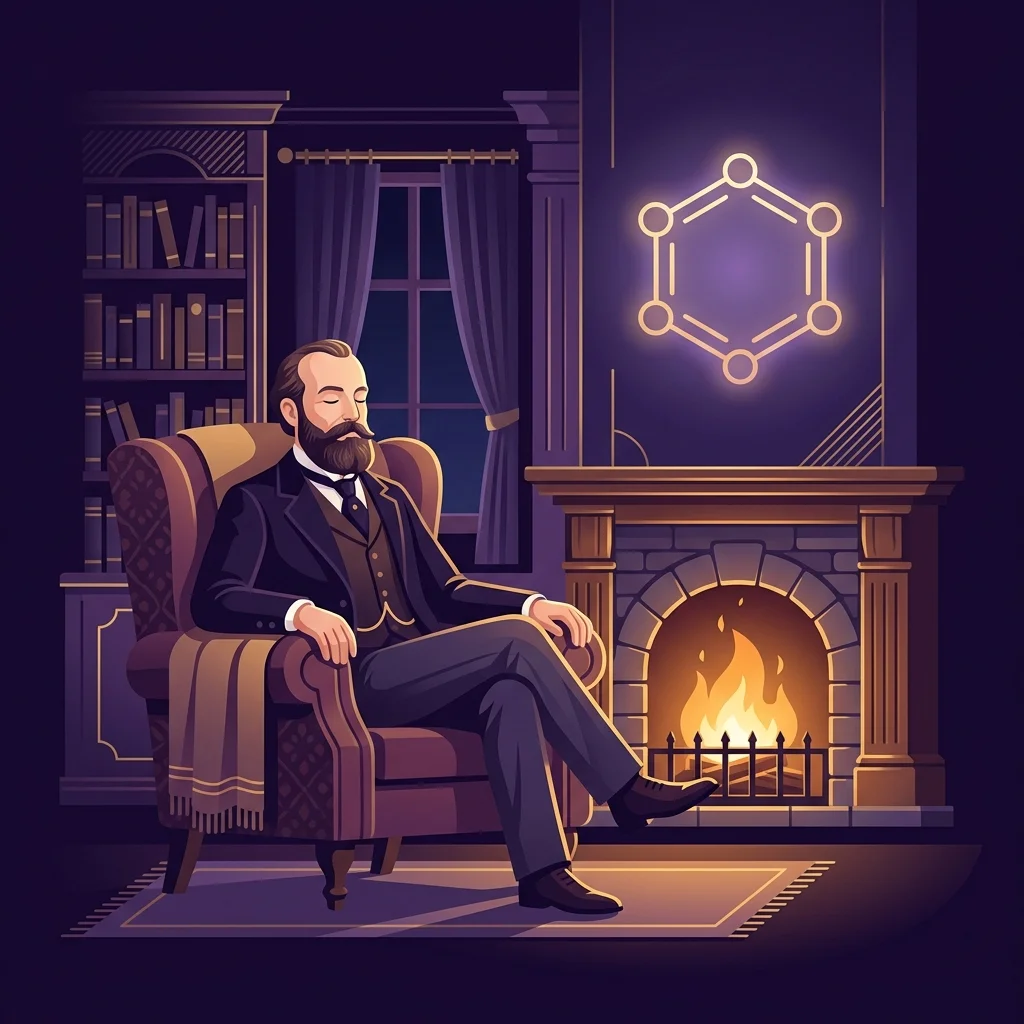
When hitting cognitive roadblocks after intense focus, Kekulé sat back on the upper deck of a London omnibus or by a quiet fireplace and closed his eyes. In that state of relaxation, visual reveries unfolded in his mind: geometric molecular particles dancing and chaining together. Upon awakening, he immediately opened his pocketbook, sketching those imaginary shapes into geometric diagrams and converting them into precise chemical structures. This ‘hypnagogic sketching routine’ bridged unconscious insights to reality.
In today’s post, we explore the cognitive neuroscientific principles of hypnagogia and unconscious visual recombination within Default Mode Networks (DMN) behind chemist August Kekulé’s post-immersion relaxation and sketching routine.
Historical & Academic Evidence
This content is based on Historical Records from German Chemical Society (GDCh) Archives & Kekulé's 1890 Benzol-Fest Address with Cognitive Neuroscience Research.
 BuildSelf
Inspired by historical greats? Make it your daily habit!
BuildSelf
Inspired by historical greats? Make it your daily habit!
















1. Neuroscience of Hypnagogia and Unconscious Visual Recombination
Entering a hypnagogic state of relaxation after intense immersion shifts brainwaves into alpha and theta bands, loosening the prefrontal cortex’s rigid control.
During this phase, the Default Mode Network (DMN) and Visual Cortex interact closely, embodying high-level abstract concepts into geometric visual imagery previously suppressed by conscious executive control. Sketching these visions immediately upon waking translates metaphorical unconscious insights into conscious logical structures.
2. 3-Step Practical Routine for Modern Professionals
Step 1: Creating Deliberate Relaxation After Intense Immersion
When blocked by a difficult problem, close your eyes on a bus, by a fireplace, or in a comfortable chair to release prefrontal tension.
Step 2: Exploring Visual Imagery in Hypnagogic States
Observe free-flowing particles, geometric shapes, and metaphorical images without suppressing unconscious associations.
Step 3: Immediate Visual Sketching & Logical Translation Upon Awakening
The moment you awaken from relaxation, draw the envisioned shapes onto paper as symbols or lines, converting them into concrete logic.
3. Guide to Capturing Visual Insight in Daily Life and Work
Do not force focus to the point of burnout when answers remain elusive. The key is creating deliberate relaxation periods after intense concentration and immediately anchoring passing intuitions through notes or sketches.
📌 Frequently Asked Questions (FAQ)
It's hard to remember dreams or fleeting imagery; how can I sketch them immediately? ▼
The 30 seconds right after awakening from relaxation is the golden window. Keep a notepad and pen within reach; capture the idea first with intuitive lines, symbols, or shapes rather than full text, then reconstruct the details logically.
Can this method be applied outside of chemistry or art, such as in general business or studies? ▼
Absolutely. Complex project plans, organizational structures, code schemas, or writing outlines can be conceptualized visually as diagrams or flowcharts in your mind, allowing spontaneous structural insights to surface during relaxation.