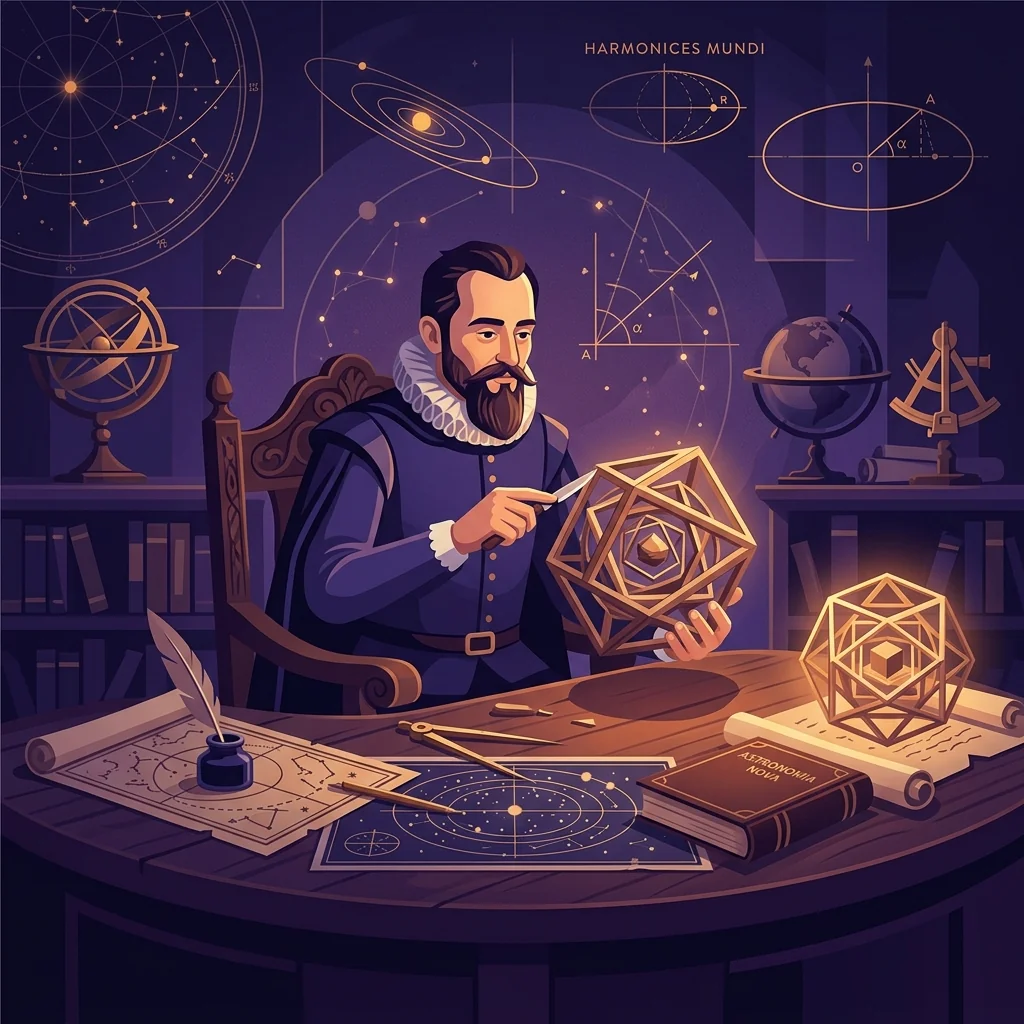
“Geometry existed before the Creation; it is co-eternal with the mind of God… A physical 3D model carved by hand reveals spatial truths that numerical equations alone obscure.” 🚶♂️
Johannes Kepler (1571–1630) was the legendary German astronomer and mathematician whose landmark formulation of Kepler’s Three Laws of Planetary Motion proved heliocentrism and laid the physical foundation for Isaac Newton’s universal gravitation. Operating in the early 17th century without computational technology, Kepler spent months wading through grueling numerical calculations to resolve tiny orbital discrepancies in Tycho Brahe’s planetary data.
Whenever his progress stalled amidst dense two-dimensional equations, Kepler paused writing. As detailed in his 1596 masterwork Mysterium Cosmographicum, he grabbed pocketknives, scissors, paper, clay, and wood to physically carve and assemble nested three-dimensional geometric models of the universe. By crafting physical representations of the five Platonic polyhedra (tetrahedron, cube, octahedron, dodecahedron, icosahedron) enclosed within concentric spherical shells, Kepler engaged tactile spatial visualization. Translating abstract data into haptic, 3D physical manipulation stimulated his parietal cortex, bypassing prefrontal cognitive overload and sharpening spatial reasoning.
In today’s post, we unpack the cognitive neuroscience behind Johannes Kepler’s ‘haptic spatial visualization’ routine and present a modern 3-step framework to convert abstract conceptual blockades into intuitive physical solutions.
Historical & Academic Evidence
This content is based on Historical Verification from Johannes Kepler's *Mysterium Cosmographicum* (1596), Kepler Archives & Cognitive Neuroscience and Spatial Cognition Research.
 BuildSelf
Inspired by historical greats? Make it your daily habit!
BuildSelf
Inspired by historical greats? Make it your daily habit!

















1. Parietal Lobe Spatial Stimulation and Mitigating Prefrontal Cognitive Overload
Attempting to process complex spatial laws or systemic architectures purely through abstract mental formulas overtaxes executive working memory, inducing rapid Cognitive Overload in the prefrontal cortex. Physically manipulating 3D objects directly stimulates the Parietal Lobe and association cortices responsible for spatial cognition. Concurrently processing Haptic Input from nerve endings alongside visual feedback converts dense abstract data into intuitive spatial structures, significantly boosting Spatial Reasoning capacity and problem-solving velocity.
2. 3-Step Practical Routine for Modern Professionals
Step 1: Deploying 3D Physical Tools (Blocks & Cards) Upon Facing Complex Abstractions
Step away from digital screens and clear your desk surface. Arrange tactile physical tools—such as sticky notes, index cards, or toy building blocks—that can be freely manipulated by hand.
Step 2: Hands-On Haptic Manipulation, Spatial Sorting, and Physical Interconnection
Assign core concepts to each physical tool. Manually reorder, stack, move, and connect them on your desk, visually and haptically analyzing structural relationships between components.
Step 3: Re-Transplanting Haptic Spatial Insights into Digital Blueprints or Formulas
Once blind spots and structural errors are resolved through physical modeling, map the established spatial architecture directly back into your digital document, system code, or equation.
3. Caution: Pivoting from Abstract Mental Blockades to Physical Multi-Sensory Object Manipulation
When encountering a mental blockade while mapping complex software architecture, business pipelines, or system designs, avoid forcing abstract prefrontal reasoning. Turn off the monitor and manipulate sticky notes, physical blocks, or index cards directly on your desk; changing spatial dimensions unlocks intuitive problem-solving.
📌 Frequently Asked Questions (FAQ)
What specific geometric structure did Johannes Kepler carve for his model? ▼
Kepler carved models of the five Platonic solids (tetrahedron, cube, octahedron, dodecahedron, icosahedron) nested sequentially inside concentric spheres representing planetary orbits. This physical model allowed him to visually and haptically verify spatial proportions between planetary distances.
How can I easily practice this routine if I don't have physical 3D blocks or models? ▼
Simply spreading sticky notes or index cards across your desk and physically repositioning them by hand, or folding and tearing paper to structure relationships, fires up the parietal lobe's spatial networks. This delivers identical haptic benefits to dissolve abstract cognitive blockades.