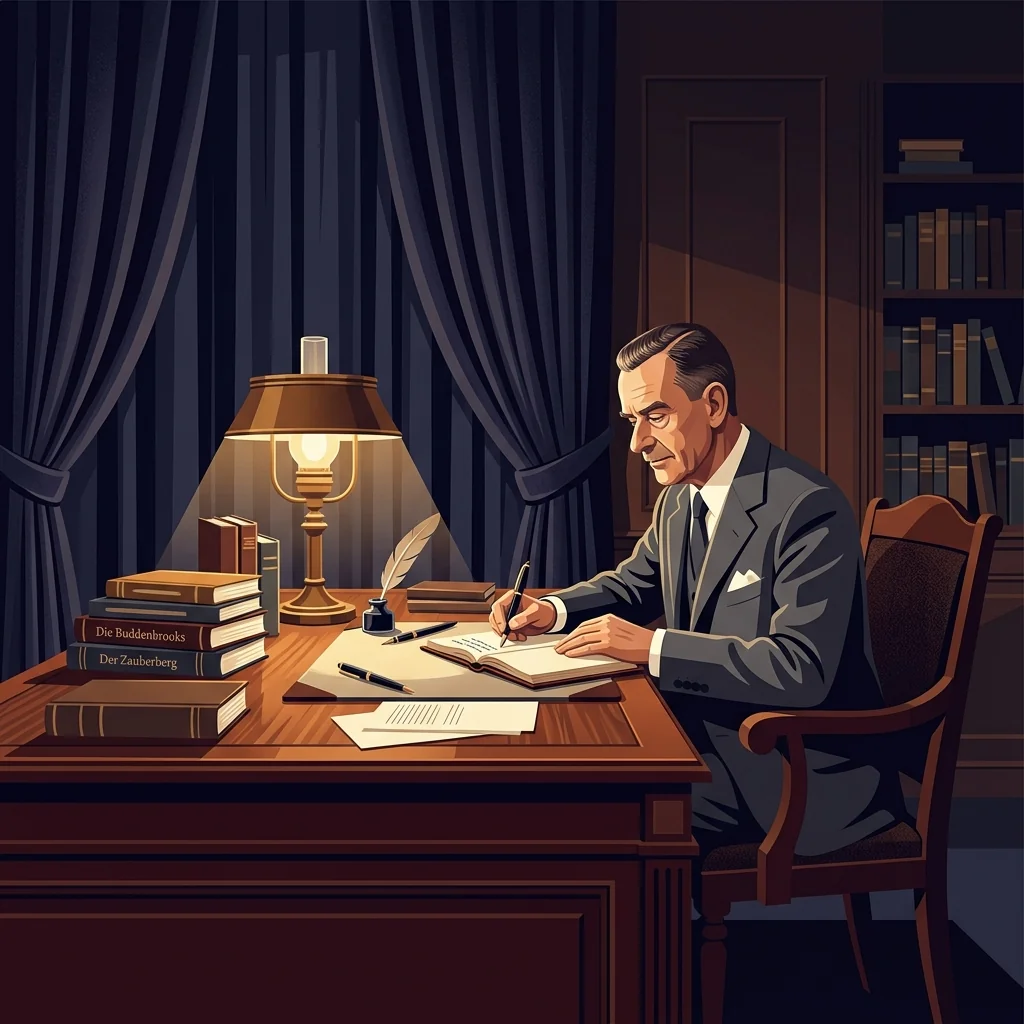
Thomas Mann (1875–1955), Nobel Prize-winning author of masterpieces like ‘The Magic Mountain’ and ‘Buddenbrooks’, stands as a titan of German intellectual history. His massive, intricate narratives of profound philosophical depth were not born from spontaneous flashes of inspiration, but from clockwork time control executed with mechanical precision. 🕰️
Mann despised waiting around for inspiration to strike spontaneously. Every morning at exactly 9:00 AM, he entered his study and locked the door from the inside. He wrote continuously until 1:00 PM. During this 4-hour blocked writing window, nobody in the world—including his wife and children—was allowed near his study or permitted to knock on his door. Even on agonizing days when no words would come, he never left his study before 1:00 PM. The moment the clock struck 1:00 PM, he put down his pen completely, like a factory bell signaling the end of a shift.
In this post, we analyze the neuroscientific principles behind Thomas Mann’s strict environmental control routine and present a zero-distraction focus protocol for modern individuals navigating constant digital interruptions.
Historical & Academic Evidence
This content is based on Historical biographies, autobiographical records of Thomas Mann & Cognitive Neuroscience research.
 BuildSelf
Inspired by historical greats? Make it your daily habit!
BuildSelf
Inspired by historical greats? Make it your daily habit!

















1. Environmental Control and Prevention of Cortical Cognitive Fatigue
Cognitive energy in the Prefrontal Cortex—which coordinates willpower and complex problem-solving—is highest in the morning, but its capacity is strictly limited. Minor distractions such as smartphone notifications, social media, or casual chatter drain this energy rapidly.
Due to the phenomenon of ‘Attention Residue’, which occurs whenever attention switches targets, an interrupted brain wastes up to 20 minutes or more regaining deep immersion. Thomas Mann’s study-locking routine fundamentally isolated his brain from incoming external stimuli, allowing him to channel 100% of his finite cognitive resources with maximum density into a single high-level task—an exceptionally efficient brain protection strategy.
2. 3-Step Practical Routine for Modern Professionals
Commit to a 2-Hour Morning Focus Block
Schedule a 2-hour 'Deep Work' time block in your calendar during the morning when brain energy is clearest, dedicated solely to your most critical project or planning without interruption.
Physical Space Isolation and Visual Cleansing
Close the door or move to a quiet room. Place your smartphone face-down inside a bag or in another room to eliminate visual prompts, and clean your desk surface so only necessary tools remain.
Enable Do-Not-Disturb and Fix a Single Window
Set all messaging and notification apps to 'Do Not Disturb'. Keep only the single window relevant to your task open in full-screen mode, committing to not escape into shallow tasks for the full 2 hours.
3. The Trap of Shallow Work
Checking emails, replying instantly to chat messages, or mindless web browsing give the brain a false sense of productivity without driving meaningful cognitive progress—these represent ‘Shallow Work’. Like Thomas Mann, you must block out specific focus hours, ban shallow tasks during that window, and place your brain in a stimulus-free state to achieve true Deep Work and high-efficiency output.
📌 Frequently Asked Questions (FAQ)
Did Thomas Mann really stop writing completely at 1:00 PM? ▼
Yes, because he poured 100% of his mental energy into the morning session, he recognized that his cognitive capacity was depleted after 1:00 PM. Believing that writing after 1:00 PM resulted in lower quality, he reserved his afternoons for light tasks that required less energy, such as reading, walking, and editing.
Can Deep Work sessions be performed at night instead of in the morning? ▼
Depending on an individual's circadian rhythm (night owls), night hours may be the most effective. The core principle lies not in the exact hour of the day, but in securing a continuous block of 2 or more hours free from external distractions when your energy is at its peak.