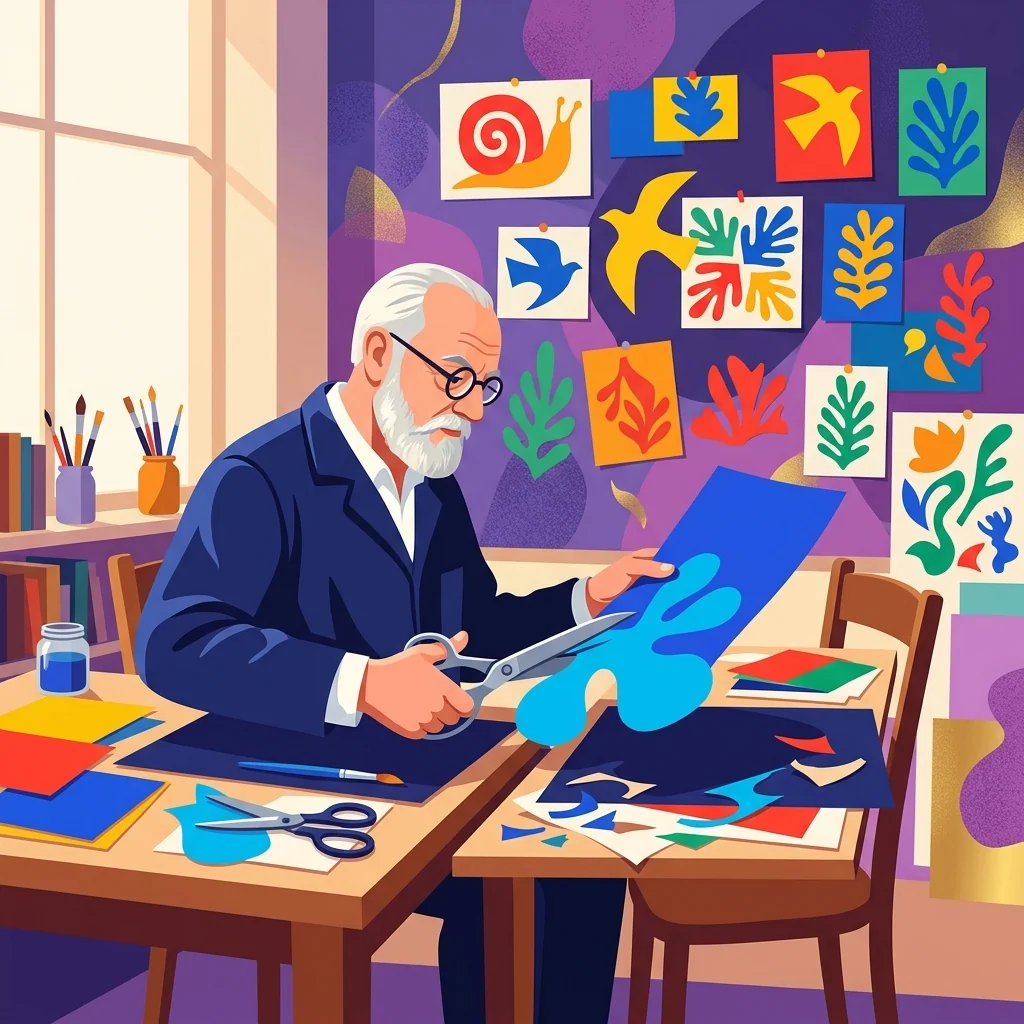
“Cutting paper with scissors is like carving directly into stone. It allows one to move straight from color into form.” ✂️
Henri Matisse (1869–1954) was a French visual artist and leader of Fauvism who, alongside Pablo Picasso, revolutionized 20th-century modern art. Renowned for vibrant masterpieces such as ‘La Danse’ and ‘Woman with a Hat’, his final years brought debilitating physical suffering. Following major abdominal cancer surgeries in old age that confined him to a wheelchair and bed, Matisse was given a devastating physical sentence: he could no longer stand before an easel to paint in oils.
Refusing to abandon art, Matisse pioneered ‘paper cut-outs’ (Découpage) using long tailor scissors to cut sheets of paper hand-painted in bold gouache colors by his assistants. From his bed, he cut iconic silhouettes of leaves, birds, algae, and human figures, arranging them on walls to create monumental masterpieces like ‘Blue Nudes’ and the Chapelle du Rosaire in Vence. Engaging in fine-motor paper cutting supplied dopamine to his brain and blocked pain pathways, turning physical agony into a triumph of artistic innovation.
In today’s post, we explore the science of visual-tactile relaxation in Henri Matisse’s cut-out routine and present a color paper-cutting mental detox routine for knowledge workers.
Historical & Academic Evidence
This content is based on Historical Verification of Henri Matisse's Biographies & Cognitive Neuroscience Research.
 BuildSelf
Inspired by historical greats? Make it your daily habit!
BuildSelf
Inspired by historical greats? Make it your daily habit!
















1. Visual-Tactile Feedback Distracting Pain and Stimulating Neuroplasticity
When the brain experiences severe physical pain or mental stress, merely lying down to rest keeps attention locked onto pain and anxiety networks.
Fine-motor activities like holding scissors and meticulously cutting smooth paper—as Matisse did—simultaneously stimulate the motor cortex and visual association areas. Rich color stimuli from vivid papers trigger dopamine and endorphin release. While immersed in this dense visual-tactile feedback, the brain’s attention filters block pain signals heading to the prefrontal cortex. Beyond blocking discomfort, this process restores positive Neuroplasticity to promote vitality and recovery.
2. 3-Step Practical Routine for Modern Professionals
Prepare Color Tools and Scissors
Prepare several sheets of vivid primary, fluorescent, or soft pastel colored paper and a pair of long craft scissors. Clear smartphone and tablet screens from view to block digital notifications.
Cut Freeform Shapes Spontaneously
Skip conscious sketching with a pencil; hold scissors directly against the paper to boldly cut organic curved silhouettes like leaves, feathers, or freeform geometric patterns.
Arrange Shapes and Harmonize Colors
Arrange the cut colorful paper pieces across a desk or white paper backing. Focus your attention on visual harmony—complementary contrast, overlaps, and spatial balance—for 5–10 minutes to engage sensory immersion.
3. Creation at Your Fingertips Heals a Fatigued Brain
Modern individuals accumulate visual fatigue through passive web surfing or social media, leaving the brain drained. Adopt a tactile ritual like Matisse—even once a week—by using real scissors to cut colorful paper into freeform shapes and arranging them on a wall or notebook. This is an artistic mental detox therapy that restores sensory networks in the brain.
📌 Frequently Asked Questions (FAQ)
Can beginners without artistic talent benefit from doing paper cut-outs? ▼
Yes. Creating an artistic masterpiece is irrelevant. The core benefit lies in the brain receiving tactile stimulation from fine scissor movements and visual input from cutting vivid colors. This diverts pain and activates neuroplasticity regardless of how crude or distorted the shapes look.
What about using clay or a drawing app instead of paper cutting? ▼
Sculpting clay is highly recommended as it provides excellent tactile feedback. However, tablet drawing apps are discouraged because smooth glass friction, internet connection, and digital notifications distract the brain and prevent complete cognitive reset; analog tools are much preferred.