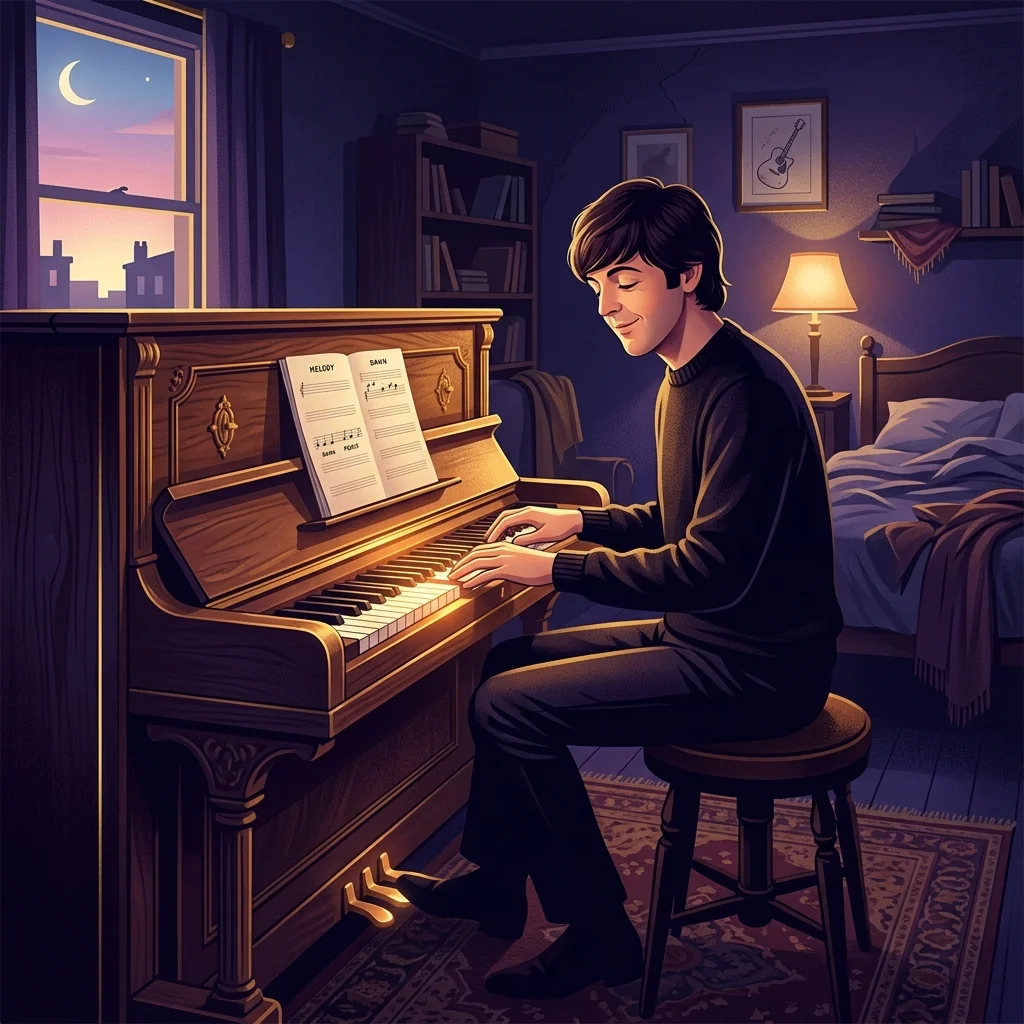
“The melody was playing perfectly in my dream. If I hadn’t gotten straight up and played it on the piano, it would have evaporated forever like morning mist.” 🎹
Paul McCartney (1942– ), the most successful singer-songwriter in pop music history and leader of the legendary 20th-century band The Beatles. The classic pop ballad ‘Yesterday’, played tens of millions of times worldwide, was born entirely from a dream he had in his bedroom. One morning in 1964 in England, waking with a beautiful melody echoing in his mind, he rushed straight to the piano beside his bed to capture it before it faded. His habit of capturing subconscious thoughts immediately before they evaporated became the wellspring of numerous masterpieces.
The human brain experiences a highly creative state immediately upon waking at the boundary between sleep and wakefulness, when rational censorship is inactive. In today’s post, we analyze the cognitive neuroscience principles behind Paul McCartney’s hypnagogic inspiration capture routine, offering a 3-step actionable guide for modern individuals to record fleeting subconscious ideas without loss and transform them into creative assets.
Historical & Academic Evidence
This content is based on Paul McCartney Historical Biography & Autobiographical Records Research & Cognitive Neuroscience Studies.
 BuildSelf
Inspired by historical greats? Make it your daily habit!
BuildSelf
Inspired by historical greats? Make it your daily habit!















1. Hypnagogia and the Brain’s Diffuse Mode
For a few minutes right after waking, humans remain in ‘hypnagogia’, where the dorsolateral prefrontal cortex (DLPFC), responsible for conscious control and logic, is not fully online. In this state, the cerebrum enters diffuse mode, where rational filters and self-censorship are loosened, allowing scattered memories and auditory data in the subconscious to freely mix. However, the moment full wakefulness sets in, the brain switches to focused mode and flushes short-term memory, permanently losing subconscious inspirations. Recording them with a physical tool within 30 seconds of waking prevents this loss.
2. 3-Step Practical Routine for Modern Professionals
Placing Analog Recording Tools at Bedside
Keep a pen and analog notebook permanently on your nightstand within arm's reach. If using a smartphone voice recorder, configure your screen to launch only a simple audio memo without opening other apps.
Immediate Unconscious Physical Action Upon Waking
The instant you wake, grab your pen immediately without entertaining extraneous thoughts. Hum the echoing melody into a voice recorder or freely scribble fleeting words and fragmented dream images onto your notebook.
Eliminating Self-Censorship and Accumulating Raw Data
While writing, completely exclude self-evaluations like 'Does this make logical sense?' or 'Is this weird?'. Focus purely on pouring unprocessed subconscious raw data onto paper; leave analysis and logical refinement for later in the afternoon.
3. Precautions and Tips
The most critical mistake when practicing this habit is checking social media or reading news emails on your smartphone right upon waking. When external, structured information forcibly dominates your visual cortex and working memory, the brain instantly shifts to a high cognitive tension mode and completely formats the faint neural circuits of your dream memory. Therefore, keep only an analog pen and paper notebook near your bed so your brain transitions smoothly out of hypnagogia. Avoid external media contact for at least 3 minutes upon waking and focus entirely on extracting the unique data inside your brain.
📌 Frequently Asked Questions (FAQ)
What should I do if I don't remember my dreams at all on most mornings? ▼
It is completely fine if you don't remember the dream itself. While your brain is still hazy right after waking, randomly write down 3 or more lines of your 'stream of consciousness' on a blank page. This practice also turns off self-censorship and warms up the subconscious mind, dramatically enhancing creative flexibility during the day.