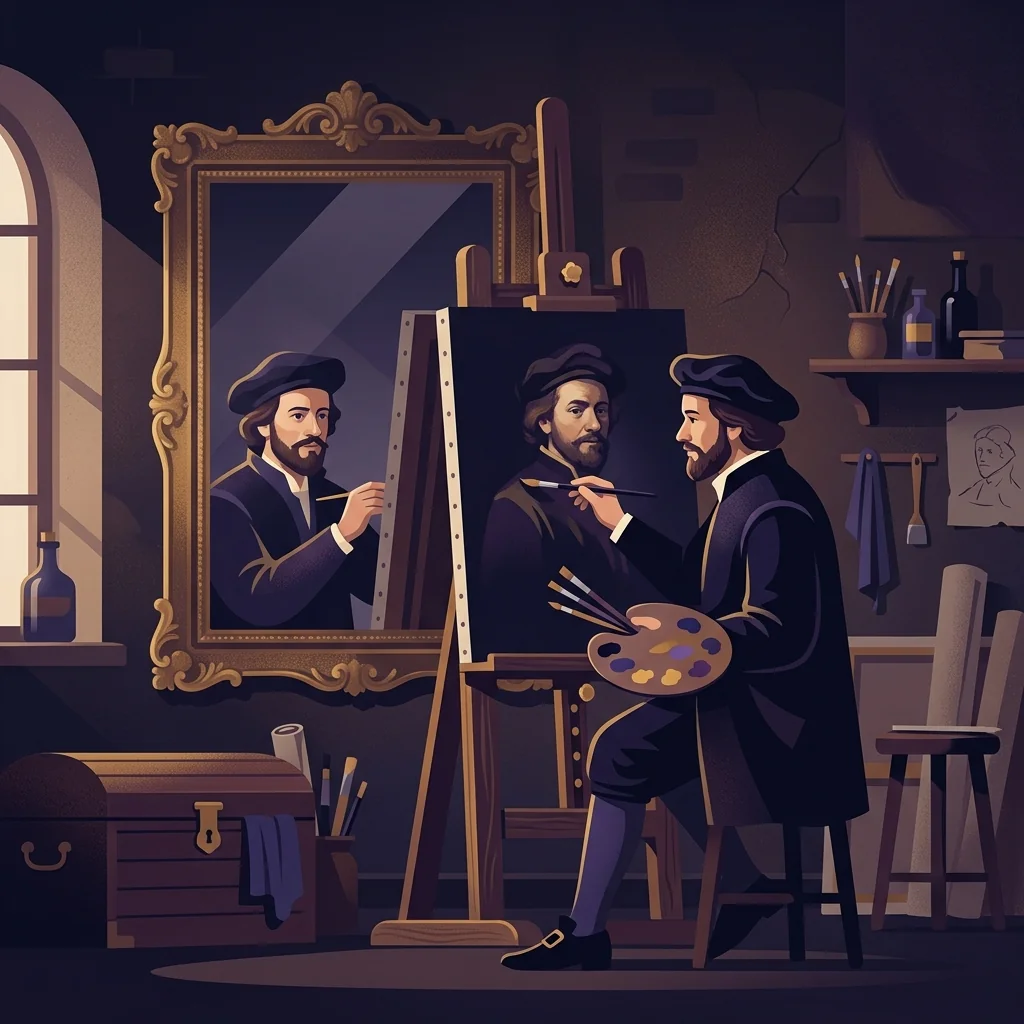
“The only way to confront one’s inner self is to gaze deeply into the pupils reflected in the mirror.” 🎨
Rembrandt van Rijn, a master painter of the Dutch Golden Age often hailed as the ‘Master of Light’. Although he enjoyed supreme wealth and fame in his youth, in his later years he faced severe hardship including bankruptcy and the successive deaths of loved ones. Yet he did not bow to trial, pouring out masterpieces. His secret lay in his lifelong habit of self-portrait visual reflection. Rembrandt left behind over 80 self-portraits during his lifetime, which were traces of daily reflection through the mirror—gazing at his own transformations from youthful arrogant glory to lonely old-age wrinkles. We explore Rembrandt’s reflection formula of standing before a mirror to awaken the brain’s self-referential cognitive circuits and steady emotional fluctuations.
Historical & Academic Evidence
This content is based on Historical critical biography and autobiographical records of Rembrandt Self Portrait Reflection & Cognitive Neuroscience research.
 BuildSelf
Inspired by historical greats? Make it your daily habit!
BuildSelf
Inspired by historical greats? Make it your daily habit!

















1. Mirror Self-Gazing and Self-Referential Effect of the Medial Prefrontal Cortex (mPFC)
Gazing deeply into one’s own eyes in the mirror for more than 3 minutes strongly activates the cerebrum’s ‘medial prefrontal cortex (mPFC).’ This region governs self-referential processing, allowing one to perceive the ‘pure self’ hidden behind others’ evaluations or social masks (personas). The physical image of oneself entering through the visual cortex recalibrates the brain’s emotional prediction model, soothing stress neurotransmitter secretions and serving as a powerful tool to restore self-compassion and psychological homeostasis.
2. 3-Step Practical Routine for Modern Professionals
Secure Calm Space in Front of Mirror and Lighting
Stand directly in front of a mirror in a quiet room or bathroom free from noise. Adjust the lighting gently so your eyes do not get fatigued.
Gaze Quietly at Both of Your Pupils
Look into both of your pupils reflected in the mirror with a gentle gaze. Allow natural blinking, but fix your gaze.
Exclude Subjective Emotions and Accept Visual Facts
Without passing judgment on wrinkles or facial lines in the mirror, quietly observe 'the brightness of your eyes today, the contrast of fatigue' for 3 minutes, then conclude with a gentle smile.
3. Precautions and Tips
The item to guard against most when conducting mirror reflection is ‘evaluating and obsessing’ over physical flaws (skin trouble, wrinkles, symmetry, etc.). Starting to evaluate facial flaws activates the brain’s negative emotional filter again, causing stress. Like Rembrandt, you must observe the light and shadow of the whole face, the sparkle in your eyes, and the flow of facial expressions in a matter-of-fact, visual fact-based manner—as if viewing another person’s painting—to achieve true self-objectification.
📌 Frequently Asked Questions (FAQ)
Should I stop if I feel strange or depressed when looking at the mirror continuously? ▼
Yes. If mood distortion or feelings of depression intensify, you may have fallen into a self-criticism loop, so stop immediately. Instead, detour to training that checks your body grounding (earthing) sensations first by looking at your shoulder line or hand shape rather than your pupils.
When is the best time of day to do mirror self-reflection? ▼
A 3-minute routine in front of the bathroom mirror right after finishing a shower is best. In a parasympathetic-dominant state where the body is relaxed, the brain's defense mechanisms soften, making for the most truthful and comfortable self-confrontation.