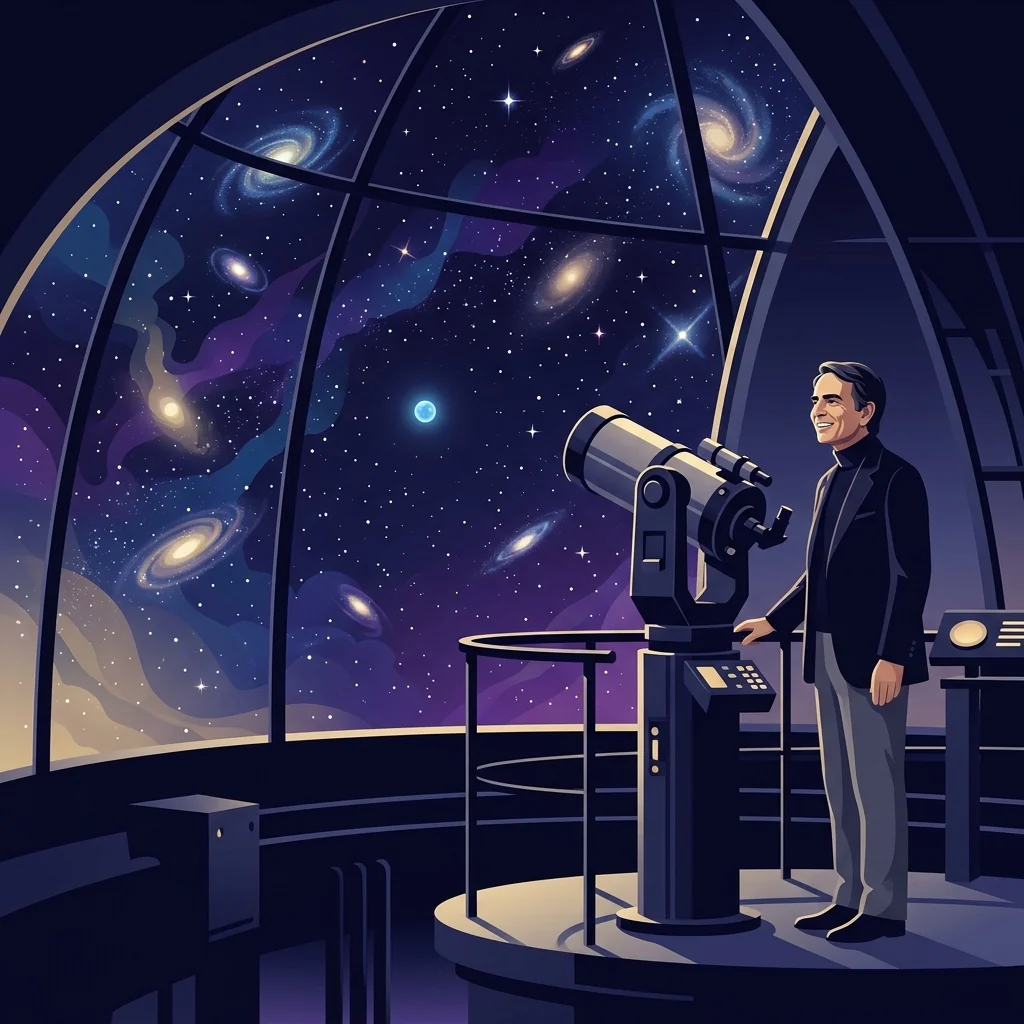
“Everyone you love, everyone you know, everyone you ever heard of, every human being who ever was, lived out their lives on a mote of dust suspended in a sunbeam.” 🌌
Carl Sagan (1934–1996) was a leading 20th-century American astronomer, director of the Laboratory for Planetary Studies at Cornell University, and a brilliant author who popularized science. He served as a key scientist on NASA’s Mariner, Viking, and Voyager missions, reminding humanity of its place in the cosmos through Pulitzer Prize-winning works like ‘Cosmos’ and ‘Pale Blue Dot’.
On February 14, 1990, as Voyager 1 was leaving the solar system, Sagan persuaded NASA to turn its camera back toward Earth. Despite internal opposition, his persistence yielded a famous photograph of Earth as a 0.12-pixel point of light from 6 billion kilometers away: the ‘Pale Blue Dot’.
Before launching into demanding research and writing each day, Sagan followed a perspective-reset routine: quietly gazing at this photo of the Pale Blue Dot and distant nebulae for 3 minutes. By zooming out to view himself and Earth from cosmic dimensions, he shed daily anxieties, subdued amygdala stress, and focused intensely on essential work.
Historical & Academic Evidence
This content is based on Historical Biography & Autobiographical Verification of Carl Sagan & Cognitive Neuroscience Research.
 BuildSelf
Inspired by historical greats? Make it your daily habit!
BuildSelf
Inspired by historical greats? Make it your daily habit!

















1. How Cosmic Awe Calms Amygdala and Egotistical Stress
Neuropsychology calls this the ‘Small-Self Effect’. Visualizing the vast awe of the cosmos or nature calms hyperactive stressin the brain’s amygdala and insula, replacing trivial anxieties with a broad objective perspective.
2. 3-Step Practical Routine for Modern Professionals
Gaze at the Pale Blue Dot Image
Gaze quietly at a photograph of Earth from space or a wide Milky Way image for 30 seconds. Block external distractions completely and focus on establishing a clear mental frame.
Visualize a 3-Minute Cosmic Zoom-Out
Zoom out mentally from your desk to your city, to Earth, and into the vast cosmos, looking back down at your worries from an overarching perspective.
Hyper-Focus on 1 Essential Task for Today
With a calmed mind and trivial ego stresses shed, immerse yourself deeply into the single most essential and valuable task for your day.
3. Precautions and Tips for Sagan’s Perspective Reset
Do not mistake cosmic vastness for helplessness. Instead, use it as a tool to realize that the stresses weighing on you are small enough to be tackled calmly. Rather than relying solely on willpower, design environmental cues that naturally prompt this habit.
📌 Frequently Asked Questions (FAQ)
Is this routine effective when feeling anxious before a presentation or an important meeting? ▼
Yes! Visualizing a 1-minute cosmic zoom-out stabilizes your heart rate and significantly reduces stage fright or performance anxiety.
What if I don't have space photos around me? ▼
Simply close your eyes and imagine a small, beautiful blue dot floating in vast dark space to yield the exact same neuroscientific benefits.