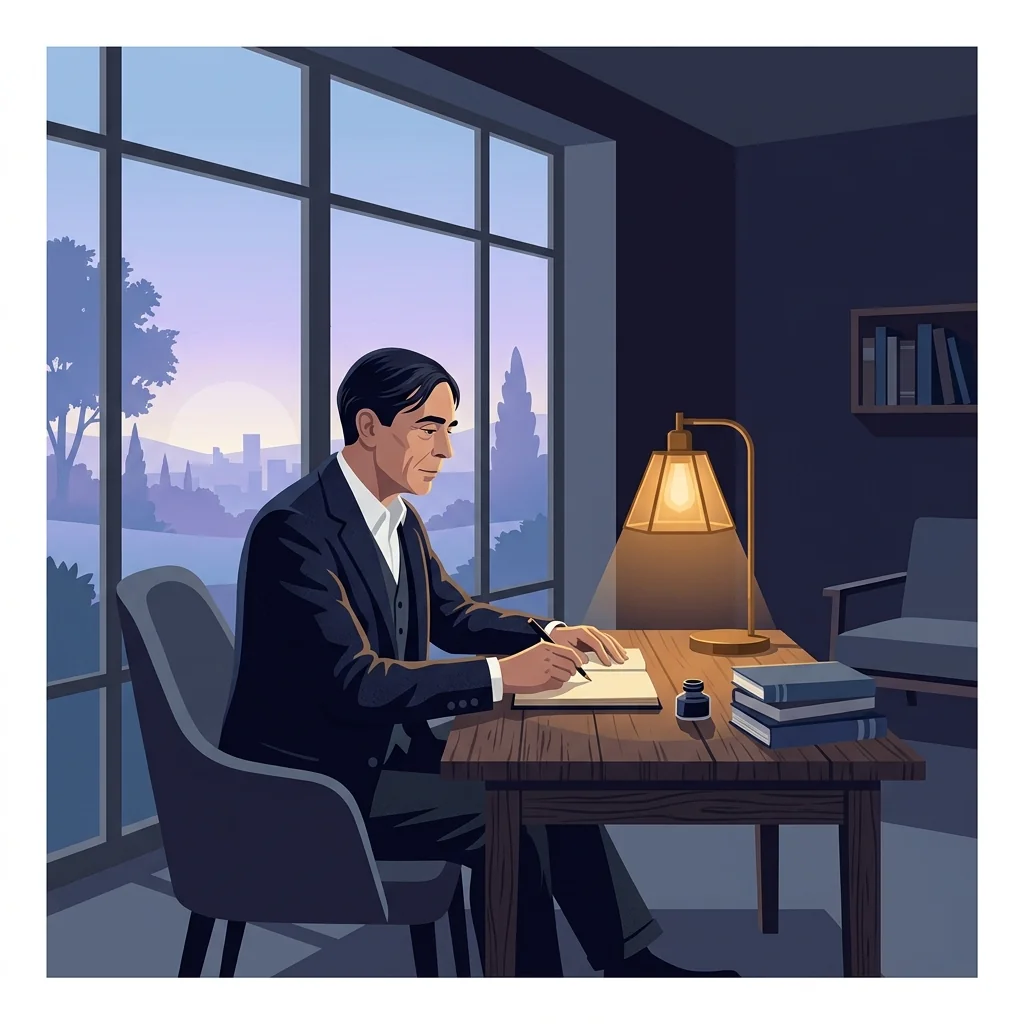
“Dawn is the sacred time when my consciousness awakens in its clearest, most whole state. Only the records left at this hour are my essence.” 🌅
Paul Valéry, a pinnacle of French Symbolist literature and a sharp intellect. Every day at 4 AM throughout his life, he r his eyes awake and lit his lamp without fail. He headed straight to his writing desk. During those hours before dawn when the world was at its quietest, Valéry meticulously recorded the emerging stream of consciousness and contemplation. Accumulated over 51 years, these handwritten notebooks reached an astounding 261 volumes, forming the matrix of all his philosophical thought. We explore how dawn silence extracts the purest ideas through our cognitive filter from a neuroscientific perspective.
Many people in modern society start their day as soon as they open their eyes by checking smartphone notifications and reading real-time news or emails. However, this immediate influx of external stimuli injects immense cognitive noise into a freshly awakened brain, stealing control of the day. In contrast, Valéry utilized the early hours when the whole world was asleep, securing an independent cognitive shield that blocked external signals and organized inner thought.
In today’s post, we interpret Paul Valéry’s self-tuning mechanism through early morning notebooks from brain science and physiological viewpoints, providing a 3-step morning action plan for modern people to guard a peaceful mental space amidst external battles for attention.
Historical & Academic Evidence
This content is based on Valéry Dawn Notebook historical biographies & autobiographical records validation & Cognitive Neuroscience research.
 BuildSelf
Inspired by historical greats? Make it your daily habit!
BuildSelf
Inspired by historical greats? Make it your daily habit!

















1. Cognitive Noise Blockage & Awakening Hormone Action Provided by Dawn Silence
During normal daytime hours, the brain faces countless external stimuli like noise, emails, and instant messages, wasting cognitive resources. However, at 4 AM, the surrounding world is completely still, bringing the energy spent filtering external stimuli close to zero. Simultaneously, the gradual rise in cortisol levels as one wakes calmly awakens the brain without stress, creating perfect physiological conditions for prefrontal cortex-led deep reflective writing and self-contemplation.
2. 3-Step Practical Routine for Modern Professionals
Build a Dawn Awakening Space and Wake Up
Wake up quietly between 4 AM and 5 AM, moving from bedroom to study room or table so the brain feels comfortable, turning on only indirect lamp lighting.
Erect a Disconnect Wall against External Digital Stimuli
To protect early morning mind quietude, keep your smartphone turned off or isolated far away for the first 1 hour after waking up.
Journal the Stream of Consciousness (Cahiers) and Contemplate
Open your notebook and quietly write down your thoughts, emotions, and emerging intellectual ideas with a pen for 30 minutes without form constraint, refining your thinking.
3. Cautions and Tips
Diving straight into complex mechanical tasks or numerical calculations in a groggy state before the brain fully awakens lowers productivity. In this time block, arranging intuitive note-taking, free writing, or philosophical reading is most suitable for cognitive efficiency over logical computation. Additionally, to keep early morning hours undisturbed, establishing a disconnect wall where you never check smartphones or emails for 1 hour after waking is essential.
📌 Frequently Asked Questions (FAQ)
What if I suffer from sleep deprivation and find waking up at dawn difficult? ▼
Waking up early at dawn must be accompanied by early sleeping so as not to harm the body. If early sleeping is impossible due to late work shifts, instead of forcing yourself up at 4 AM, use the first 30 minutes of your normal waking time as 'Digital Disconnect & Cahiers Time' to enjoy the same cognitive anchoring effect.