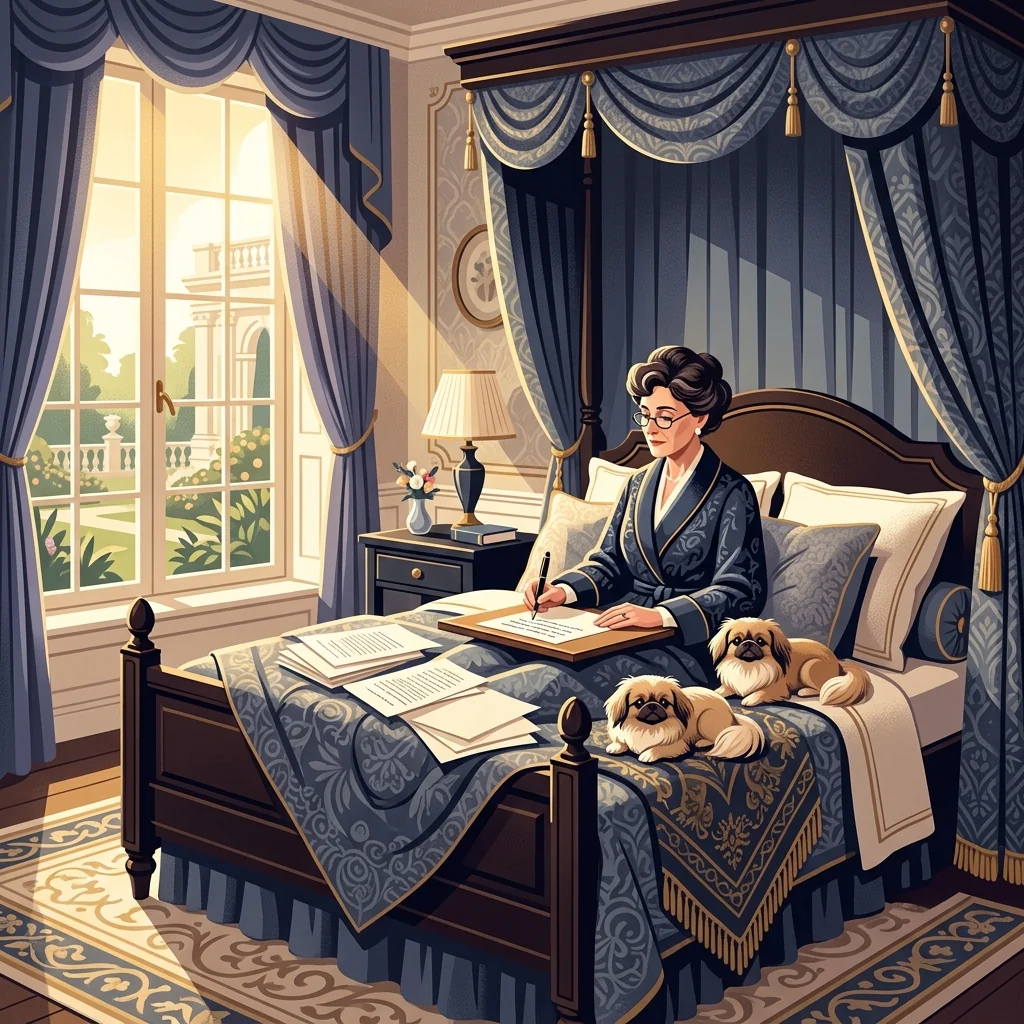
“My bed is my only safe haven. When I am tucked in warm, soft bedding with my dogs, my fictional imagination awakens most flexibly.” 🛏️
Edith Wharton stood tall as a peerless master of early 20th-century American literary history, becoming the first woman to win the Pulitzer Prize with her novel ‘The Age of Innocence’. A novelist who depicted human weakness and hypocrisy behind high-society etiquette more sharply and minutely than anyone. Contrary to her piercing authorial gaze, the morning writing habit she chose was strangely cozy and comfortable. She stayed in bed until nearly 11 AM, resting with a lapboard across her knees while her beloved dogs lay tucked in the blankets. We examine the secret of Wharton’s creative morning routine that fully relaxed the body’s parasympathetic nervous system to induce artistic inspiration.
Historical & Academic Evidence
This content is based on Edith Wharton historical biography & autobiographical record examination & Cognitive Neuroscience research.
 BuildSelf
Inspired by historical greats? Make it your daily habit!
BuildSelf
Inspired by historical greats? Make it your daily habit!

















1. Physical Relaxation and the Cognitive Action of Parasympathetic Dominance Mode
When creating or generating complex ideas, the bottleneck many experience is the stiffening of frontal lobe reasoning circuits due to anxiety and pressure to ‘write well’. Maintaining a fully relaxed physical state in bed while leaning back and touching pets strongly activates the Parasympathetic Nervous System. In this state, feeling safe reduces cortisol secretion and releases Alpha Waves suitable for comfortable immersion. Alpha waves gently connect loosely scattered ideas and words across cerebral cortices, guiding fluid and delicate fictional imagination.
2. 3-Step Practical Routine for Modern Professionals
Bedside Back Cushion Support and Semi-Fowler Position Setup
Upon waking in the morning, stay in bed without engaging in other tasks. Place cushions behind your back to maintain a comfortable reclining posture with your spine angled.
Lapboard Setup and Relaxation Environment Creation
Place a wide, flat wooden board or writing lapdesk over your knees to create a stable horizontal surface. Let your pet sit on the blanket or cover with a soft blanket for tactile comfort.
30-Minute Unfiltered Creative Session
Perform writing for 30 minutes in a deeply relaxed, silent state. Discard logic filters or perfectionist censorship, flowing ideas and fictional contexts gently onto paper.
3. Precautions and Tips
A common pitfall when applying bedside writing relaxation is slipping back into sleep as focus melts away. If the brain over-relaxes into delta waves, unproductive drowsiness replaces creative flow. Avoid lying fully flat; use back cushions to maintain a Semi-Fowler’s position with your spine angled at 45 to 60 degrees. Keep the room slightly cool with fresh airflow so that while your body remains comfortably relaxed, your brain stays in a state of vivid alertness.
📌 Frequently Asked Questions (FAQ)
Won't working in bed turn the bedroom into a stressful work space and cause insomnia? ▼
That boundary is crucial. Therefore, stressful work like analytical management, scheduling, or critical emails must be blocked in bed. Restricting activity purely to enjoyable creative drafting, brainstorming, or reflective journaling preserves the bedroom's cognitive safe value.