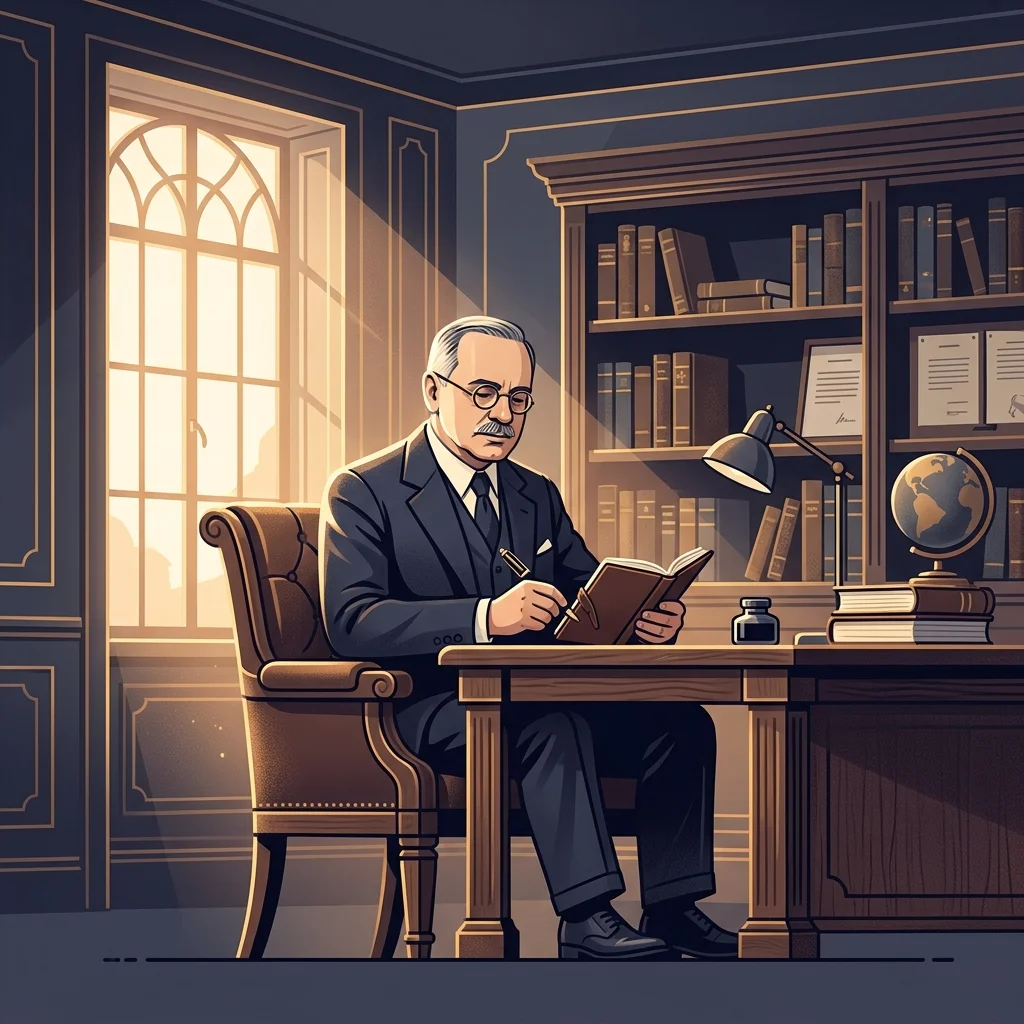
“All human problems stem from interpersonal relationships. But the solution also lies in Social Interest that connects us with others.” 🤝
Alfred Adler, the founder of Individual Psychology who laid the groundwork for modern psychotherapy by emphasizing self-determination and overcoming inferiority feelings. As a therapist healing the deep psychological wounds of countless patients, how did he clear his own ego each morning before consultations and maintain optimal mental balance? 📖
Every morning, before welcoming patients and embarking on research, Adler spent 10 quiet minutes opening his personal notebook. He wrote down in concrete sentences: “How will I contribute to others and the community today?”. Rather than fixating on his own professional authority or personal anxiety, he pre-set a perspective focused on ‘Social Interest’ (Gemeinschaftsgefühl). This 10-minute reflective note served as an unshakeable anchor for his psychological stability.
In today’s post, we explore the cognitive neuroscientific principles of decentering and prosocial orientation embedded in Alfred Adler’s morning Social Interest journaling routine.
Historical & Academic Evidence
This content is based on Official Biography The Drive for Self: Alfred Adler and the Founding of Individual Psychology by Edward Hoffman, Adler's Understanding Human Nature & Cognitive Neuroscience & Positive Psychology Research.
 BuildSelf
Inspired by historical greats? Make it your daily habit!
BuildSelf
Inspired by historical greats? Make it your daily habit!

















1. Neuroscience of Decentering and Prosocial Perspective Setting
When excessively ruminating on personal anxiety, inferiority, or achievement, the medial prefrontal cortex (mPFC) and Default Mode Network (DMN) become hyperactive, driving self-focused stress.
Writing about ‘contributing to others and community’ in the morning prompts decentering—shifting awareness from ‘I’ to ‘We’. This activates the dorsolateral prefrontal cortex (dlPFC), instantly mitigating self-referential anxiety and cortisol release while engaging social cognition networks (Theory of Mind) to cultivate emotional resilience and psychological freedom.
2. 3-Step Practical Routine for Modern Professionals
Step 1: Opening a 10-Minute Morning Reflection Journal
Before starting work or daily tasks, turn off your phone and open a notebook for 10 quiet minutes.
Step 2: Writing 1–2 Lines on Today's Contribution
Write concrete action sentences answering: 'How can I be of small help to colleagues, family, or others today?'.
Step 3: Decentering Ego and Setting Other-Oriented Perspective
Let go of pride or concern over personal evaluation, anticipating the perspectives of people you will meet today.
3. Guide to Setting Social Interest in Daily Life and Work
Do not approach this as a self-sacrificing obligation leading to burnout. The key is gently setting an other-oriented perspective focused on small acts of kindness and genuine connection.
📌 Frequently Asked Questions (FAQ)
Does thinking about contributing to others help even when I feel exhausted and overwhelmed myself? ▼
Yes, in fact, it is even more effective. Psychological research demonstrates that shifting from self-absorbed rumination to prosocial framing redirects neural activity away from anxiety loops, restoring feelings of social connectedness and personal agency.
How can busy professionals maintain this habit consistently? ▼
Keep it brief. A single line written in one minute—such as 'Listen attentively to a colleague today' or 'Express genuine gratitude in today's meeting'—is fully sufficient to activate prefrontal social cognition networks.