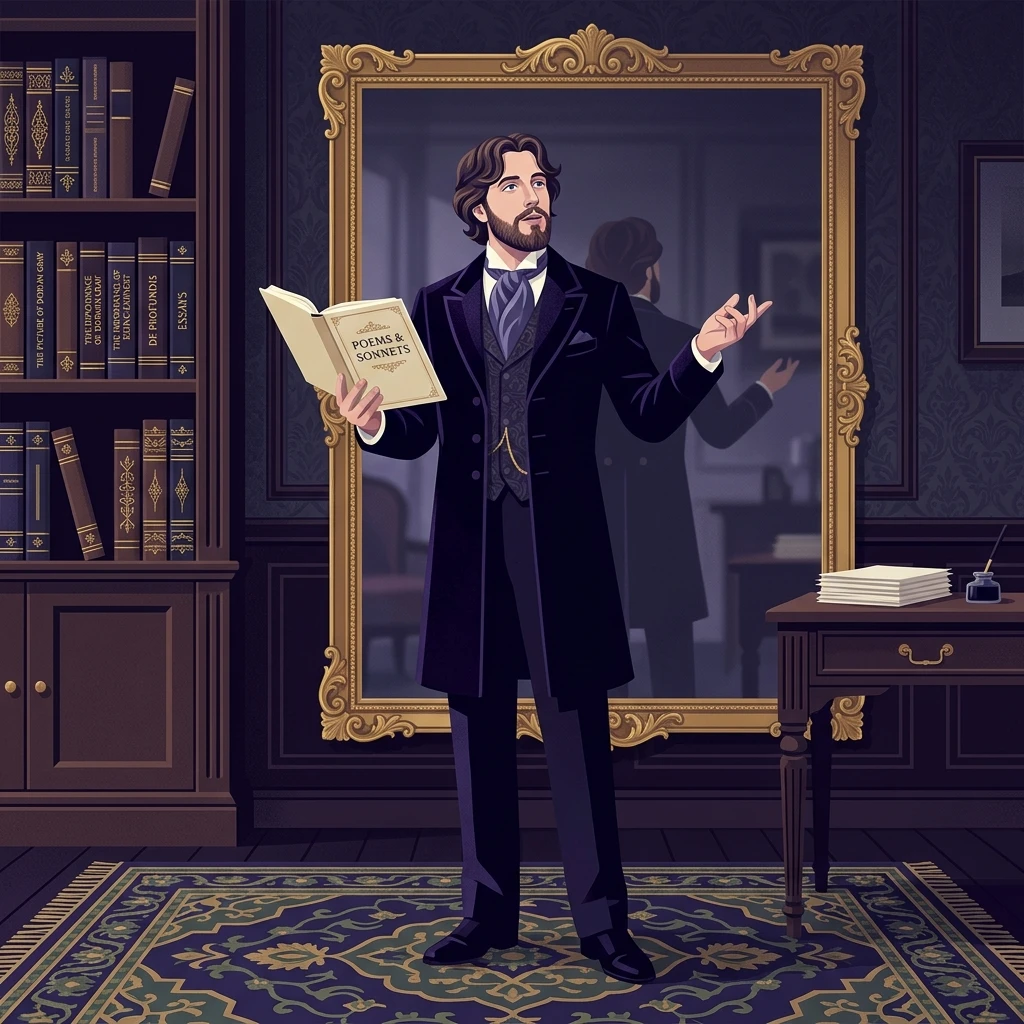
“Literature is a beautiful struggle to test the limits of the soul and overcome the boundaries of the body.” ✍️
James Joyce (1882–1941) was the monumental Irish author whose masterworks Ulysses and Finnegans Wake revolutionized 20th-century modernist literature through the stream of consciousness technique. Throughout his adult life, Joyce endured catastrophic eye afflictions—including severe iritis, cataracts, and glaucoma—undergoing over 25 agonizing ocular surgeries. During the composition of Finnegans Wake, he was legally blind and physically frail.
Faced with immense physical suffering, Joyce engineered an ingenious ergonomic adaptation documented in Richard Ellmann’s definitive biography. He wrote while lying flat on his stomach in bed, wearing a bright white coat and wielding oversized blue crayons on large cardboard sheets. The white coat acted as an analog light reflector, bouncing ambient room light onto his manuscript paper without harsh glare, while the thick blue crayon provided high contrast that his failing retinas could easily track. By stripping away gravitational muscle strain and visual strain, Joyce directed 100% of his preserved prefrontal cognitive bandwidth into linguistic creation.
In today’s post, we unpack the cognitive neuroscience behind James Joyce’s ‘bed writing and blue crayon’ routine and present a modern 3-step action guide to minimize sensory fatigue and optimize mental performance.
Historical & Academic Evidence
This content is based on Historical Verification from Richard Ellmann's *James Joyce* Biography, Joyce Archives & Cognitive Neuroscience and Visual Perception Research.
 BuildSelf
Inspired by historical greats? Make it your daily habit!
BuildSelf
Inspired by historical greats? Make it your daily habit!

















1. Reducing Gravitational Muscle Load and Alleviating Primary Visual Cortex (V1) Fatigue
Lying flat or reclining comfortably reduces postural muscle tension and stabilizes heart rate, minimizing physical energy expenditure. This allows oxygenated blood flow to concentrate heavily inside executive processing centers of the Prefrontal Cortex. Furthermore, utilizing thick, high-contrast blue writing tools under reflected light reduces decoding strain in the brain’s Primary Visual Cortex (V1), drastically mitigating neurological Visual Fatigue and eye strain.
2. 3-Step Practical Routine for Modern Professionals
Step 1: Establishing a Reclined Ergonomic Position to Minimize Muscle Tension
When experiencing severe fatigue, position supportive cushions or a mattress to align your neck and spine comfortably. Offload muscular energy expenditure to reserve cognitive capacity strictly for executive tasks.
Step 2: Preparing High-Contrast Writing Instruments to Eliminate Visual Noise
Select plain unlined paper paired with a thick, smooth navy or dark blue marker. Avoid blue-light digital screens that demand intense accommodation focus and accelerate ocular fatigue.
Step 3: Unstructured Freewriting of Keyphrase Diagrams and Conceptual Clues
Disregarding neat penmanship or formal grammar, freely scribble raw keyphrases, mind maps, or creative sparks onto the paper to clear mental clutter and organize executive thoughts.
3. Caution: Embracing Physical Fatigue Signals and Maximizing Visual Contrast
For James Joyce, writing in bed was a brilliant survival adaptation to overcome physical constraints. When physical or ocular exhaustion peaks, avoid forcing yourself to sit rigidly in a hard chair. Recline with supportive back cushions and casually sketch thoughts using thick blue markers and plain unlined paper.
📌 Frequently Asked Questions (FAQ)
Why did James Joyce wear a white coat while writing in bed? ▼
The white coat acted as a natural light reflector, bouncing ambient room light directly onto his manuscript paper without harsh glare. It served as a brilliant analog lighting-assist tool that allowed his severely damaged retinas to perceive written words clearly.
Doesn't working while lying in bed or on a sofa induce drowsiness? ▼
To prevent falling asleep, avoid lying completely flat. Prop your upper body up at a 30 to 45-degree angle using supportive wedge cushions, and work in brief 20-minute ideation sprints followed by short horizontal rests to regulate cortical arousal.