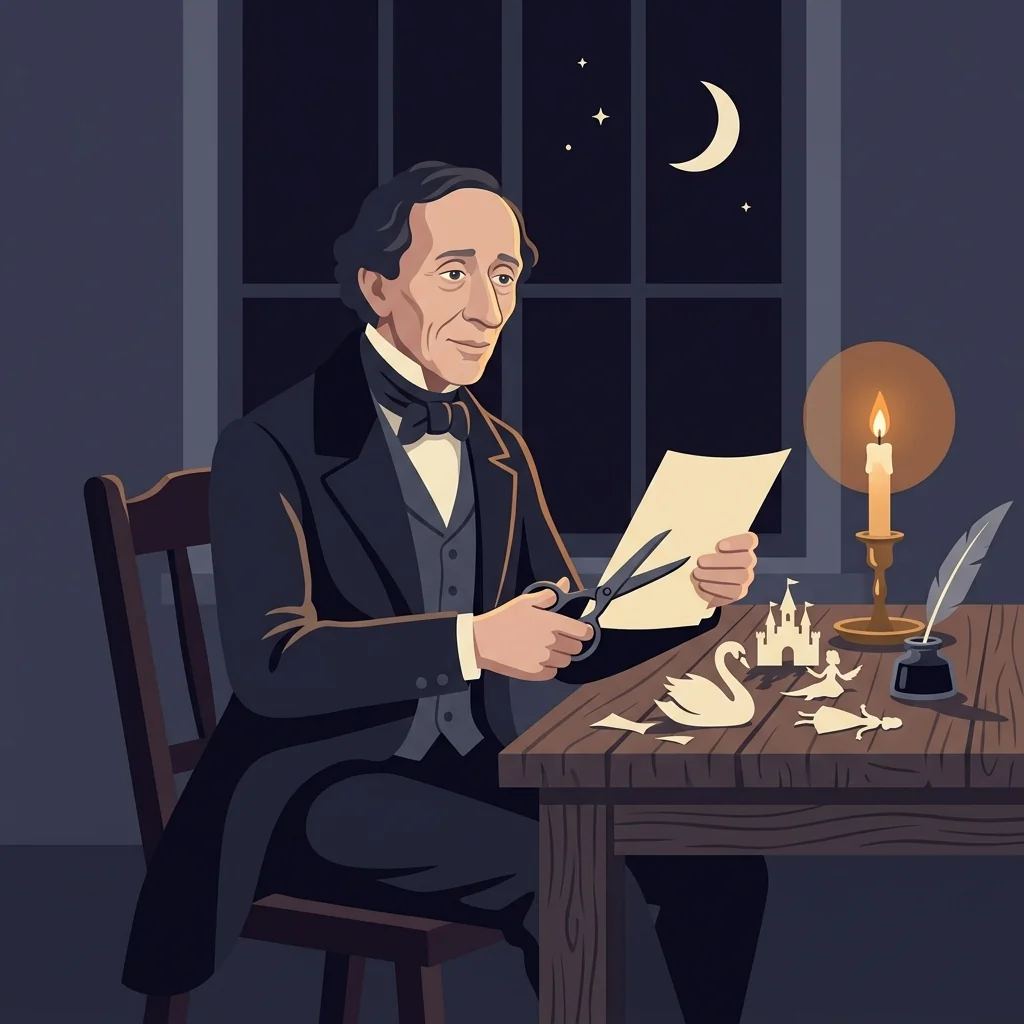
“My scissor-work is the first chapter of a fairy tale. The moment the scissors touch the paper, my imagination takes flight.” ✂️
Hans Christian Andersen, the father of fairy tales who brought timeless dreams and inspiration to children and adults worldwide through works like The Little Mermaid, The Ugly Duckling, and The Little Match Girl. Suffering throughout his life from severe poverty, intense depression, abandonment anxiety, and a complex about his appearance, where did he find the secret to retaining his imagination and gaining serene peace of mind in the face of harsh reality?
When Andersen conceived fairy tales or immersed himself in reflection, he always pulled out a piece of paper and a pair of scissors from his pocket. As he invented and spoke improvised fairy tales, his hands folded paper and executed precise paper cutting. When the story ended and he unfolded the paper, symmetrical artwork of whimsical and beautiful figures such as swans, lilies, and fairies appeared before everyone’s eyes. This sensory routine of cutting paper while keeping his fingertips busy was his closest emotional remedy for escaping brutal reality and attaining mental peace.
In today’s post, we introduce the psychiatric healing benefits of Andersen’s ‘Paper Cutting’ routine and a manual immersion routine re-engineered for modern individuals.
Historical & Academic Evidence
This content is based on Historical Verification from the Paper Archives of the Hans Christian Andersen Museum in Odense, Denmark & Cognitive Neuroscience Research.
 BuildSelf
Inspired by historical greats? Make it your daily habit!
BuildSelf
Inspired by historical greats? Make it your daily habit!

















1. Stabilization of the Default Mode Network (DMN) via Delicate Manual Work
The ‘Default Mode Network (DMN)’, which operates when the brain rests without performing a specific task, amplifies unnecessary overthinking such as past regrets and future anxieties in modern individuals. According to occupational therapy and neuroscience research, ‘delicate manual work’ like scissor-cutting or drawing, which delicately controls the fingertips, broadly warms up the brain’s motor cortex while immediately deactivating the hyperactive, overloaded DMN. The simple, symmetrical tactile stimulation of folding and cutting paper right before your eyes stops overthinking and provides deep cognitive rest to the brain.
2. 3-Step Practical Routine for Modern Professionals
Step 1: Preparing a Sheet of Paper and Scissors
In the afternoon or after finishing your workday, turn off smartphone notifications and place a sheet of regular paper (such as scrap paper or an envelope) along with safe scissors on your desk.
Step 2: Rule-Free Folding and Cutting
Fold the paper in any random shape twice or four times. Without any rules or target pattern designs, hold the scissors and cut through the paper freely wherever your hand leads.
Step 3: Immersing in Crisp Sounds and Tactile Sensations
For the 5 minutes of scissor-cutting, focus all your attention exclusively on the crisp friction sound of the scissors brushing against paper and the refreshing recoil felt at your fingertips as the paper falls away.
3. Focus on the Trajectory of Your Fingertips and the Cutting Sound, Not Perfect Design
To enjoy the brain-resting effects of the scissor-cutting routine, you must let go of the obsession to create a wonderful output. If you start mentally designing a pattern thinking ‘I must complete a pretty pattern’, the planning and control areas of the prefrontal cortex overheat, making it difficult to achieve the DMN deactivation effect. Just as Andersen closed his eyes and cut as his hands moved, entirely entrusting your attention solely to the crisp friction sound of the scissors cutting paper and the analog vibration at your fingertips is the first step toward relaxation.
📌 Frequently Asked Questions (FAQ)
Is it okay if I lack artistic sense and am not good at cutting? ▼
Of course. In fact, cutting randomly without a design is more effective in reducing DMN activity. The brain does not care at all whether the completed pattern looks strange or crooked. What matters is not the precision of the shape, but the delicate movement of fingertip muscles and the auditory stimulation itself. Since this is a fail-safe, value-free creative activity, enjoy cutting comfortably.
Does generating paper scraps after cutting disrupt the relaxation during cleanup? ▼
If you are concerned about generating scraps, try placing a small trash bin or tray on your desk from the start and cutting over it. Setting it up so cut paper pieces naturally gather in one place allows you to finish with a quick physical action (10 seconds) of picking them up and tossing them into the trash bin after the routine, preserving your emotional state of relaxation.