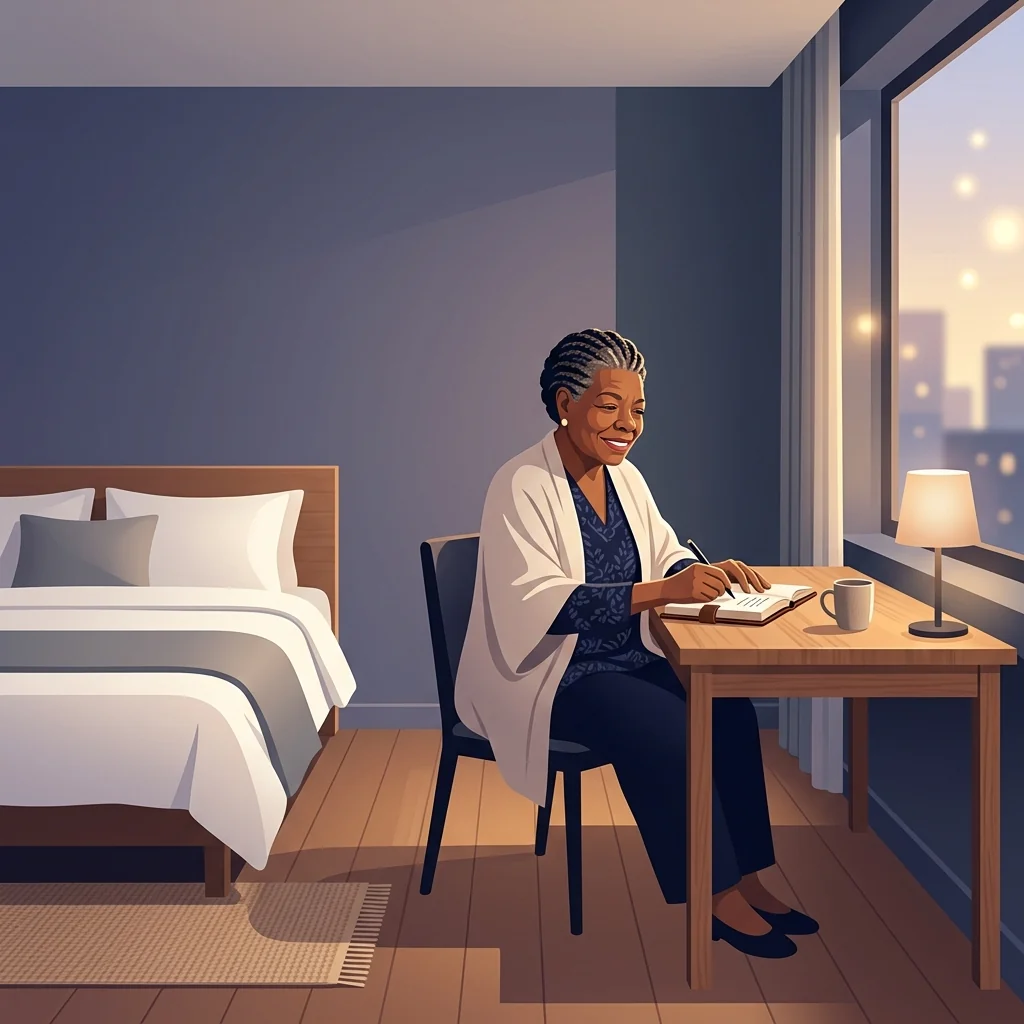
“A masterwork is never born by accident. It blossoms only through relentless focus and self-discipline.” 🖋️
Maya Angelou, who left behind timeless masterpieces including her autobiography ‘I Know Why the Caged Bird Sings’, overcame racial discrimination and deep childhood trauma to become one of the greatest poets and civil rights activists in American literary history. Amid the overwhelming noise and stimulation of the world, how was she able to focus entirely on her inner self and pen immortal sentences?
To construct a perfectly immersive writing environment, Angelou headed to a small nearby hotel room every morning at 6:30 AM. She asked the hotel staff to remove all paintings and decorations from the walls, creating an empty room that completely blocked visual stimuli. In that space existed only the bare minimum of tools: a cup of tea, a yellow legal pad, a volume of Shakespeare’s poetry, a bottle of sherry, and cigarettes. This strict routine of isolating herself from all cognitive noise of household and social life served as her focus fortress that maximized her literary inspiration.
In today’s post, we analyze the neuroscientific principles of environmental stimulus control and prefrontal cognitive energy conservation embedded in Maya Angelou’s ‘hotel isolation writing’ routine, and present a 3-step guide for modern individuals to build an immersive environment in daily life.
Historical & Academic Evidence
This content is based on Historical Verification from Maya Angelou's Autobiographical Records & Mason Currey's *Daily Rituals* & Cognitive Neuroscience Research.
 BuildSelf
Inspired by historical greats? Make it your daily habit!
BuildSelf
Inspired by historical greats? Make it your daily habit!

















1. Visual Stimulus Control and Prefrontal Cognitive Energy Conservation
Even without conscious awareness, the human brain constantly scans visual and auditory stimuli in the surrounding environment, consuming cognitive energy. Securing a dedicated, minimalist isolation space drastically reduces environmental stimuli, preserving prefrontal energy entirely for task immersion.
2. 3-Step Practical Routine for Modern Professionals
Designating a Dedicated Space Solely for Focus Work
Designate a specific desk, library seat, or clean corner of a room as your personal focus zone. Ban resting or mobile phone use in this space and strictly utilize it for concentrated work only.
Clearing Away All Visual and Digital Stimuli
Remove everything from your desk that is unrelated to the task at hand right now. Place your smartphone out of sight or in another room to strictly control environmental visual notifications at their root.
Establishing Clear Start and End Rituals
Set clear times for entering and leaving the focus zone. When the set writing or work session ends, rise completely from your seat to create a psychological boundary line between work and rest.
3. Neuroscientific Advice for Successful Environmental Focus Habits
It is difficult to overcome distractions through willpower alone. True immersion comes from designing in advance a physical environment where temptations cannot take root. Organize your desk and isolate electronic devices to create an environment where your brain has no choice but to focus.
📌 Frequently Asked Questions (FAQ)
Can I achieve the same environmental isolation effect without physically changing locations? ▼
Yes, it is possible. By completely clearing items from your desk, wearing noise-canceling headphones, or signaling device notification blocks, you can convey a powerful focus mode transition signal to your brain without physically moving.