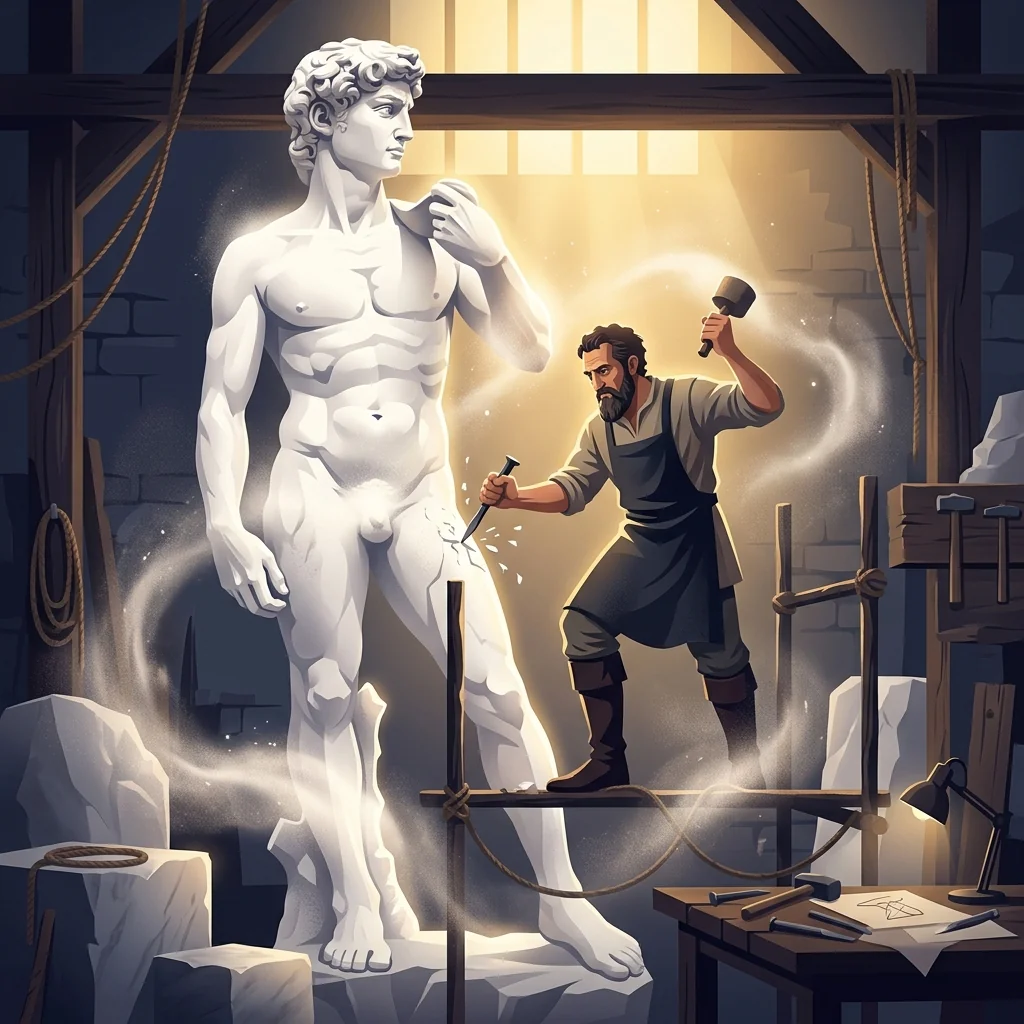
The Pietà, David, and the ceiling of the Sistine Chapel in the Vatican—masterpieces that stand immortal in human artistic history were created by the Renaissance genius sculptor Michelangelo Buonarroti (1475–1564). Behind these monumental works lay an obsessively intense habit of flow. 🏛️
According to contemporary biographer Giorgio Vasari, when Michelangelo immersed himself in a work, he would not take off his riding boots or clothes for weeks at a time, sleeping in brief naps in the corner of his workshop while surviving on a few crusts of bread. In later years, when he finally pulled off his boots, skin came off with them; yet he channeled 100% of his cognitive resources into a single endeavor: liberating the living form trapped within the marble block.
In this article, we examine the cognitive science behind Michelangelo’s minimization of daily rituals and extreme flow habit, offering practical ways for modern professionals to master decision fatigue and direct maximum focus toward their core objectives.
Historical & Academic Evidence
This content is based on Michelangelo Historical Biographies & Autobiographical Records Research & Cognitive Neuroscience Studies.
 BuildSelf
Inspired by historical greats? Make it your daily habit!
BuildSelf
Inspired by historical greats? Make it your daily habit!














1. Minimizing Decision Fatigue and Preserving Cognitive Resources
Modern behavioral science defines the exhaustion of self-regulatory mental energy caused by trivial daily choices as ‘Ego Depletion’ or ‘Decision Fatigue.’ Deciding what to wear or eat each morning fatigues the brain’s executive control center. By isolating himself and minimizing mundane decisions regarding clothing and meals, Michelangelo preserved 100% of his mental energy exclusively for creation, sustaining unprecedented artistic productivity.
2. 3-Step Practical Routine for Modern Professionals
Automate and Standardize Trivial Decisions
Standardize non-essential daily choices like morning attire or meal plans into fixed routines before tackling core work, preserving cognitive capacity (e.g., Steve Jobs' capsule wardrobe).
Block External Sensory Inputs (Deep Focus Zone)
Physically isolate distracting stimuli like phone alerts, open browser tabs, or background noise. Set up your environment so your brain focuses 100% of its computing power on a single task.
Utilize Short, Simple Micro-Rests During Flow
Once in a state of flow, rather than taking long disengaging breaks, lean back in your chair for 10–15 minutes with closed eyes to rest your mind while sustaining momentum.
3. Genius Explodes When Energy Focuses Solely on the Core
Michelangelo pushed himself to the extreme to keep his momentum uninterrupted until his sculpting was complete. In today’s era of information overload, rather than draining your brain on endless choices and content, build cognitive walls to protect your highest priority task.
📌 Frequently Asked Questions (FAQ)
Why did Michelangelo sleep without taking off his clothes or boots? ▼
Because he refused to break his highly sensitive state of flow. By completely eliminating mundane transitions (changing clothes, showering, long sleeps), he poured the continuous current of artistic flow directly into his sculptures without disruption.
What are practical ways to reduce decision fatigue in modern daily life? ▼
Pre-plan minor choices like meals and attire using a set schedule or uniform approach (like Steve Jobs), and eliminate peripheral clutter in your workspace to prevent wasting cognitive energy.