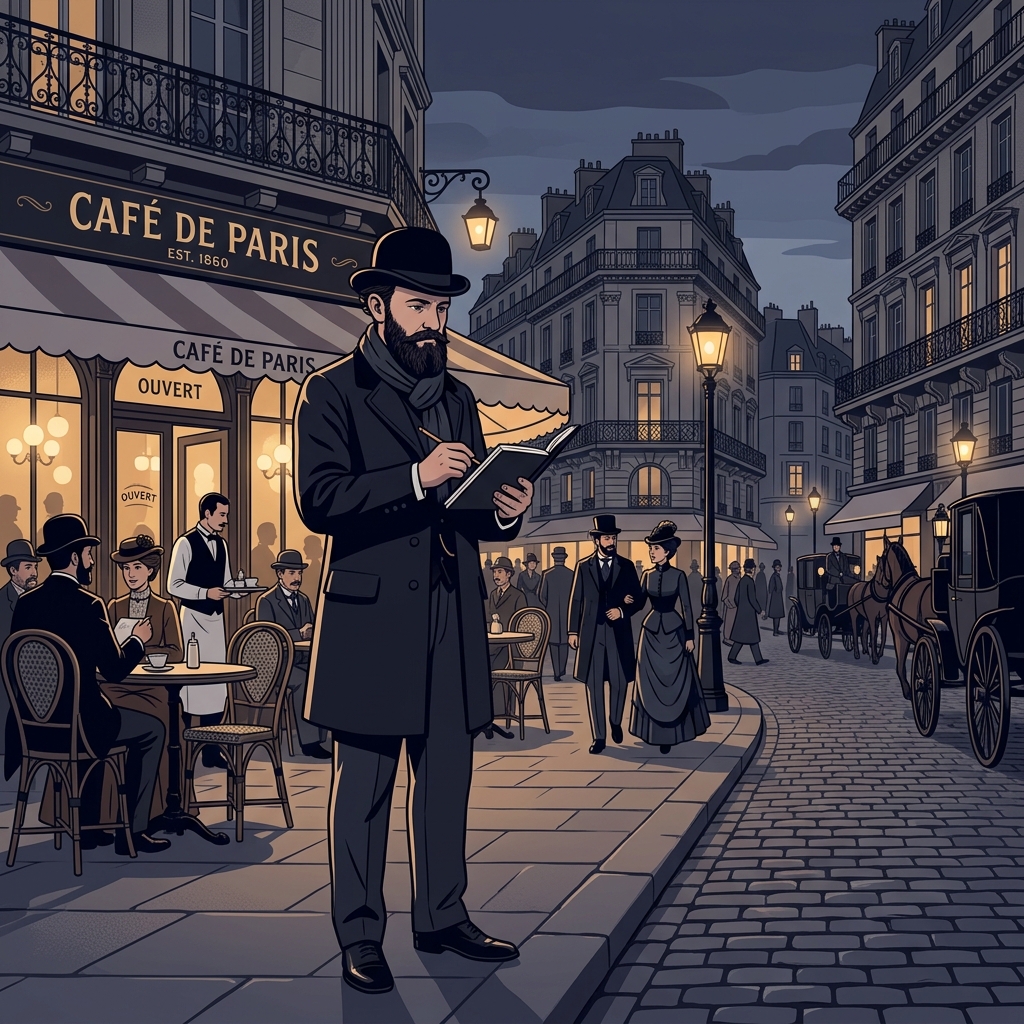
“The field is the ultimate atelier, and the fleeting moments of daily life are an unyielding spring of inspiration.” 🎨
Édouard Manet, a master who opened the doors to modern 19th-century art, shattered traditional academicism, and laid the conceptual bridge for Impressionism. Born into a wealthy judicial family, he rejected the rigid molds of the traditional art world and sought to capture the vibrant ‘truth of modern life’ on canvas, remaining a passionate observer who daily explored the streets of Paris.
Manet sat every day at Café Tortoni or outdoor tables along Parisian boulevards, opening a palm-sized pocket sketchbook. Within seconds, he precisely captured the fleeting expressions of passersby, sunlight reflecting on cheeks, the rustle of garments, and subtle gazes. As recorded in the biography by his lifelong friend Antonin Proust, field sketching was Manet’s inspiration-gathering procedure that breathed innovative realism and vitality onto the canvas while keeping his visual sensory apparatus razor-sharp.
In today’s post, we introduce the neuroscientific principles of Visual Working Memory enhancement and Attentional Control embedded in Édouard Manet’s live sketching observation routine.
Historical & Academic Evidence
This content is based on Musée d'Orsay Manet Sketchbook Archives & Antonin Proust's Biography 'Édouard Manet: Souvenirs' & Cognitive Neuroscience Research on Visual Working Memory and Sensory Integration.
 BuildSelf
Inspired by historical greats? Make it your daily habit!
BuildSelf
Inspired by historical greats? Make it your daily habit!

















1. Inspiration Stock Effects Created by Visual Working Memory and Attentional Control Circuits
Observing real-time environmental changes and immediately recording them strongly stimulates neuroscientific mechanisms of ‘Visual Working Memory’ and the ‘Attentional Control Circuit’.
Intentionally scanning subtle patterns and behavioral characteristics of your surroundings highly activates the occipital lobe’s visual cortex (Visual Cortex) and the prefrontal attentional network. Moving beyond passive visual reception, this process induces high-order pattern recognition (Pattern Recognition) and cognitive offloading of visual information, building an ‘Inspiration Stock’ state in the brain for efficient idea accumulation.
2. 3-Step Practical Routine for Modern Professionals
Set a Location and Target for 5 Minutes of Daily Observation
Choose a daily space such as a café, public transit, or park, and select specific targets (movements, light reflections, postures) to capture.
Collect Visual Traits (Expressions, Movements, Context) via Text or Sketches
Immediately record fleeting observations into a notebook or digital app, focusing on core facial expressions, behavioral patterns, and lighting dynamics.
Review Collected Inspiration Notes and Reorganize into an Idea Index
Revisit your recorded observational notes at the end of the day to build a reservoir of inspiration connected to planning, design, and work ideas.
3. Avoid Passive Viewing and Set Active Observation Targets
The core of Manet’s observation routine is not staring blankly at scenery, but picking concrete targets like ‘facial expressions, light angles, or postures’ to focus on. Bystander-like passive viewing fails to stimulate cognitive circuits, so select a clear subject to observe and record even for just 5 minutes daily.
📌 Frequently Asked Questions (FAQ)
Can someone who cannot draw still apply the 'live sketch' routine? ▼
Yes, absolutely. The essence of Manet's habit lies in 'collecting visual symbols and observational data.' Jotting down text descriptions of behavioral features, clothing details, or light reflections instead of drawing fully activates the visual cortex and delivers the complete inspiration stock effect.
How can busy modern individuals maintain this observation habit effortlessly? ▼
Instead of watching short-form videos on public transit or during lunch, spend 3 to 5 minutes closely observing posture or light angles around you and write a 3-line summary note to train prefrontal attentional circuits.