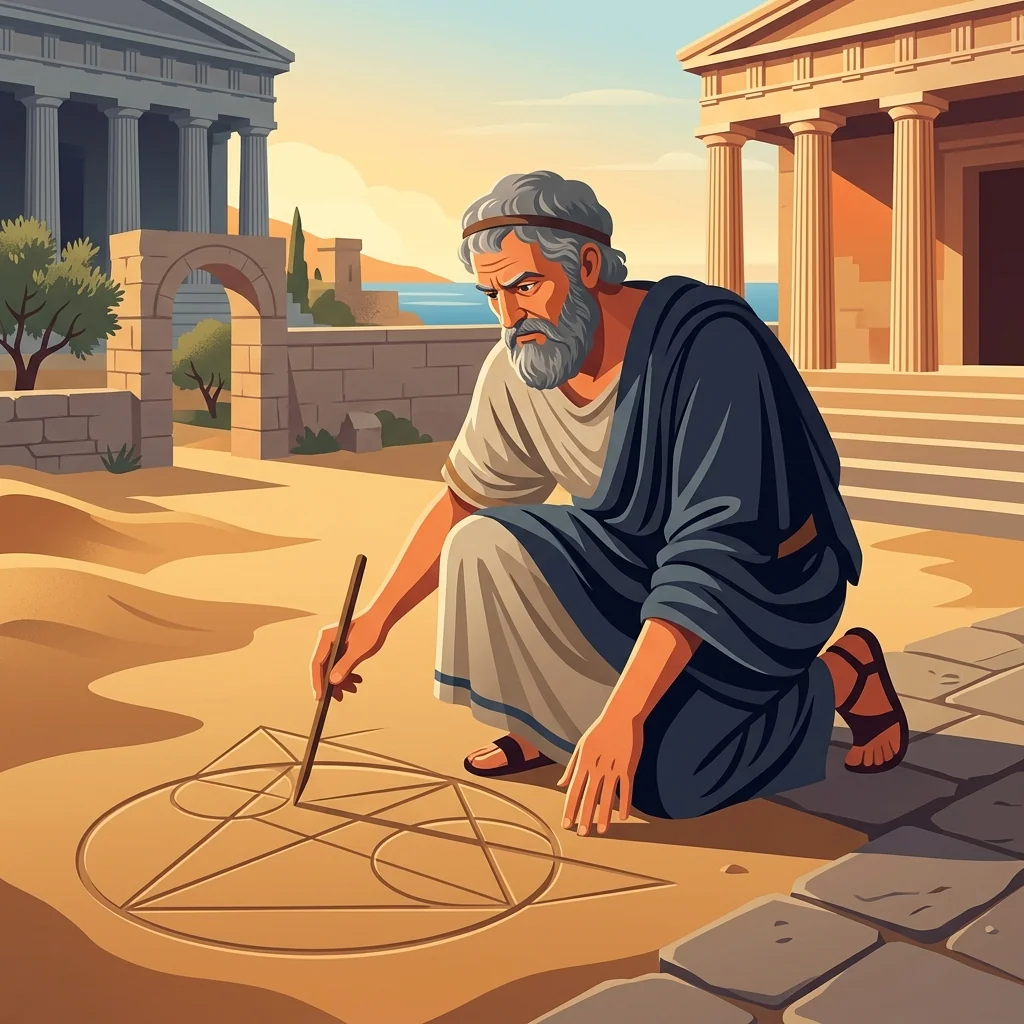
“Do not disturb my circles. Do not trample my flow of thought.” 📐
Archimedes, the mathematician and physicist who illuminated the dawn of ancient science with geometric shapes and formulas. At every moment of world-changing discovery, he was immersed in a specific reflective ritual. He would immediately draw abstract ideas hovering in his head onto a bed of sand using his fingers or sharp twigs. Even after bathing and applying oil to his body, he had such an extreme visualization habit that he drew geometric shapes using his own skin as a canvas. Even at the desperate moment when Syracuse fell and enemy soldiers rushed in, he was so engrossed in solving the geometric dilemma of circles drawn in the sand that he failed to notice the soldier’s blade. We explore the neuroscientific principles of how this seemingly trivial sketching motion relieves brain burden and builds a state of hyper-focus.
Historical & Academic Evidence
This content is based on Historical Verification from Plutarch's *Life of Marcellus* & Cognitive Neuroscience Research.
 BuildSelf
Inspired by historical greats? Make it your daily habit!
BuildSelf
Inspired by historical greats? Make it your daily habit!
















1. Preventing Working Memory Overload and the Dual-Coding Cognitive Effect
Human working memory has strict limits on the amount of information it can process at once. Trying to calculate abstract mathematical formulas or physical laws purely in one’s head causes the brain to tire rapidly and breaks focus. At this moment, the act of sketching lines in one’s surroundings by moving hands induces ‘Distributed Cognition’, transferring cognitive burden to the external environment. Furthermore, through the dual-coding effect where visual images and tactile movements are activated together, it stimulates spatial memory cells and promotes sophisticated processing of information.
2. 3-Step Practical Routine for Modern Professionals
Preparing a Visual Sketch Space
Secure a free visual physical space in front of your eyes—such as a tablet screen, notepad, or scrap paper—where your hands can move freely.
Simplifying Concepts Through Shapes and Symbols
Replace the idea or complex concept you currently want to solve with the most intuitive basic geometric symbols, such as circles, squares, or triangles.
Sketching Relational Networks and Developing Reflection
Connect arrows or lines between shapes to visually expand relationships like cause and effect, categorization, and interactions while reflecting for 5 minutes.
3. Precautions and Tips
When applying the geometry sketching habit, the key point to watch out for is falling into perfectionism aimed at drawing flawless and pretty sketches. Paying excessive attention to line shape or precision causes cognitive resources to be wasted on drawing skill itself. Therefore, geometric sketching should only be used as a guide to organize information and aid brain concentration, with the core being drawing lightly at a messy, unfinished doodle level.
📌 Frequently Asked Questions (FAQ)
Can people who cannot draw at all still utilize this habit? ▼
Yes. Archimedes's sketching habit is not an artistic drawing act, but a cognitive task of placing brain thought structures into external space. Simply drawing circles or placing boxes around text and connecting them with arrows as doodles significantly reduces working memory burden, producing clear effects in enhancing concentration.