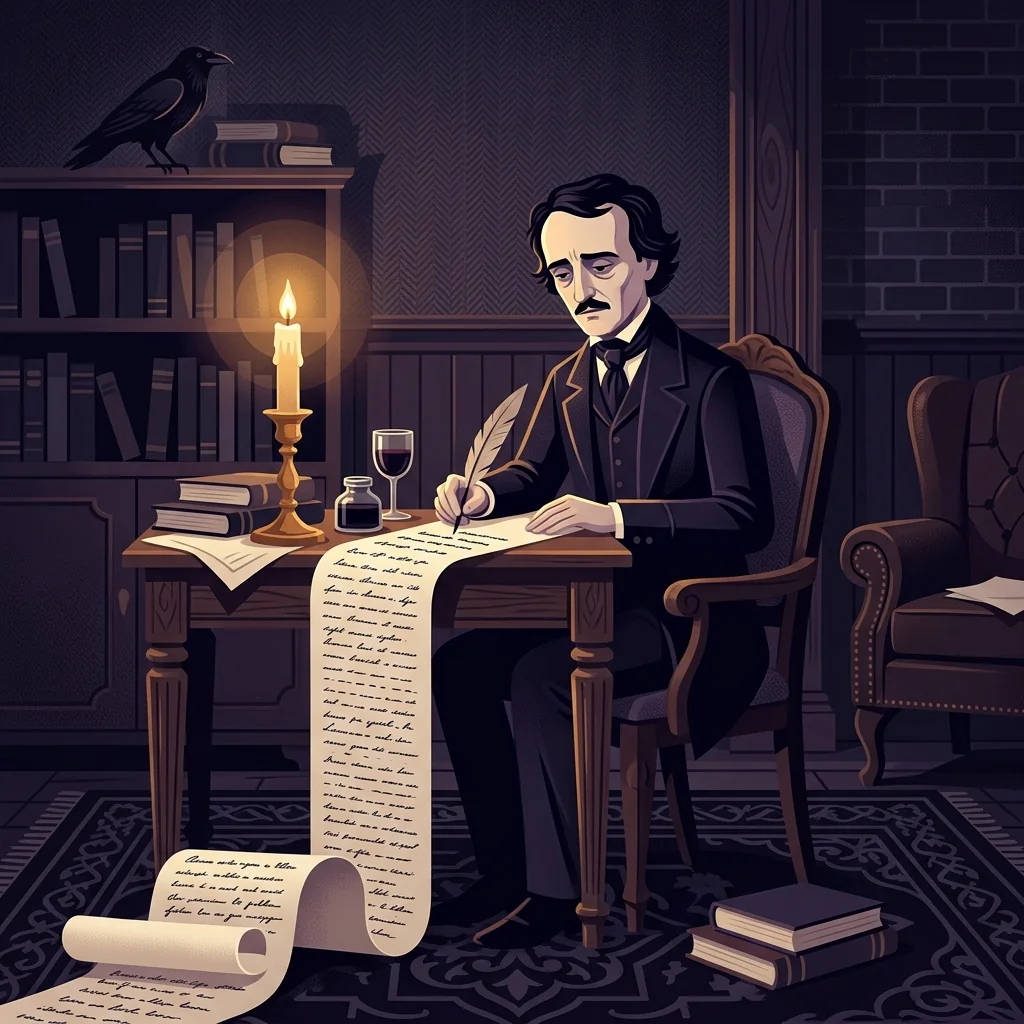
Edgar Allan Poe (1809–1849), hailed as the pioneer of macabre gothic fiction such as ‘The Raven’ and ‘The Black Cat’, as well as the father of the modern detective story. How were his brilliant manuscripts—weaving human psychological anxiety with intricate logical mysteries—crafted in his study? 📜
When writing in his study, Poe rarely used standard rectangular sheets of paper. Instead, he wrote on long, narrow strips of paper ribbon in an extraordinarily fine, neat, almost print-like handwriting. Once a ribbon was filled, he applied paste or wax to the end to attach the next strip. As his work progressed, his manuscript turned into a long ‘scroll’ rolled up tightly. Poe confessed that focusing on this strangely narrow and extended visual space allowed all sensory resources of his brain to converge into a single narrative flow with immense depth.
In today’s post, we examine the visual feedback principles hidden within Poe’s ‘scroll writing’ routine and explore modern focus mode techniques to elevate writing productivity.
Historical & Academic Evidence
This content is based on Historical biography & autobiographical record verification of Edgar Allan Poe & Cognitive Neuroscience research.
 BuildSelf
Inspired by historical greats? Make it your daily habit!
BuildSelf
Inspired by historical greats? Make it your daily habit!















1. Cognitive Tunneling and Suppression of the Self-Monitoring Circuit
Controlling the field of view into an extremely narrow band reduces unnecessary saccadic eye movements, dramatically preventing the frontal lobe from wasting visual attention. Neuroscience calls this state ‘Cognitive Tunneling’, which restricts visual input width to induce deep immersion.
At the same time, the physical scroll structure continuing downward inhibits a destructive habit common among writers: re-reading and editing freshly written sentences. When the brain’s ‘Self-monitoring’ circuit—which seeks to immediately evaluate text—is suppressed, the brain maintains an unhindered stream of free association, enabling highly original and fluent writing.
2. 3-Step Practical Routine for Modern Professionals
Visual Reduction of the Writing Space
Turn off all unnecessary layouts on your screen and narrow the text editor window width as much as possible, fixing your vision like a tunnel to prevent lateral eye drift.
Lock Self-Criticism and Commit to Scrolling Forward
Consciously stop pressing backspace or scrolling up to previous lines while drafting. Type strictly forward, pouring out thoughts without filtration.
Strict Separation of Creation and Editing Cognitive Modes
Turn off draft mode only after completing the entire scroll manuscript. Take a 10-minute break, then switch on critical thinking to edit typos, grammar, and context calmly like reviewing loose sheets.
3. Isolation from Self-Editing
Fixating on sentence-by-sentence editing while drafting causes constant friction between the right brain’s creative circuits and the left brain’s critical circuits, causing cognitive fatigue. Just as Poe wrote on a continuous scroll, turn off critical editing circuits during drafting to dedicate brain energy solely to output, reserving revision for later.
📌 Frequently Asked Questions (FAQ)
Do Edgar Allan Poe's scroll manuscripts still exist today? ▼
Yes, some of his surviving manuscripts (such as essays and critical pieces) are preserved in narrow scroll form pasted together with glue at institutions like the Free Library of Philadelphia.
Are there software programs that block the habit of editing while typing on digital screens? ▼
Yes, drafting-focused apps that disable backspacing or erase text if you pause typing (such as The Most Dangerous Writing App) as well as typewriter-mode editors are highly effective.