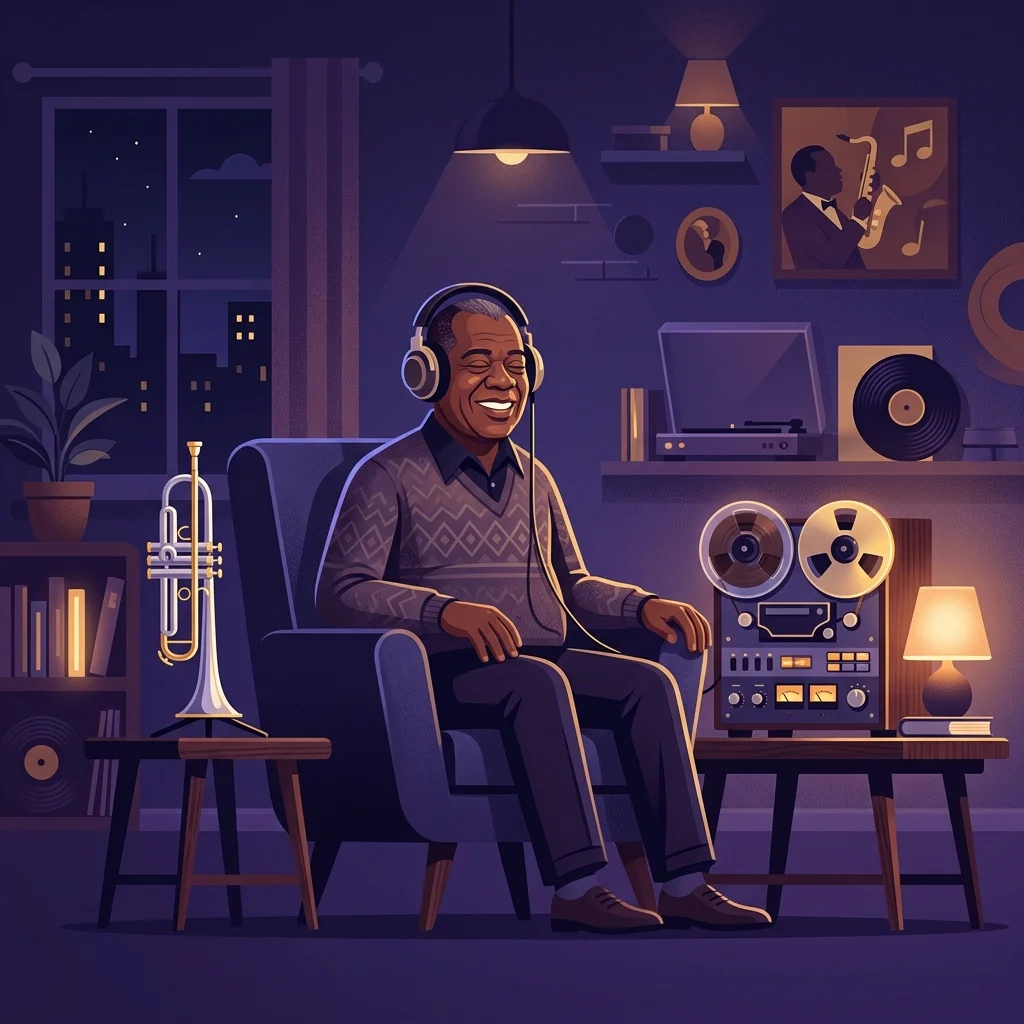
“If you really want to know how you sound, you have to listen to yourself and stop lying to your own ears.” 🎺
Louis Armstrong, the legendary giant who reshaped 20th-century popular music and jazz with his gravelly voice and groundbreaking trumpet virtuosity. Was his legendary capacity for spontaneous improvisation—transforming emotion into flawless rhythm and melody without sheet music—purely the product of innate genius? 🎙️
Every single night, whether traveling on tour buses or returning to his hotel room after grueling concerts, Armstrong set up a portable reel-to-reel tape recorder. He captured his daily trumpet sessions, live rehearsals, and even casual conversations with bandmates on magnetic tape. Each night, he put on headphones to listen back again and again, meticulously reflecting on subtle shifts in tone, tempo fluctuations, and vocal phrasing while crafting handmade collages on the tape boxes. This nightly ‘audio feedback journal’ was his ultimate tool for maintaining supreme artistic metacognition.
In today’s post, we explore the cognitive neuroscientific principles of the auditory-motor feedback loop and metacognitive recalibration embedded in Louis Armstrong’s lifelong reel-to-reel audio feedback journal routine.
Historical & Academic Evidence
This content is based on Historical Records from Louis Armstrong House Museum Archives (over 650 Official Reel Tapes, Queens, NY) & Biography Louis Armstrong: An Extravagant Life by Rick Bowe with Cognitive Neuroscience Research.
 BuildSelf
Inspired by historical greats? Make it your daily habit!
BuildSelf
Inspired by historical greats? Make it your daily habit!

















1. Neuroscience of the Auditory-Motor Feedback Loop and Metacognitive Recalibration
Re-listening to one’s own voice or musical performance as objective acoustic data stimulates the brain’s superior temporal gyrus and auditory cortex, generating a prediction error signal between intended sound and actual output.
This precise feedback process fine-tunes motor memory in the motor cortex while activating the prefrontal metacognitive network. It eliminates subjective bias and self-deception, maximizing self-objectification and performance accuracy under high-pressure conditions.
2. 3-Step Practical Routine for Modern Professionals
Step 1: Recording Daily Speech, Practice, or Performance
Use a smartphone or portable recorder to capture your voice during presentations, foreign language practice, work calls, or musical rehearsals.
Step 2: Nightly Focused Re-Listening & Error Detection
Listen back to your recordings in a quiet evening environment, objectively identifying errors in tone, tempo, filler words, or articulation.
Step 3: Jotting Down Feedback Memos & Calibrating Tomorrow's Routine
Summarize key observations in 1–2 lines of feedback notes and immediately apply these adjustments to tomorrow's speech or practice patterns.
3. Guide to Applying Audio Feedback Journaling to Daily Life and Self-Improvement
Avoid evaluating your performance based solely on subjective memory or mood. Establish an objective system using voice recorders to listen directly to your speech, practice, and presentations to enable continuous refinement.
📌 Frequently Asked Questions (FAQ)
Why does listening to my own recorded voice feel awkward, and how can I overcome it? ▼
The awkwardness occurs because your brain usually hears your voice through bone conduction rather than air conduction. This is a natural physiological reaction; after a few days of consistent listening, your brain categorizes the audio as objective data, turning it into a powerful metacognitive feedback tool.
Can non-musicians, such as corporate workers or students, benefit from audio feedback journaling? ▼
Absolutely. Utilizing audio feedback for presentation rehearsal, job interviews, foreign language speaking, or daily self-reflection dramatically sharpens communication clarity, vocal presence, and self-awareness.