“Unsanitary environments and emotional nursing lacking empirical data drive patients to death.” 🕯️
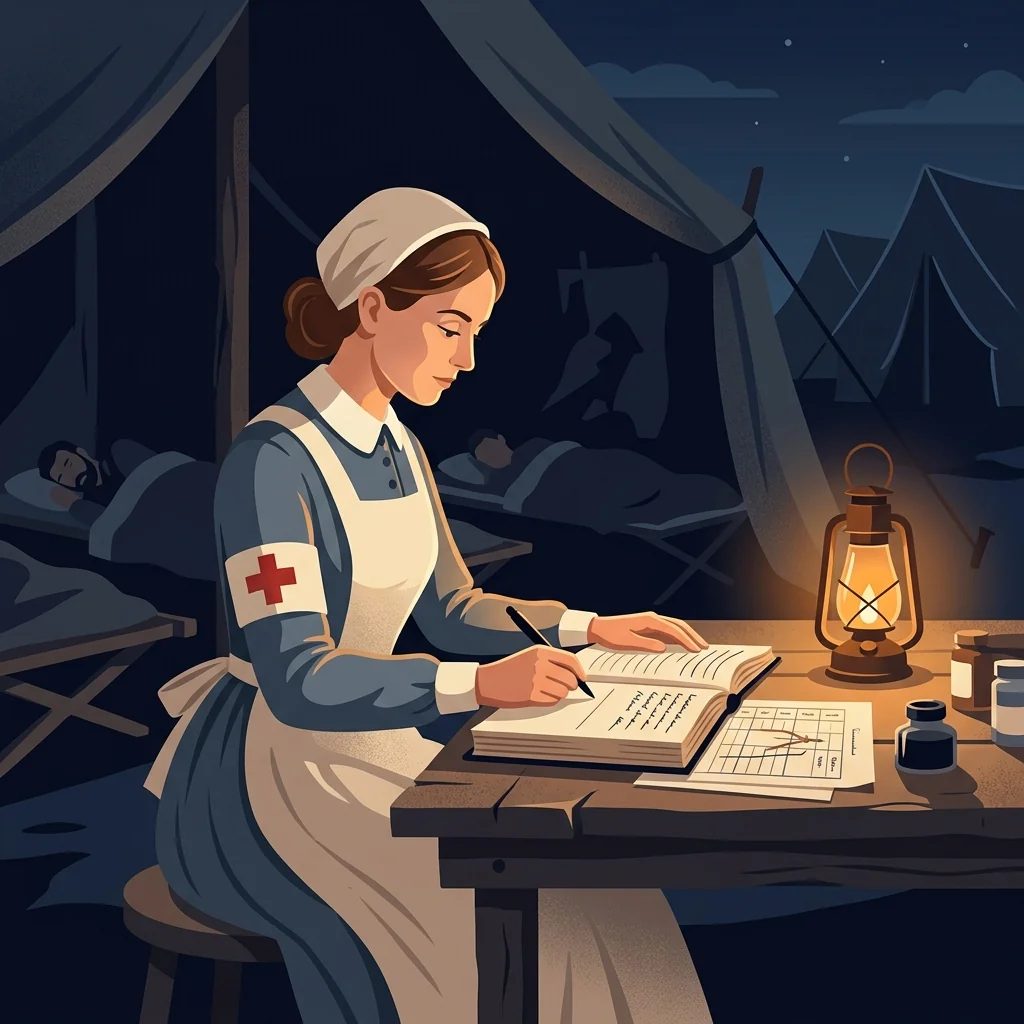
Florence Nightingale (1820–1910) was the founder of modern nursing, a healthcare administrator, and a pioneering British statistician who saved thousands of wounded soldiers during the Crimean War. Carrying a single lamp through four miles of dark, harrowing hospital corridors every night, she earned the moniker ‘The Lady with the Lamp’.
Yet beyond offering comfort, Nightingale meticulously recorded quantitative metrics—patient temperatures, dampness of bedding, and ventilation airflow—on her notepad. Her innovative ‘Rose Diagram’ (coxcomb chart) and empirical datasets slashed field hospital mortality rates dramatically from 42% down to 2%. Her systematic assessment routine established a new paradigm in medical statistics.
In today’s post, we explore the cognitive neuroscience behind her nightly observational rounds and present a 3-step practical framework to sharpen environmental awareness and executive precision in daily life.
Historical & Academic Evidence
This content is based on Historical Biographies and Autobiographical Records of Florence Nightingale & Cognitive Neuroscience Research.
 BuildSelf
Inspired by historical greats? Make it your daily habit!
BuildSelf
Inspired by historical greats? Make it your daily habit!

















1. Neuroscientific Analysis of Environmental Precision
Closely observing subtle environmental risks and converting qualitative phenomena into quantitative metrics stimulates Mirror Neurons and the prefrontal cognitive filtering network. Digitizing qualitative observations activates the dorsolateral prefrontal cortex, heightening metacognitive resolution to catch minor business risks and systemic flaws proactively.
2. 3-Step Practical Routine for Modern Professionals
Step 1: Environment Diagnostics & Setup
Upon waking or arriving at your desk, spend 1 minute assessing ambient temperature, ventilation, lighting, and unnecessary clutter. Visually scan key environmental metrics.
Step 2: Sensory Target & Immediate Action
Select the single biggest visual distraction (e.g., stray receipts, dust on the monitor) identified during diagnostics and eliminate or organize it within 30 seconds.
Step 3: Objective Logging & Metacognitive Log
Convert your environmental state into a 3-tier rating (Good/Fair/Needs Work) and jot it in your planner corner, training your brain's sense of environmental control.
3. Behavioral Science Advice for Successful Habit Adoption
Obsessively trying to deep-clean your whole room consumes immense willpower and derails your daily routine. Focus on lightweight micro-environment adjustments and a 3-minute quick scan.
📌 Frequently Asked Questions (FAQ)
Does logging micro-environmental assessments affect self-efficacy? ▼
Yes. When the brain controls micro-environmental variables (lighting, cleanliness) and transcribes the results visually, it releases dopamine in the prefrontal cortex, enhancing self-efficacy and soothing anxiety.
Does this principle apply to digital environment cleanup like emails or chat apps? ▼
Yes. Cleaning up 3 temporary desktop files or writing down your target remaining unread emails (e.g., 'Target: 5 left') in your physical notepad exerts the exact same cortical control benefits.