“The squeak of a door is the surest alarm that protects my immersion.” 🚪
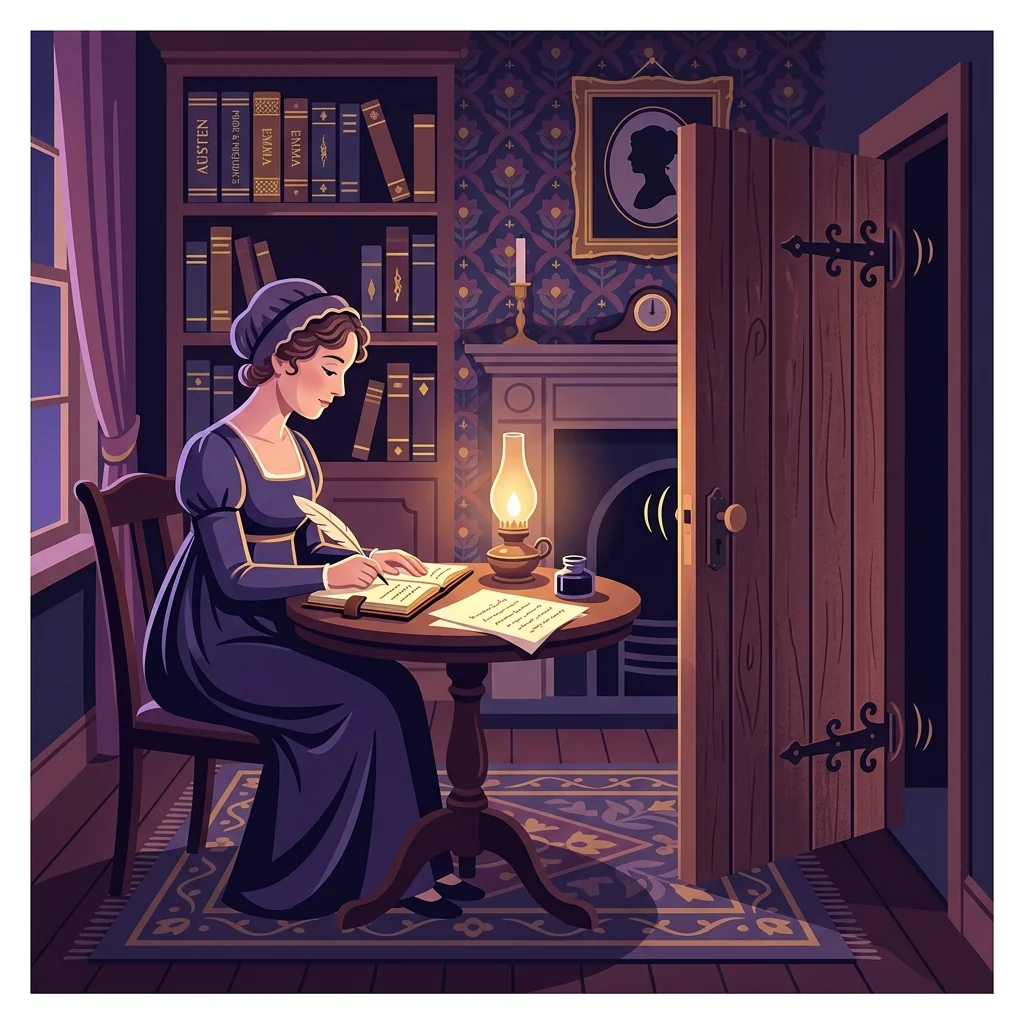
There was someone who turned the sound of a creaky sitting room door into a secret protective shield for creative work: Jane Austen, the novelist who adorned a grand page of English literature with masterpieces such as ‘Pride and Prejudice’ and ‘Sense and Sensibility’.
Nineteenth-century British society, where Austen lived, was by no means welcoming to women engaging in professional creative endeavors. She could not possess her own quiet, cozy dedicated study, and always had to write at a small wooden table placed in a corner of a shared sitting room where family members and visitors came and went constantly. The relentless demands of household chores and the unannounced chatter of guests were threats that could shatter her precious inspiration and creative flow at any moment.
Remarkably, when the hinges of the sitting room door began to creak loudly, Austen steadfastly refused her family’s offer to repair them. The creaking noise produced when the door opened served as a wonderful natural alarm system warning her of incoming visitors in advance. Upon hearing this sound, Austen could quickly cover her manuscript and hide it under her sewing box to avoid others’ eyes, calmly wrapping up her attention.
In today’s post, we examine the cognitive science principles of the ‘creaky door’ focus firewall utilized by Jane Austen and explore how modern individuals can apply it to defend concentration in complex work environments.
Historical & Academic Evidence
This content is based on James Edward Austen-Leigh, *A Memoir of Jane Austen* (1869) & *Neuropsychologia*.
 BuildSelf
Inspired by historical greats? Make it your daily habit!
BuildSelf
Inspired by historical greats? Make it your daily habit!

















1. Task-Switching Friction Defense Provided by the Creaky Door Sound
Sudden, unannounced external intrusions cause ‘Task-Switching Friction’ in the brain and maximize the loss from ‘Attention Residue’, where focus remains tied to the prior task.
The creaky door sound utilized by Jane Austen functioned as an Early Warning Signal, buying cognitive prep time for the brain. It served as a perfect firewall that enabled the prefrontal cortex to stably manage cognitive resources in advance and minimize concentration loss, preventing sudden startle or stress(cortisol secretion).
2. 3-Step Practical Routine for Modern Professionals
Step 1: Constructing a Sensory Early Warning Signal
Set up physical or digital sensory signals in advance (such as a door chime or dedicated Slack/messenger notification sounds) to immediately perceive when someone approaches or enters your focus zone.
Step 2: Securing 3 Seconds of Buffer Time to Wrap Up Manuscripts and Thoughts
Secure 3 to 5 seconds of cognitive buffer time to naturally wrap up and organize your current work, preventing panic or cognitive overload when sudden interruptions occur.
Step 3: Building a Digital Firewall and Writing Return Memos
Maintain a complete Do Not Disturb state until the early warning sounds, and leave a brief memo of your current work point so you can return immediately to your original flow even if work is interrupted.
3. Focus Retention Guide for Handling External Intrusive Noise
Rather than relying solely on willpower, design environmental constraints to create a state where the brain has no choice but to stay focused. Constructing a sensory early warning signal, like the sound of a creaky door hinge, is key.
📌 Frequently Asked Questions (FAQ)
Why did Jane Austen write in a sitting room with a creaky door instead of a private study? ▼
In 19th-century Britain, female writers were very rarely provided with independent studies. Austen also had to write in the shared space of a sitting room, so she utilized the creaky door to perceive family members' sudden visits and buy time to hide her manuscripts.
How can this method be applied in a modern digital environment? ▼
By setting messenger statuses to 'Do Not Disturb' or 'In a Call' to block direct influxes of external notifications, and adjusting key communication tools to notify only at designated time intervals, you can control unexpected cognitive interruptions.