“A leader’s primary duty is making sound decisions, which requires stepping away from noise into absolute mental calm.” 🃏
General Charles de Gaulle (1890–1970) was the towering French statesman who led Free France during World War II and served as President of the French Republic. Bearing the immense weight of post-war reconstruction, Cold War diplomacy, and constant military crises, his daily life was an unbroken marathon of high-stakes executive choices.
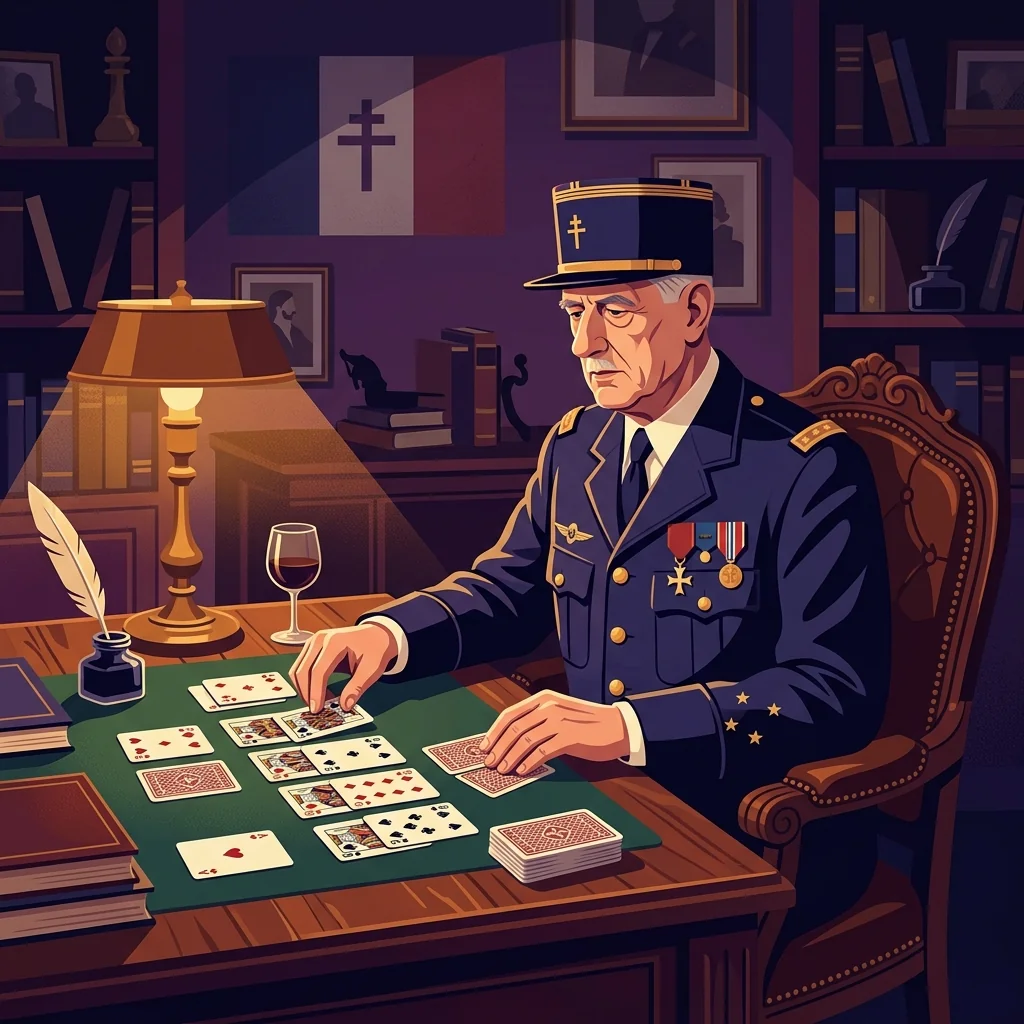
To survive this relentless pressure without suffering burnout, de Gaulle relied on a nightly sanctuary: playing solitary card games, known as ‘Solitaire’ or ‘Patience’. Late at night following exhausting cabinet sessions, he retired to his study, laid out worn paper playing cards beneath soft candlelight, and sorted them strictly by suit and sequence. Staff members observed that de Gaulle remained completely silent during these sessions, fixated entirely on the tactile arrangement of cards. This ritual offered a neurophysiological break, turning off prefrontal decision-making filters and restoring his analytical sharpness.
In today’s post, we analyze the brain science underlying Charles de Gaulle’s ‘solitaire card matching’ routine and present a 3-step practical action plan for modern professionals to recover from decision fatigue through non-verbal analog matching.
Historical & Academic Evidence
This content is based on Historical Verification from Charles de Gaulle's Memoirs *War Memoirs (Mémoires de guerre)* & Cognitive Neuroscience Research.
 BuildSelf
Inspired by historical greats? Make it your daily habit!
BuildSelf
Inspired by historical greats? Make it your daily habit!

















1. Mitigating Decision Fatigue & Calming Amygdala Overload via Non-Verbal Pattern Matching
Prolonged high-stakes decision-making depletes glucose in the prefrontal cortex (PFC), inducing severe ‘Decision Fatigue’. This state triggers cortisol spikes and keeps the amygdala in a hyper-reactive stress response. Engaging in structured, non-threat solitary pattern matching—such as solitaire card sorting—instantly shifts brain processing from ‘Active Executive Judgment Mode’ to ‘Passive Visual Pattern Matching Mode’. Cognitive neuroscience demonstrates that this non-verbal spatial focus temporarily silences prefrontal decision-making filters, allowing working memory networks to replenish energy while restoring functional connectivity between the prefrontal cortex and amygdala to build emotional resilience.
2. 3-Step Practical Routine for Modern Professionals
Step 1: Preparing Analog Tools & Blocking Digital Environments
Set up a physical deck of playing cards (or a jigsaw puzzle/wooden tile set) instead of a digital screen. Store smartphones and laptops completely out of sight.
Step 2: 10 Minutes of Structured Analog Pattern Matching
Set a silent 10-minute timer. Lay out cards into 7 columns on a table and calmly sort them by alternating colors (red/black) and descending numbers according to standard solitaire rules.
Step 3: Immersing Awareness in Tactile Feedback & Non-Verbal Flow
Disconnect completely from verbal thoughts or daily work stresses. Focus 100% of your awareness on the tactile texture of cards, the gentle thud of placement, and visual pattern matching to rest prefrontal networks.
3. Caution & Tips: Blocking Digital Overload & Embracing Tactile Analog Matching
Attempting to relax by scrolling social media short-form videos or playing mobile games keeps prefrontal cognitive filters activated, prolonging decision fatigue through constant information evaluation and blue-light exposure. To achieve true prefrontal disengagement like de Gaulle, disconnect from digital notifications for 10 minutes and engage in tactile, non-verbal analog matching—such as physical playing cards, jigsaw puzzles, or coloring. Tactile sensory feedback combined with non-verbal spatial rules shuts down executive filters.
📌 Frequently Asked Questions (FAQ)
Does playing solitaire on a smartphone app offer the same decision fatigue relief? ▼
No. Smartphone apps emit blue light, display popup ads, and deliver push notifications that continuously recruit prefrontal attention networks. Using physical, tactile analog tools (like paper playing cards) allows the somatosensory cortex to engage while disengaging prefrontal executive filters for superior cognitive recovery.
Does failing to complete or win a game of solitaire cause additional stress? ▼
The objective is not competitive victory, but deactivating prefrontal executive filters through structured pattern matching. Even if a layout gets stuck, the physical act of moving cards according to visual rules accomplishes cognitive reset. Disregard winning or losing; simply reshuffle the deck and begin anew.