“When I lost my sight, I only then began to explore the inner world and the true labyrinths.” 📚
Jorge Luis Borges (1899–1986) was an Argentine literary giant who possessed one of the most original minds in 20th-century literature. Having pioneered postmodernism and speculative fiction through masterpieces such as ‘Ficciones’ and ‘The Aleph’, tragedy struck him early in life. Due to hereditary glaucoma, his vision progressively deteriorated from his thirties, leaving him completely blind by 1955—the very year he was appointed Director of the National Library of Argentina. Surrounded by hundreds of thousands of books he could no longer read, he faced an agonizing irony.
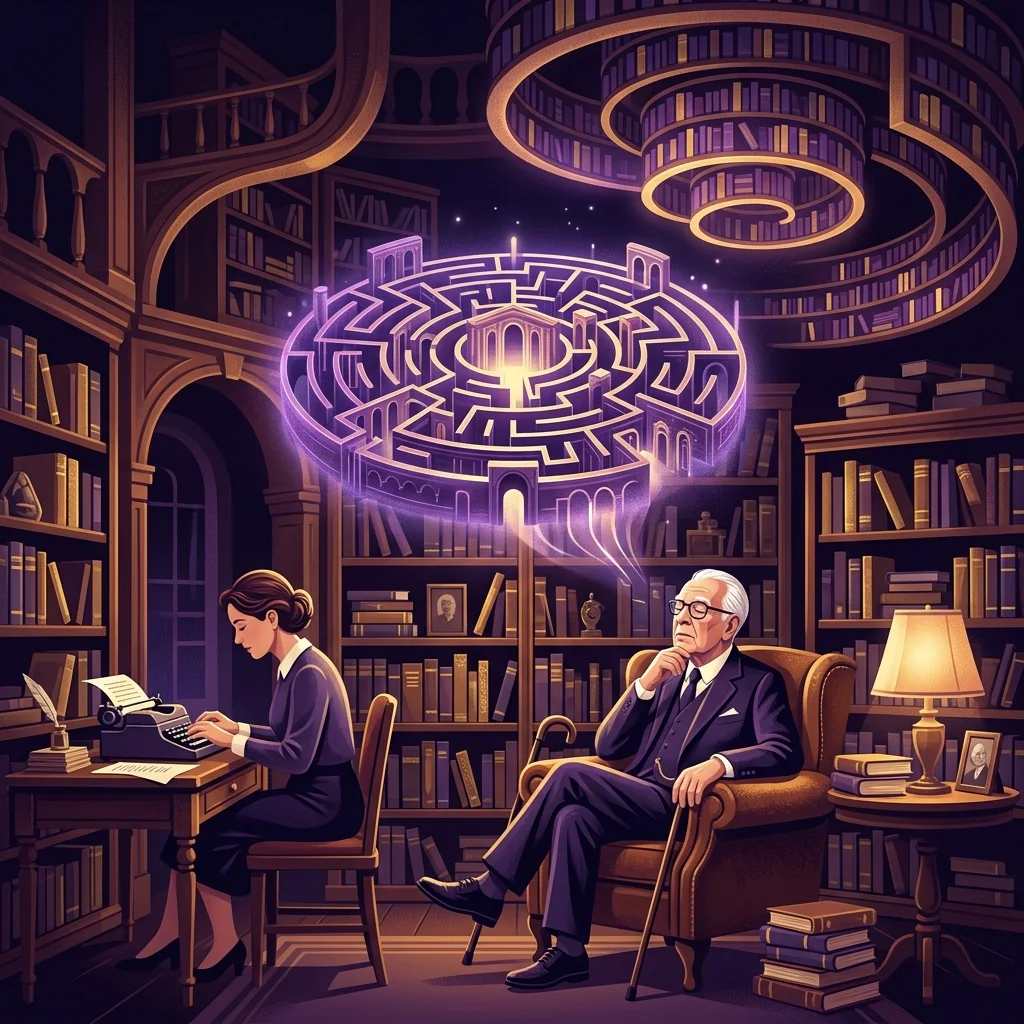
Yet Borges refused to succumb to despair or abandon creation. Instead of writing on paper, he honed a ‘Mental Dictation’ routine, transforming his inner mind into a massive 3D architecture. He systematically arranged sentences, logical flows, and literary structures onto an imaginary mental chalkboard and spatial labyrinth. After completing all edits and structural adjustments purely in his head, he dictated the polished prose aloud to his mother, Leonor Acevedo, or to assistants. This extraordinary practice stretched his visuospatial working memory to its absolute limits, becoming a celebrated example of neuroplasticity in cognitive neuroscience.
In today’s post, we analyze the brain science underlying Jorge Luis Borges’s ‘mental dictation and 3D spatial visualization’ routine and present a 3-step practical guide for modern knowledge workers to boost working memory capacity and mental focus.
Historical & Academic Evidence
This content is based on Historical Verification from Edwin Williamson's Biography *Borges: A Life* & Cognitive Neuroscience Research.
 BuildSelf
Inspired by historical greats? Make it your daily habit!
BuildSelf
Inspired by historical greats? Make it your daily habit!

















1. Cross-Modal Plasticity and Visuospatial Working Memory Expansion Principles
When external visual input is restricted, the brain recruits the visual cortex to process auditory, tactile, and spatial information—a phenomenon known as ‘Cross-Modal Plasticity’. When the blind Borges mentally assembled intricate labyrinths and text structures, his visual cortex operated as an association area dedicated to high-level logical design and spatial layout. Mentally visualizing 3D abstract concept maps with closed eyes dramatically expands the visuospatial working memory capacity between the hippocampus and prefrontal cortex, unlocking advanced intuition to assemble complex, fragmented data into coherent frameworks.
2. 3-Step Practical Routine for Modern Professionals
Step 1: 2 Minutes of Eyes-Closed Visual Deprivation & Calm Breathing
Faced with a complex project or unsolved dilemma, intentionally close your eyes for 2 minutes to block light input, regulating your breath to clear away mental clutter.
Step 2: Visualizing 3D Spatial Topography & Organic Concept Connections
Convert each core component into 3D blocks or geometric shapes inside your mind's eye, mapping out a 3D structural network that shows how they dynamically interconnect.
Step 3: Opening Eyes & Immediately Transcribing the Completed Mental Prose
Once the 3D mental architecture is stabilized, open your eyes immediately and type out the complete, fully formed structure onto screen or paper as if transcribing dictation.
3. Caution & Tips: Focusing on Organic Interstructures Rather Than Text Symbols
The core of the Borgesian visualization routine is not reproducing text fonts or letter spellings behind your eyelids. It is drawing a ‘3D structural framework’ (mind maps, spatial organograms, or 3D labyrinth models) showing how key concepts connect and interact. Focus on abstract causal relationships and organic structures rather than literal letter shapes to maximize neuroplastic benefits for visuospatial working memory.
📌 Frequently Asked Questions (FAQ)
When I try mental visualization, images keep fragmenting or blurring. Any tips? ▼
This is a completely natural neurological response. Rather than attempting vivid, detailed pictures right away, start with a highly simplified abstract model—drawing 2 or 3 basic boxes or circles connected by lines. As training progresses, the brain's visuospatial resolution increases.
Does the habit of eyes-closed 3D visualization actually improve real-world skills like planning or coding? ▼
Yes, immensely. Expert system architects and strategic planners model organic data flows and component dependencies in mental space before writing code or drafting documents. Mental visualization training dramatically enhances prefrontal working memory, allowing you to sustain and assemble complex logical frameworks effortlessly.