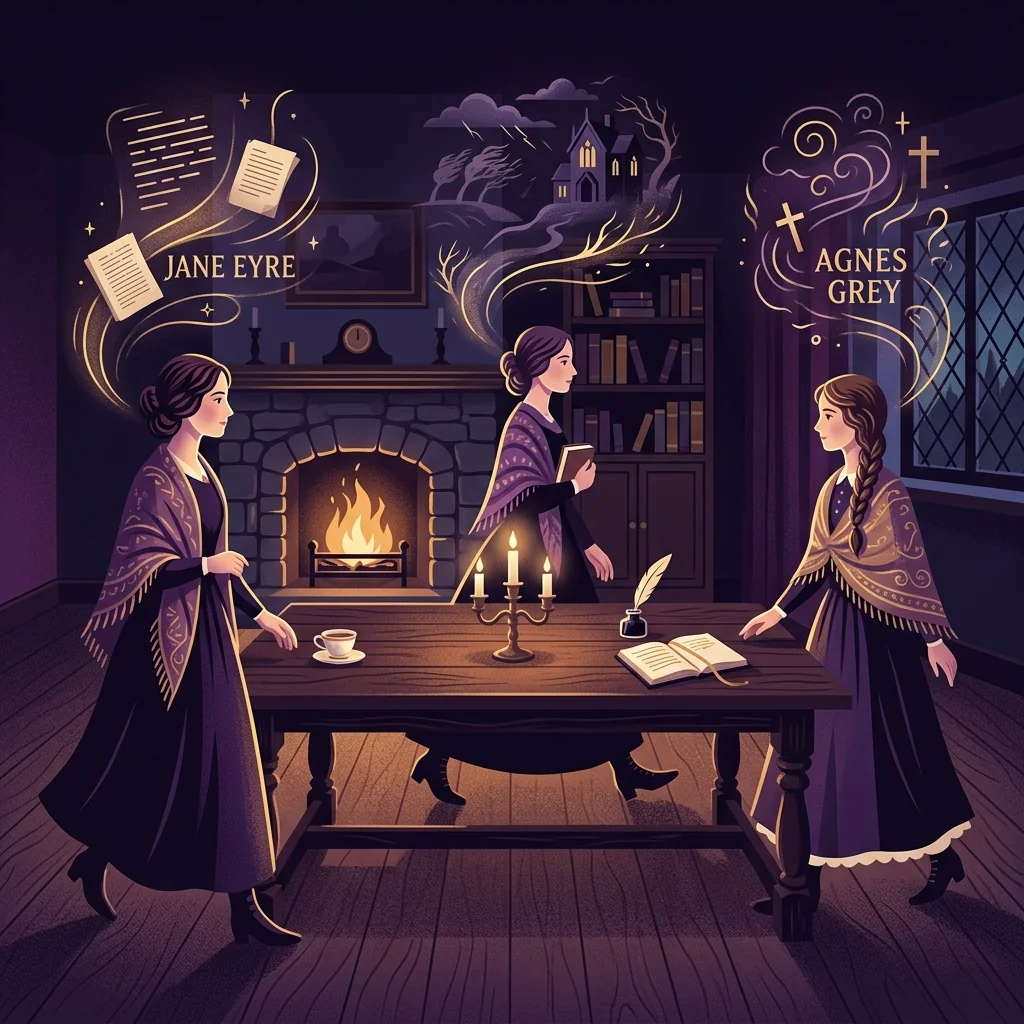
“We paced around the table in the dark every night, talking. In that walking rhythm, the souls of our novels finally came to life.” 🕯️
Charlotte Brontë (1816–1855) was a literary titan of 19th-century English literature who boldly explored female agency and passion, leaving an immortal mark on world literature. Living in the bleak, isolated parsonage of Haworth, Yorkshire, alongside her sisters Emily and Anne, she endured severe isolation, poverty, and tragic family losses. How did this isolated trio simultaneously produce classics like ‘Jane Eyre’, ‘Wuthering Heights’, and ‘Agnes Grey’?
Far stronger than their environmental constraints was their nightly ‘Table Walking Discussion’ routine. After writing individually in isolation during the day, at 9 PM the sisters gathered to pace continuously around the large dining table in the dark or dim light. As they walked, they read aloud their daily drafts, character arcs, and dialogue, unleashing sharp, unvarnished critiques and fresh ideas upon one another. This nocturnal walking collaboration served as a magical conduit, shattering the narrow ‘Tunnel Vision’ inherent in solitary creation and elevating their works with structural coherence.
In today’s post, we analyze the brain science underlying Charlotte Brontë’s ‘table walking discussion’ routine and present a 3-step practical action plan for modern individuals to break through ideational deadlocks and harness collective intelligence.
Historical & Academic Evidence
This content is based on Historical Verification from Elizabeth Gaskell's Biography *The Life of Charlotte Brontë* & Cognitive Neuroscience Research.
 BuildSelf
Inspired by historical greats? Make it your daily habit!
BuildSelf
Inspired by historical greats? Make it your daily habit!

















1. Boosting Cerebral Blood Flow via Walking and Overcoming Tunnel Vision with Mirror Neurons
Physical walking increases cerebral blood flow and oxygenation while triggering Brain-Derived Neurotrophic Factor (BDNF) release, boosting creative divergent thinking by over 60% compared to sitting. Furthermore, reading aloud and engaging in structured dialogue activates the brain’s ‘Mirror Neuron’ system and Theory of Mind networks. This counters the ‘Tunnel Vision’ inherent in solitary thinking, allowing creators to view their work through an objective third-person lens, effortlessly exposing logical flaws, plot holes, and structural gaps.
2. 3-Step Practical Routine for Modern Professionals
Step 1: Rising from Your Chair & Initiating Walking Upon Ideational Deadlocks
When hitting a wall during project planning or encountering logical contradictions, immediately leave your desk and begin walking around a room, corridor, or table at a steady pace.
Step 2: Conducting Verbal Discussion While Walking Alongside a Trusted Partner
Walk side-by-side with a trusted colleague or partner, explaining your project logic or narrative structure out loud, and explicitly requesting sharp, unvarnished feedback.
Step 3: Gathering Receptive Critiques & Immediately Applying Structural Revisions
Collect feedback regarding logical gaps without defensiveness, and immediately return to your desk upon finishing the walk to re-architect your plan or plot based on the insights gathered.
3. Caution & Tips: Receptive Listening to Critiques and Blocking Emotional Defensiveness
The core of the walking discussion routine lies in exchanging cold, objective critique rather than polite praise. If you perceive critique as a personal attack, your brain triggers amygdalar defensive mechanisms, shutting down creative receptivity. You must strictly separate ‘your self-worth’ from ‘your idea’, treating feedback as neutral data that identifies structural gaps to unlock the full power of this corrective process.
📌 Frequently Asked Questions (FAQ)
Does the walking creativity effect still occur in a solo workspace without a partner? ▼
Yes, physical walking alone boosts BDNF secretion and cerebral blood flow, increasing creativity by over 60%. When working alone, explain your ideas aloud to yourself in a mirror or walk while engaging in a Q&A with an imaginary critic to effectively simulate mirror neuron and metacognitive stimulation.
Doesn't listening to sharp critique cause emotional hurt and dampen creative motivation? ▼
If the brain misinterprets feedback as a personal attack, the amygdala triggers emotional defensiveness. To prevent this, strictly disconnect your personal identity from your output. Remind yourself that feedback is neutral data designed to strengthen the work's structural integrity, allowing receptive prefrontal circuits to function smoothly.