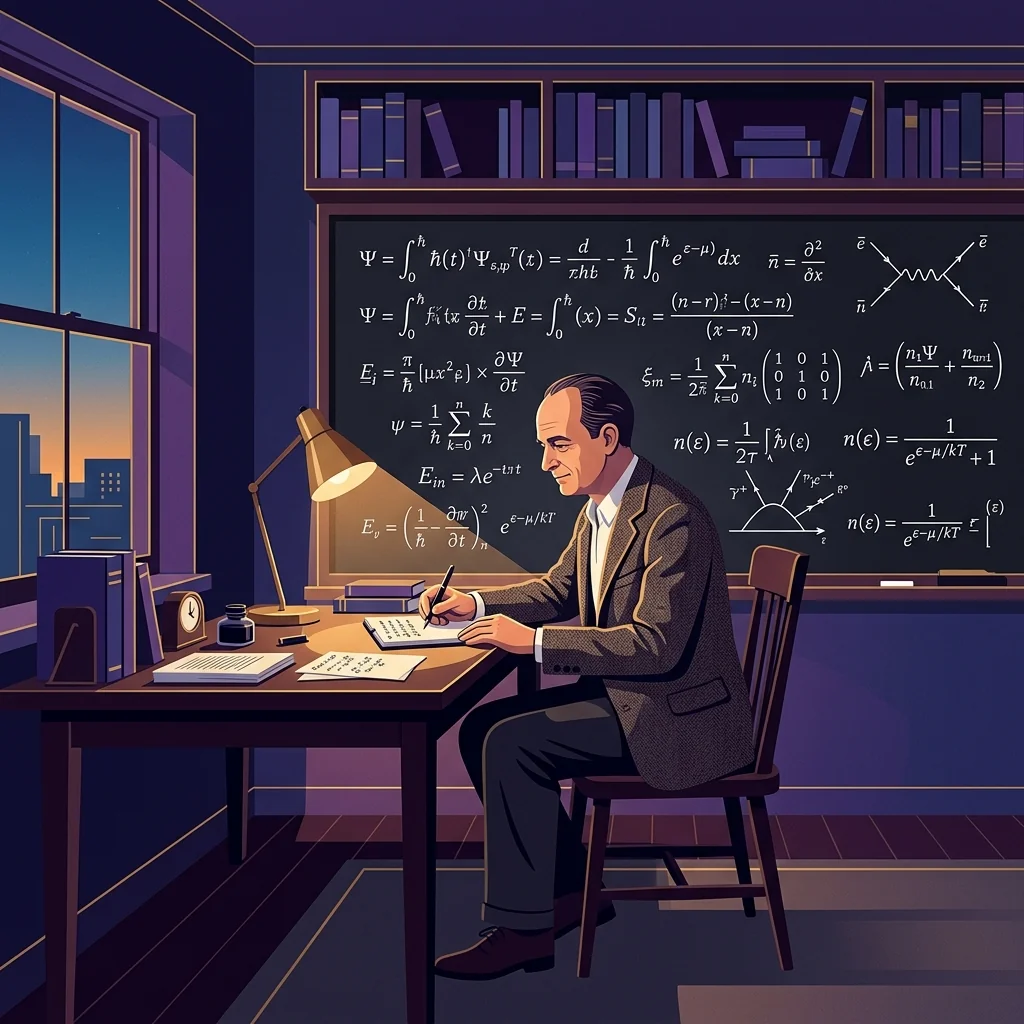
“The complexity of a problem dissolves entirely in the stillness of the morning. The hours before anyone wakes are when my brain operates with crystal clarity.” 🧮
Enrico Fermi (1901–1954) was the Italian-American physics titan awarded the 1938 Nobel Prize in Physics, creator of Chicago Pile-1 (the world’s first artificial nuclear reactor in 1942), and a key leader of the Manhattan Project. Fermi stands as the last legendary physicist who achieved supreme excellence in both theoretical deduction and experimental physics. Celebrated for his uncanny ability to instantly solve complex quantitative problems using simplified order-of-magnitude estimations (now famously known as ‘Fermi Estimates’), what was the secret behind his razor-sharp mental acuity?
As recorded by his wife Laura Fermi in her memoir Atoms in the Family, Fermi maintained an uncompromising morning ritual throughout his entire career. Waking up at 5:30 AM every day, he locked himself in his study for two uninterrupted hours before breakfast or heading to the laboratory. During this quiet dawn window, he derived intricate mathematical formulas, analyzed papers, and solved complex theoretical dilemmas. In today’s post, we dissect the cognitive neuroscience behind Enrico Fermi’s ‘dawn calculation’ routine and provide a practical guide to reclaiming your brain’s morning golden hour.
Historical & Academic Evidence
This content is based on Historical Verification from Laura Fermi's *Atoms in the Family: My Life with Enrico Fermi*, Biographical Archives & Cognitive Neuroscience Research.
 BuildSelf
Inspired by historical greats? Make it your daily habit!
BuildSelf
Inspired by historical greats? Make it your daily habit!

















1. Cortisol Awakening Response and the Brain Science of the Cognitive Golden Hour
Upon waking, human physiology triggers the ‘Cortisol Awakening Response (CAR)’, causing a natural 50% spike in cortisol levels within 30 to 45 minutes to mobilize energy. For the subsequent 2 to 3 hours, the prefrontal cortex experiences its peak ‘Cognitive Golden Hour’, during which logical reasoning, Working Memory capacity, and high-level decision-making reach their daily zenith. Shielding the visual cortex from digital notifications or social media during this window—and focusing strictly on pencil-and-paper derivations or complex coding—induces a state of High Cognitive Load Flow, drastically multiplying processing speed and problem-solving execution.
2. 3-Step Practical Routine for Modern Professionals
Step 1: Punctual Dawn Wake-Up & Warm Hydration
Wake up punctually at an early dawn hour using a reliable alarm. Drink a glass of warm water or unsweetened tea to rehydrate your body, awaken your digestive system gently, and stimulate alertness hormones.
Step 2: Study Isolation & Total Digital Network Disconnection
Before your household awakens, retreat to your study or dedicated desk and close the door. Switch off Wi-Fi and mobile networks on all smartphones and tablets to preemptively block incoming emails and digital intrusions.
Step 3: 2 Hours of Uninterrupted High-Load Cognitive Execution
Place your most challenging task—such as complex mathematical proofs, paper writing, or core software architecture—on a blank sheet of paper or clean workspace. Engage in deep, solitary execution for 2 hours without mid-session breaks.
3. Caution: Preventing Gastrointestinal Overload and Maintaining Fasting During the Golden Hour
A critical detail when practicing this solitary focus session is avoiding heavy breakfasts that overload the digestive tract. Consuming large amounts of carbohydrates or high-fat foods diverts blood flow away from the central nervous system toward the gastrointestinal tract, causing a sharp drop in cerebral perfusion and oxygenation. This triggers postprandial somnolence (food coma) during your cognitive peak, degrading computational processing speed. To preserve peak mental sharpness during your 2-hour morning session, maintain a light fasting state, consuming only water, unsweetened green tea, or black coffee until the brain work is concluded.
📌 Frequently Asked Questions (FAQ)
What if maintaining focus for 2 full hours is too difficult and my mind wanders? ▼
If 2 hours of continuous immersion is overwhelming initially, practice the '2-Set Split Focus' technique: 50 minutes of deep focus followed by 10 minutes of active stretching. Crucially, during the 10-minute break, refrain from checking messages or smartphones; simply drink water or walk lightly to maintain cerebral circulation before shifting immediately into the second session.
Can night owls who struggle with early dawn wake-ups still utilize this Cognitive Golden Hour? ▼
Yes, absolutely. The underlying mechanism depends not on the specific hour of 5:30 AM, but on allocating your prefrontal executive resources to your hardest task during the first 2 hours post-waking, free from digital distractions. By isolating yourself from smartphone alerts and news immediately upon waking—regardless of time—you unlock identical Cortisol Awakening Response benefits.