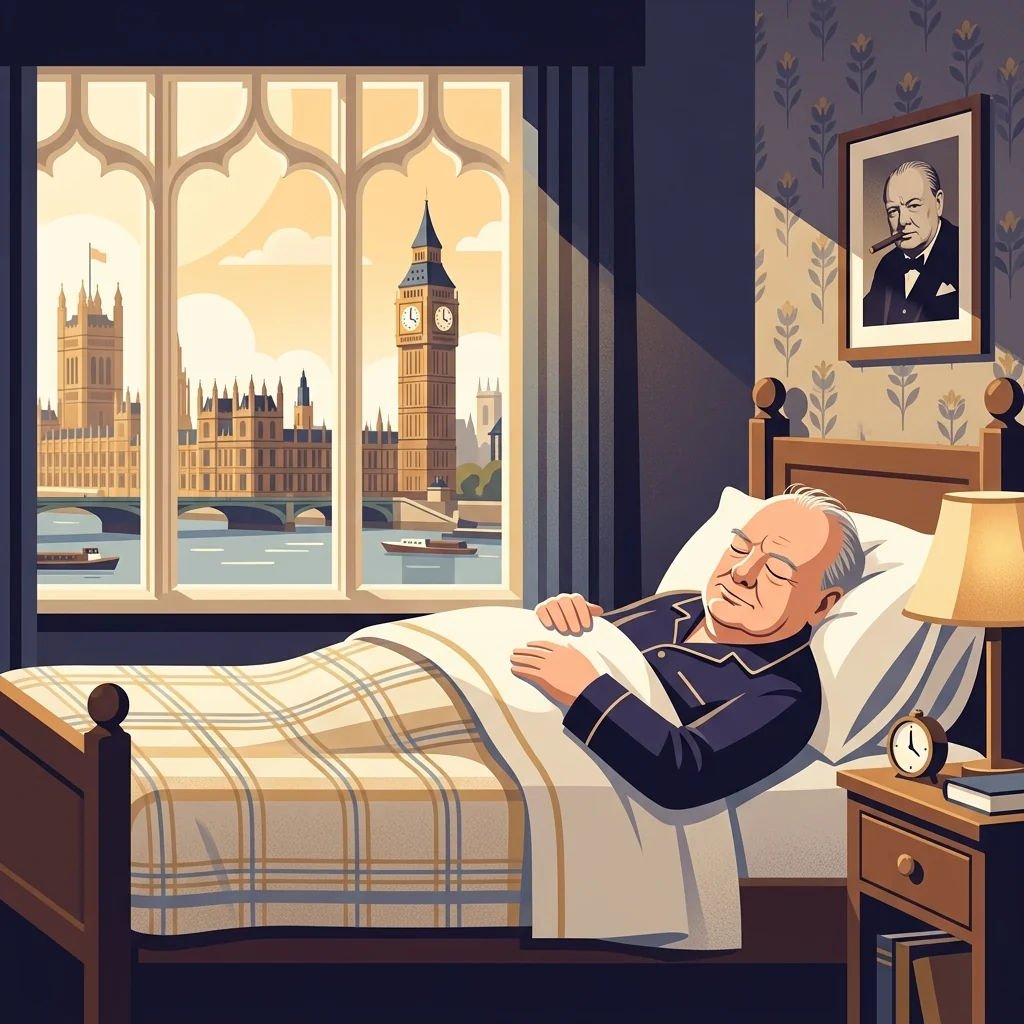
“Nature has not intended mankind to work from eight in the morning until midnight without that refreshment of blessed oblivion which, even if it only lasts twenty minutes, is sufficient to renew all the vital forces.” 🛌
Winston Churchill (1874–1965) led Great Britain through its darkest hours in World War II, orchestrating Allied strategy while simultaneously penning historical volumes that earned him the Nobel Prize in Literature. How did he sustain peak executive function during relentless 18-hour workdays amidst high-stakes wartime decisions?
His secret lay in an unyielding afternoon nap routine. Every day between 2:00 PM and 2:30 PM, Churchill halted all government briefings, undressed completely, and got into bed for a 1.5-hour deep sleep cycle. Even during intense bombing raids on London, this routine remained sacred and non-negotiable. Churchill insisted that this midday rest allowed him to divide his waking time into ‘two distinct days in one’, enabling him to chair cabinet meetings late into the night with razor-sharp mental acuity.
In today’s post, we analyze the brain science underlying Winston Churchill’s ‘afternoon nap’ routine and present a 3-step practical guide for modern individuals to flush cognitive fatigue through power naps.
Historical & Academic Evidence
This content is based on Historical Verification from Martin Gilbert's Biography *Winston S. Churchill* & Cognitive Neuroscience Research.
 BuildSelf
Inspired by historical greats? Make it your daily habit!
BuildSelf
Inspired by historical greats? Make it your daily habit!

















1. Adenosine Clearance and Cognitive Arousal Recovery Without Sleep Inertia
During waking hours, the neurochemical byproduct ‘adenosine’ continuously accumulates in the brain, generating sleep pressure. When adenosine binds to prefrontal receptors, executive processing slows and decision-making deteriorates. A brief afternoon nap (a 20-minute power nap or a full 90-minute sleep cycle) rapidly degrades accumulated adenosine. Specifically, a 20-minute nap prompts waking before the brain enters NREM Stage 3 slow-wave sleep, preventing ‘Sleep Inertia’ (post-awakening grogginess) while immediately restoring prefrontal alertness. Churchill’s 90-minute bed nap leveraged a full sleep cycle containing both NREM and REM phases, thoroughly resetting cortical architecture for nighttime governance.
2. 3-Step Practical Routine for Modern Professionals
Step 1: Setting a 20-Minute Timer Between 1:00 PM and 2:00 PM
During the post-lunch dip between 1:00 PM and 2:00 PM, set your smartphone to Do Not Disturb. Set a timer for 20 minutes to prevent sleep inertia, ensuring the session finishes before 3:00 PM.
Step 2: Environmental Isolation of Visual and Auditory Stimuli
Recline in a comfortable chair or sofa, using an eye mask or earplugs to block ambient light and noise. Even if you do not fall into deep sleep, closing your eyes and cutting visual input disengages the visual cortex, dramatically reducing cognitive fatigue.
Step 3: Immediate Rising Post-Alarm, Hydration, and Light Stretching
When the 20-minute alarm sounds, rise immediately without hesitation. Drink a glass of lukewarm water to stimulate metabolic clearance, perform 2 minutes of light stretching to re-awaken body sensations, and transition directly into afternoon tasks.
3. Caution & Tips: Preventing Nighttime Sleep Disruption & Strictly Timing Naps
The core rule of a nap routine is relieving midday fatigue without draining nighttime sleep pressure. Napping after 3:00 PM or sleeping too long in the late afternoon impairs nighttime sleep onset, triggering an insomniac loop. For modern knowledge workers, a 15-to-20-minute ‘Power Nap’ is optimal. Napping longer than 30 minutes pushes the brain into deep NREM Stage 3 sleep, resulting in severe sleep inertia upon waking. Use a strict timer to control wake-up timing.
📌 Frequently Asked Questions (FAQ)
What is the difference between Churchill's 1.5-hour bed nap during WWII and a modern 20-minute power nap? ▼
Churchill's 1.5-hour nap compensated for restricted nighttime sleep (4–5 hours) by covering a full 90-minute cycle including both NREM and REM stages. In contrast, a modern 20-minute power nap preserves a normal 7-hour night sleep, remaining within light NREM Stages 1–2 to clear adenosine instantly without sleep inertia.
Is a 20-minute nap useless if I close my eyes but fail to actually fall asleep? ▼
No, it still yields significant cognitive benefits. Even without reaching actual sleep, simply reclining with eyes closed to block visual and auditory inputs disengages the visual cortex and induces relaxed alpha brainwaves (8–12 Hz). This 20-minute sensory pause alone restores over 50% of prefrontal cognitive resources.