“The clarity of my philosophy is like the purity of light passing through a glass lens.” 🔍
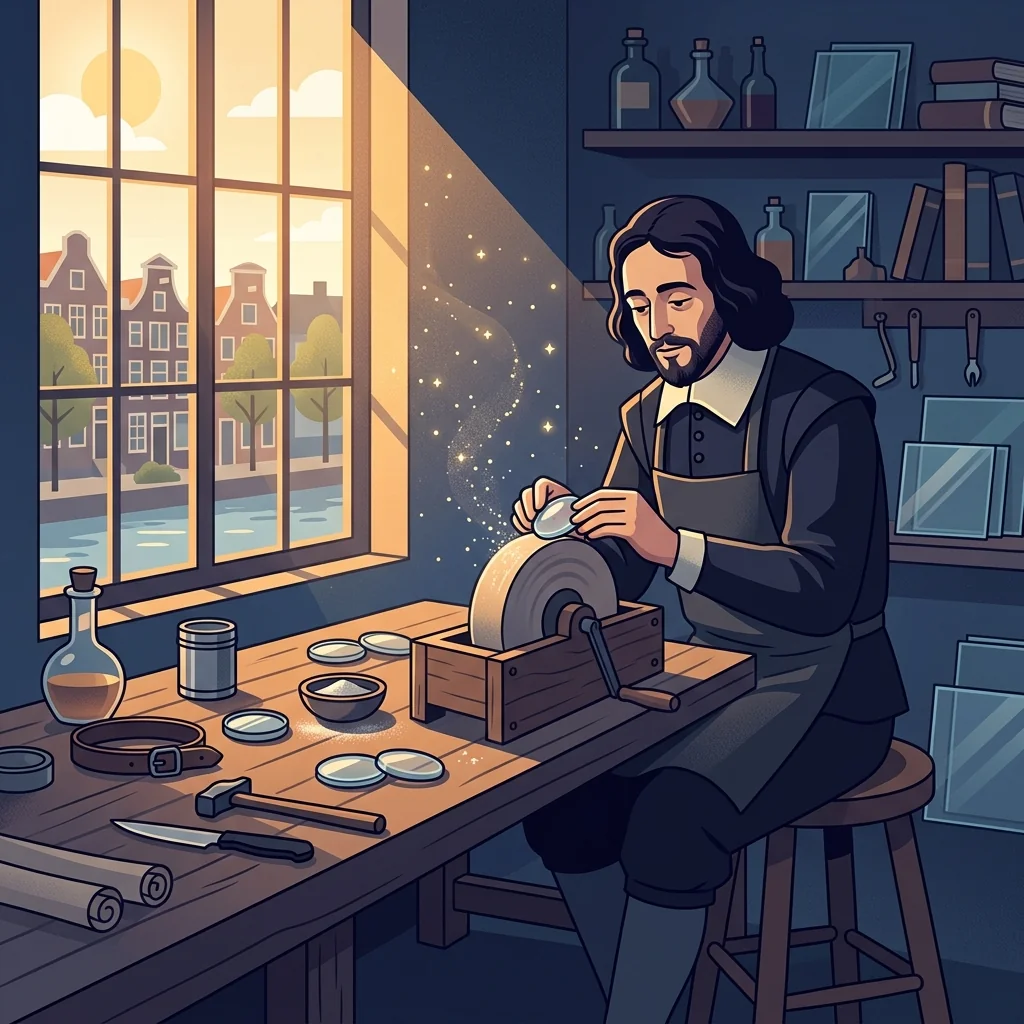
Baruch Spinoza (1632–1677) was a Dutch philosopher who opened the doors of modern Western philosophy with his pantheistic view equating God with Nature. To preserve his freedom of thought and independence, he declined university professorships and financial patronage, earning a living as an optical lens grinder.
Sitting before a workbench with glass dust, the repetitive, fine physical hand movements of polishing delicate lens surfaces provided his brain with the ultimate rest to recover composure when overloaded by the vast geometric proofs of his masterpiece, ‘Ethics’ (Ethica). Grasping grinding tools and glass when intellectual fatigue reached its peak was, from a modern neurophysiological perspective, an outstanding cognitive control activity that prevented brain burnout.
Historical & Academic Evidence
This content is based on Spinoza Lens Grinding historical biography & Cognitive Neuroscience research.
 BuildSelf
Inspired by historical greats? Make it your daily habit!
BuildSelf
Inspired by historical greats? Make it your daily habit!

















1. Neuroscience of How Simple Fine Motor Skill Prevents Cognitive Burnout
Continuous high-level rational reasoning or complex structural design depletes cognitive resources in the prefrontal cortex. Switching to fine manual labor focused deeply on touch—like grinding lenses—activates the motor cortex and cerebellum, immediately suppressing an overactive Default Mode Network (DMN) and idle thoughts. This temporary shift in brain activation allows the exhausted prefrontal cortex to recover energy.
2. 3-Step Practical Routine for Modern Professionals
Recognizing Brain's Cognitive Overload
Detect burnout signals early when cognitive resources are depleted, such as reading text without comprehension, creative blocks, or feeling mentally blank.
Engage in Fine Motor Manual Labor
Step away immediately from screens and begin pre-arranged analog manual tasks (e.g., washing dishes, paper transcription, assembling small models). Focus entirely on tactile sensations for 15 minutes.
Return to Analytical Tasks with a Refreshed Mind
After 15 minutes of manual labor, return to your computer and resume planning or development work. With restored cognitive buffer space, you will make clearer, more efficient decisions.
3. Choosing Completely De-Digitalized Manual Work
To achieve this relaxation effect, you must disconnect completely from smartphones or keyboards. Operating digital devices still demands high logical computation from the brain, failing to relieve fatigue. Choose simple physical activities requiring only tactile feedback and visuospatial control, such as washing dishes, handwriting, or craft assembly.
📌 Frequently Asked Questions (FAQ)
Should I practice this habit every day? ▼
Yes, neural plasticity is maximized when practiced at a consistent daily time. Executing it continuously at a set time and location strengthens neuroplasticity circuits for optimal success.