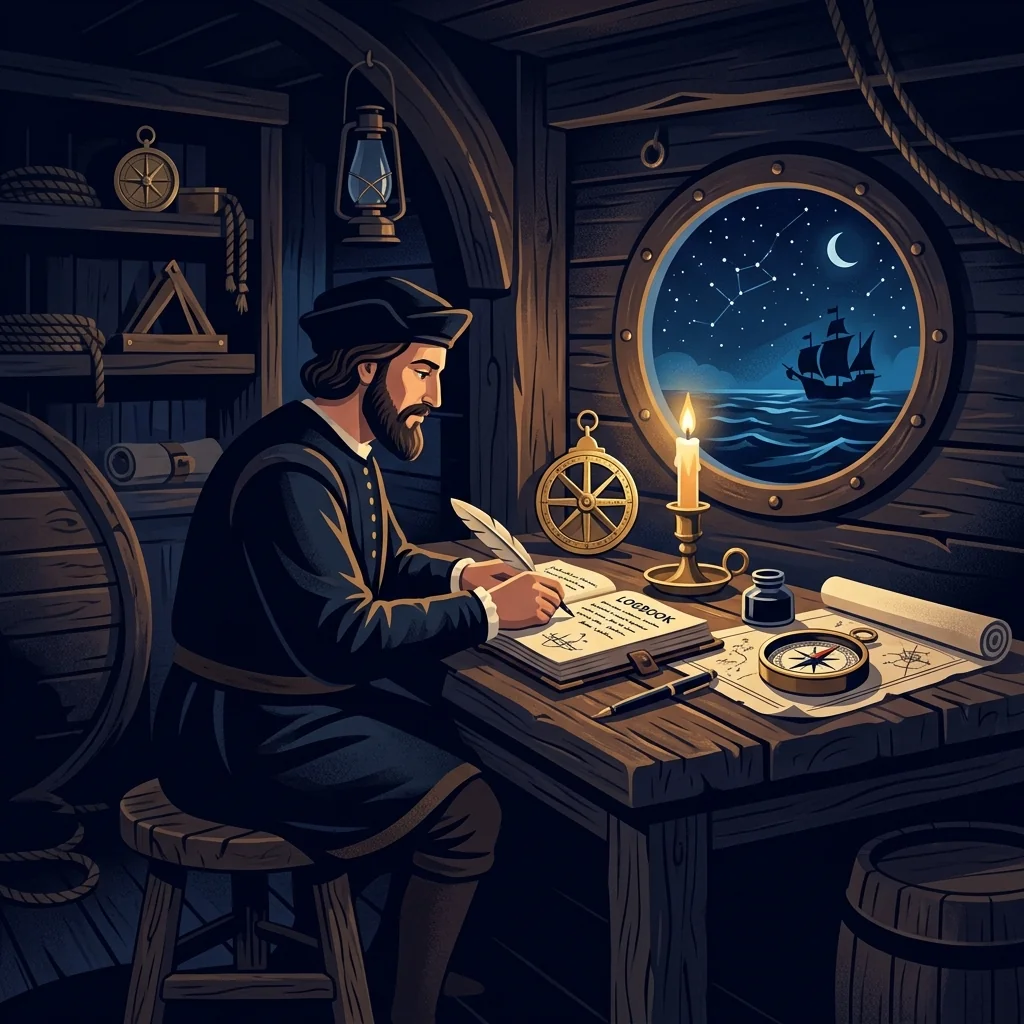
“Setting down the ocean’s depth and the angles of the stars each night transformed the horror of the dark sea into the solid certainty of numbers.” ⛵
In 1492, Christopher Columbus (1451–1506) commanded three fragile wooden vessels—the Santa María, Pinta, and Niña—into the uncharted darkness of the Atlantic Ocean. Facing the terrifying abyss of the open sea and mutinous crews convinced they would plunge off the edge of the world, how did Columbus preserve unwavering leadership and composure under extreme stress?
His core secret was a disciplined nightly record-keeping routine. Every night beneath a dim candle in his cabin, Columbus measured astronomical coordinates with an astrolabe, estimated vessel speed, and meticulously recorded depth soundings in his nautical log. Whenever existential dread and uncertainty threatened to overwhelm his crew or himself, converting chaos into precise numeric data served as a neural circuit-breaker—calming amygdala fear centers and re-anchoring his mind in prefrontal executive control.
In today’s post, we analyze the brain science underlying Christopher Columbus’s ‘nightly quantitative logging’ routine and present a 3-step practical action plan for modern individuals to diffuse vague daily anxiety and restore prefrontal control through objective metrics.
Historical & Academic Evidence
This content is based on Historical Verification from Bartolomé de las Casas's *The Diario of Christopher Columbus* & Cognitive Neuroscience Research.
 BuildSelf
Inspired by historical greats? Make it your daily habit!
BuildSelf
Inspired by historical greats? Make it your daily habit!

















1. Amygdala Deactivation and Prefrontal Switch via Nightly Quantitative Journaling
Vague, uncontrollable anxiety overstimulates the limbic system’s fear center—the amygdala—triggering sympathetic arousal, elevated heart rate, insomnia, and panic states. Keeping a ‘nightly nautical log’ that handwrites concrete facts and quantitative metrics (completed outputs, remaining tasks, tomorrow’s vectors) acts as a high-leverage neurological switch. It transfers active processing away from emotional limbic structures to the rational dorsolateral prefrontal cortex (DLPFC). Converting existential dread into visible numbers dampens amygdala reactivity, inducing physiological calm and facilitating sleep-dependent memory consolidation.
2. 3-Step Practical Routine for Modern Professionals
Step 1: Setting Up an Analog 3-Line Logbook and Pen Before Bed
10 minutes before sleep, open a paper notebook under a warm bedside light. Turn off smartphones and create a quiet, distraction-free environment.
Step 2: Handwriting 3 Fact-Based Quantitative Lines (Completed/Pending/Vector)
Handwrite strictly: 1) Today's completed numeric output, 2) In-progress metrics, and 3) Tomorrow morning's first target vector (1 sentence), using objective numbers.
Step 3: Affirming Prefrontal Control, Closing the Logbook & Transitioning to Sleep
Close the logbook while mentally reciting: 'Today's navigation is safely recorded.' Turn off the lights and transition into sleep with calm abdominal breathing.
3. Caution & Tips: Avoiding Emotional Rumination & Logging Objective Metrics
The foundation of a nautical log routine is converting subjective feelings into objective data. Writing emotional grievances or repeating phrases like ‘I felt so stressed today’ before bed re-triggers the amygdala, amplifying negative neural loops and worsening insomnia. Exclude subjective venting. Instead, log strictly quantified facts and metrics: ‘Completed 4 out of 5 targets’, ‘Progress rate: 80%’, ‘Top priority for tomorrow: 1 item’. This objective focus recruits prefrontal networks to quiet emotional reactivity.
📌 Frequently Asked Questions (FAQ)
Does recording in a smartphone note app or digital planner yield the same amygdala-calming effect? ▼
No. Physical handwriting provides tactile sensory feedback that broadly recruits motor and somatosensory cortices, engaging prefrontal cognitive control much more strongly. Furthermore, smartphone blue light suppresses nighttime melatonin secretion, disrupting sleep architecture. Using a physical paper notebook is strongly recommended.
What should I do on days when I am too exhausted to write a full log before sleeping? ▼
Writing a single line—such as 'Completed today: Task A'—is fully sufficient. The objective is not exhaustive perfection, but preserving the unbroken daily recording loop. This minimal action signals prefrontal control to your brain, lowering amygdala reactivity even on high-fatigue days.