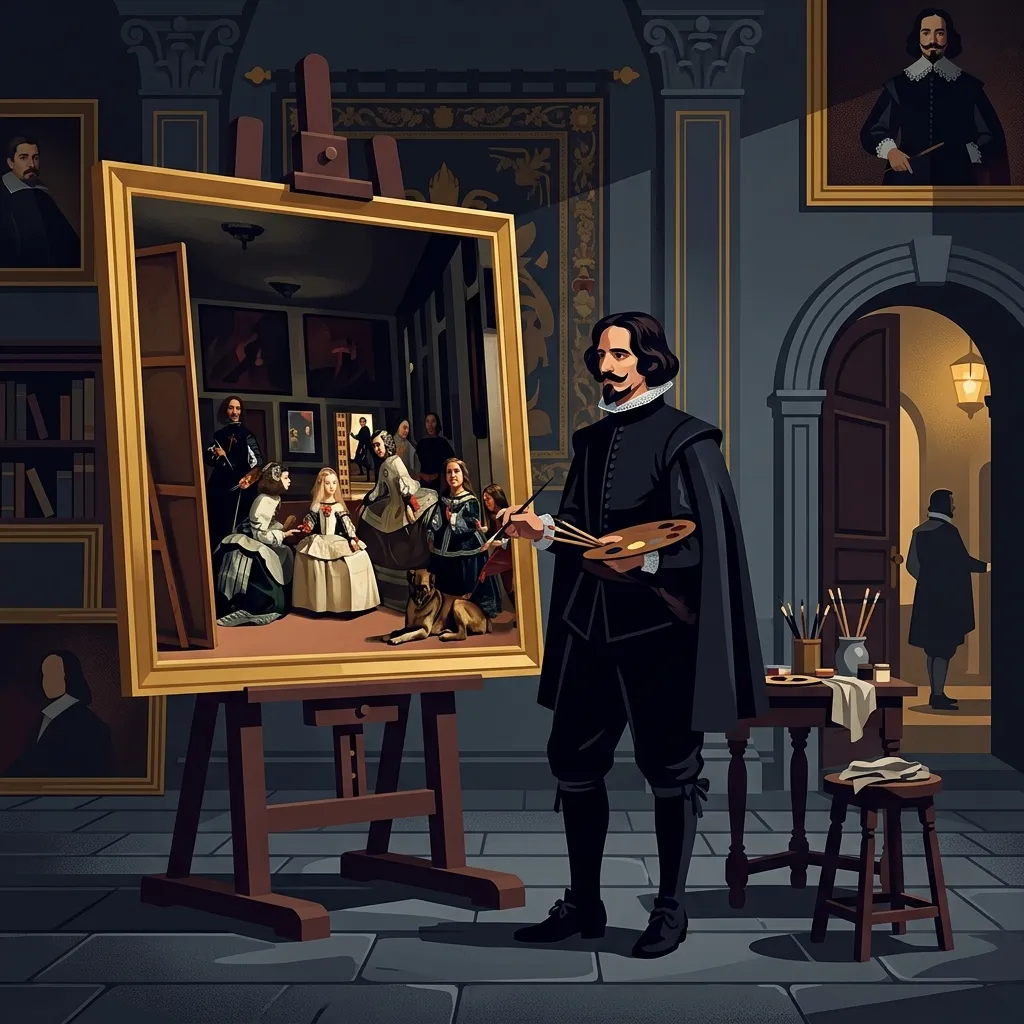
“A painting is not created by the hand alone, but completed first through the mind and gaze.” 🖼️
Diego Velázquez, the Spanish master renowned for his eternal masterpiece ‘Las Meninas’, served as court painter to King Philip IV. Beyond capturing physical appearances, his extraordinary ability to portray deep psychological interiority and spatio-temporal structure was grounded in a quiet 15-minute contemplation routine practiced before work each day.
Before picking up a brush, Velázquez stood before his canvas and quietly gazed at his subject or his own eyes in a mirror for 15 minutes. During this period, without touching a brush, he observed the angles of light, subtle shifts in tone, and the inner psychological state of the subject. Only after grasping the essence purely through vision and observation without preliminary sketches did he make his first brushstroke.
This routine was a sophisticated cognitive strategy that warmed up the visual cortex and Theory of Mind networks before execution. In today’s post, we introduce the cognitive neuroscience principles of Theory of Mind and Attentional Calibration embedded in Velázquez’s contemplation routine.
Historical & Academic Evidence
This content is based on Antonio Palomino's *El Parnaso español pintoresco laureado* (1724), Museo del Prado Archives & Visual Neuroscience Research.
 BuildSelf
Inspired by historical greats? Make it your daily habit!
BuildSelf
Inspired by historical greats? Make it your daily habit!

















1. Cognitive Synergy of Theory of Mind Activation and Visual Attentional Calibration
Gazing intently at a subject for 15 minutes before commencing work activates the brain’s ‘Theory of Mind’ network and the Mirror Neuron System. This enables a deep understanding of the subject’s internal state and essential composition.
Furthermore, static gaze heightens the sensitivity of the Visual Cortex and triggers ‘Attentional Calibration’ in the prefrontal cortex. This scientific routine prevents impulsive errors and builds a high-definition cognitive map before executing tasks.
2. 3-Step Practical Routine for Modern Professionals
Step 1: 15-Minute Quiet Contemplation Before Work (Visual Cortex Warming)
Before grasping a brush or keyboard, gaze quietly at the subject or problem for 15 minutes, focusing entirely on observation.
Step 2: Grasping Inner Essence and Structure (Theory of Mind Activation)
Look beyond surface details to quietly analyze the core essence, context, and structural depth of the problem.
Step 3: Precise Execution After Calibration
Begin execution only after the cognitive map is fully established in the brain through contemplation.
3. Modern Focus Guide to Setting Aside Haste and Contemplating Essence
When facing a task or problem, avoid rushing into execution. The key is securing a quiet warm-up period to observe the essence and structure of the task, just as an artist contemplates a subject before painting.
📌 Frequently Asked Questions (FAQ)
Is the 15-minute contemplation routine effective for general work or study outside of art? ▼
Yes, it is highly effective. Spending 10 to 15 minutes quietly observing task requirements or code structure before execution reduces impulsive errors and maximizes precision.
Why must one observe quietly without doing anything for 15 minutes? ▼
Because the brain requires a dedicated static observation window to process visual information and construct a clear cognitive map in the prefrontal cortex. Separating observation from execution curtails impulsivity.