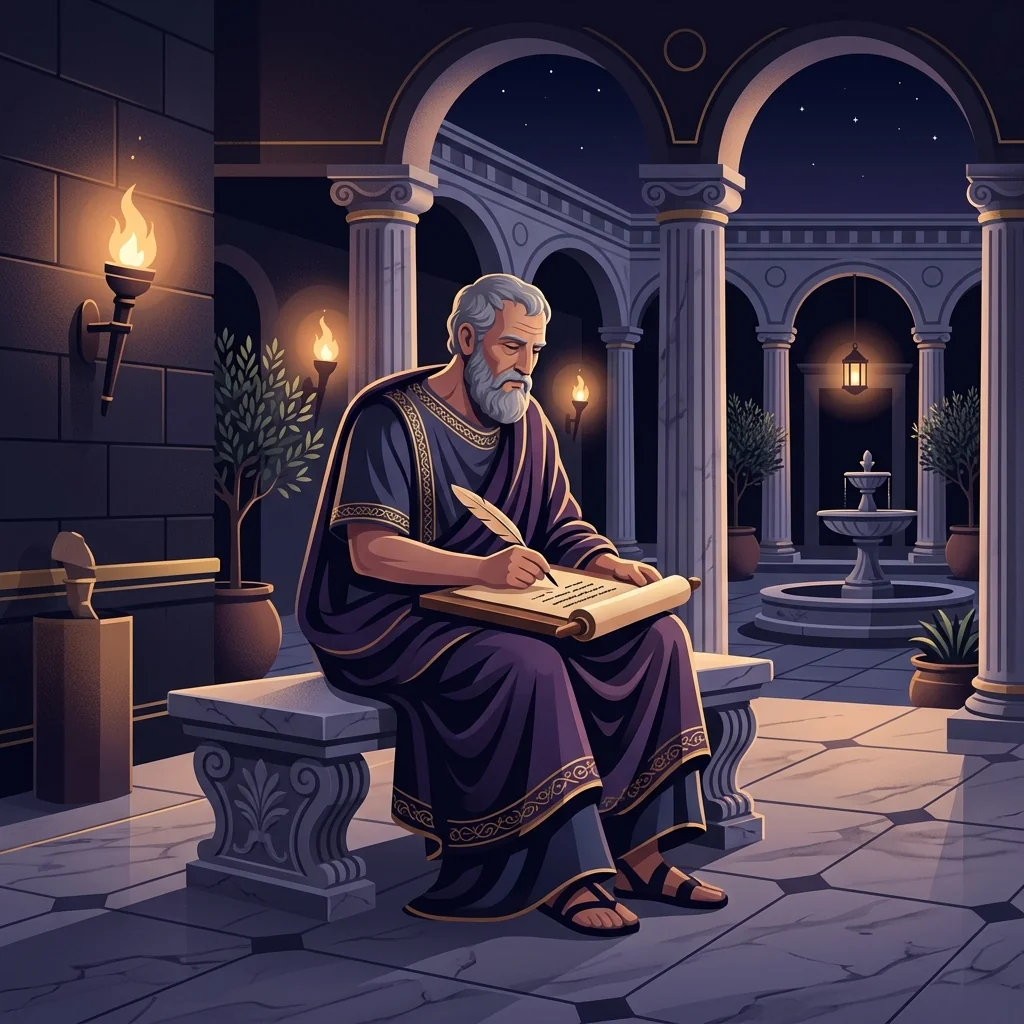
“Freedom is the only worthy goal in life. It is won by disregarding things that lie beyond our control.” 📜
Epictetus (c. 50–135 AD) was born into bitter slavery and left permanently lame from his master’s abuse. Yet, through unyielding rationality, he achieved complete mental freedom, establishing a renowned Stoic academy in Nicopolis after being exiled from Rome. His teachings deeply inspired Emperor Marcus Aurelius’s Meditations.
Though Epictetus wrote nothing himself, his student Arrian transcribed his lectures into the Discourses and compiled the Enchiridion. At the core of Epictetus’s philosophy was a nightly reflective routine built on the ‘Dichotomy of Control’. Every evening, he evaluated his daily experiences by dividing them into two strict categories: things ‘up to us’ (our thoughts, desires, actions, and judgments) and things ‘not up to us’ (other people’s opinions, external outcomes, health, and past events). He recognized that suffering begins the exact moment we attach our happiness to things outside our authority.
In today’s post, we unpack the cognitive neuroscience behind Epictetus’s ‘dichotomy of control’ evening reflection and present a practical 3-step action plan to eliminate helplessness and anxiety.
Historical & Academic Evidence
This content is based on Historical Verification from Epictetus's *Discourses* and *Enchiridion* & Cognitive Neuroscience Research.
 BuildSelf
Inspired by historical greats? Make it your daily habit!
BuildSelf
Inspired by historical greats? Make it your daily habit!

















1. Internalizing the Locus of Control and Downregulating Amygdala Cortisol Responses
Chronic stress and anxiety stem primarily from perceived helplessness when the brain hyper-focuses on external variables it cannot control (such as other people’s reactions, market conditions, or past events). Epictetus’s Dichotomy of Control shifts your ‘Locus of Control’ from external outcomes to internal agency. By formally acknowledging and releasing uncontrollable variables, the prefrontal cortex (PFC) exerts top-down executive regulation over the limbic system. This calms hyperactivation in the amygdala—the brain’s threat center—dramatically reducing cortisol levels and restoring emotional equilibrium.
2. 3-Step Practical Routine for Modern Professionals
Step 1: Drafting a 2-Column T-Chart Evening Note
Draw a line down the middle of your evening journal page. Label the left column 'Up to Us (My Responses & Attitudes)' and the right column 'Not Up to Us (External Outcomes & Others' Reactions)'.
Step 2: Accepting Uncontrollables and Severing Emotional Ties
Review the items listed in the right column ('Not Up to Us'). Internally affirm: 'This outcome is not within my jurisdiction,' and consciously sever your emotional attachment to those variables.
Step 3: Defining Actionable Commitments for Controllables Only
Shift your total focus to the left column ('Up to Us'). Define one single, concrete attitude or effort within your direct control to execute tomorrow, pledging your full energy to it.
3. Caution: Your Jurisdiction Ends at Your Own Actions
Blaming yourself when externalor market outcomes turn unfavorable—despite giving your best effort—pushes the brain into severe ego depletion and depressive cycles. Understand that your sole duty ends at your intentional effort; the ultimate outcome belongs to the universe.
📌 Frequently Asked Questions (FAQ)
Is it truly impossible to control another person's attitude or reaction? ▼
Yes, completely. Your jurisdiction covers only your sincere attempt to communicate or influence; how the other person interprets and responds to it lies 100% within their domain. The moment you internalize this boundary, interpersonal stress evaporates.
Does ignoring outcomes diminish my passion or motivation? ▼
Not at all. In fact, the opposite happens. Liberating your brain from fear and outcome anxiety allows you to channel 100% of your cognitive energy into pure immersion in the task itself.