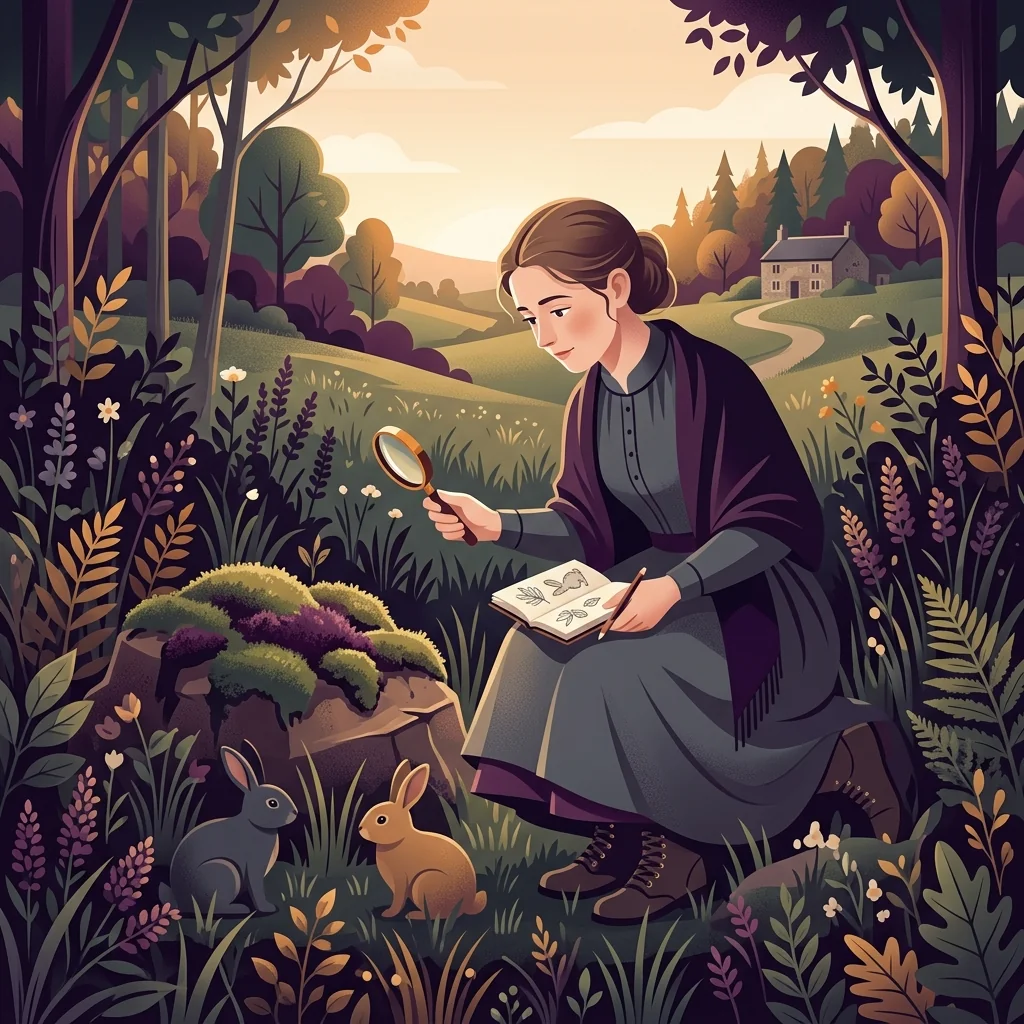
Beatrix Potter (1866–1943), creator of the beloved character ‘Peter Rabbit’ (over 300 million copies sold worldwide), 19th-century naturalist illustrator, and amateur mycologist. What drove this shy Victorian British woman to create both an imaginative fairytale world and scientifically valuable botanical illustrations? 🐰
Every morning, Beatrix Potter stepped out into the mossy fields and gardens of the Lake District carrying a magnifying glass and sketchbook. She spent long minutes examining the spore structures of mushrooms, the texture of moss, or the delicate fur of wild rabbits through her glass, sketching them with meticulous precision. This hyper-focused micro-sketching routine served as a powerful deep work tool that insulated her brain from external anxieties.
In today’s post, we explore the cognitive neuroscience behind Beatrix Potter’s lifelong micro-observation routine and how engaging right-brain spatial-sensory processing fosters effortless immersion.
Historical & Academic Evidence
This content is based on Historical biography & autobiographical record verification of Beatrix Potter & Cognitive Neuroscience research.
 BuildSelf
Inspired by historical greats? Make it your daily habit!
BuildSelf
Inspired by historical greats? Make it your daily habit!

















1. Blocking DMN Mind-Wandering and Activating Executive Control through Micro-Focused Attention
When the brain gets distracted by past regrets or future anxiety, it is because the Default Mode Network (DMN) is overheated and mind-wandering.
Potter’s ‘micro-focused training’—fixing visual attention tightly on minute patterns and textures—channels visual signals directly into the Executive Network. This effectively shuts down distraction circuits and restores the brain to a calm, clear state.
2. 3-Step Practical Routine for Modern Professionals
Select One Object for Micro-Observation
Pick up a single object nearby rich in detail—such as a leaf, apple skin, wood grain, or coffee bean.
3 Minutes of Close-Up Visual Focus Observation
Bring your eyes within 10cm of the object as if looking through a magnifying glass, immersing your focus on minute lines, textures, and shadows.
Note or Sketch One Line of Discovered Detail
Immediately write down or sketch one line describing a newly discovered detail, such as 'tiny spike pattern on back of leaf'.
3. Focus on the Minute Textures Right Before You, Not the Distant Picture
The core of this observation routine is not producing grand artistic sketches. The healing power lies in the process of microscopically exploring a single leaf, a pencil tip, or skin texture on your hand as if through a lens.
📌 Frequently Asked Questions (FAQ)
Do I need to sketch even if I am not good at drawing? ▼
No! Describing the observed features in text instead of drawing yields the exact same 100% immersion effect for your brain.
Can I apply this indoors or in an office using artificial objects instead of natural elements? ▼
Yes, any man-made object with fine texture—such as the nib of a fountain pen, paper grain, or leather wallet stitching—provides excellent immersion.