“Only he who never stops learning and humbly absorbs the greatness of predecessors becomes a new master.” 🎨
Raphael Sanzio (1483–1520) stands as the epitome of harmony, grace, and perfection in High Renaissance art. Positioned alongside titanic contemporaries like Leonardo da Vinci and Michelangelo Buonarroti, how did young Raphael refine his own impeccable style to reach the pinnacle of artistic achievement?
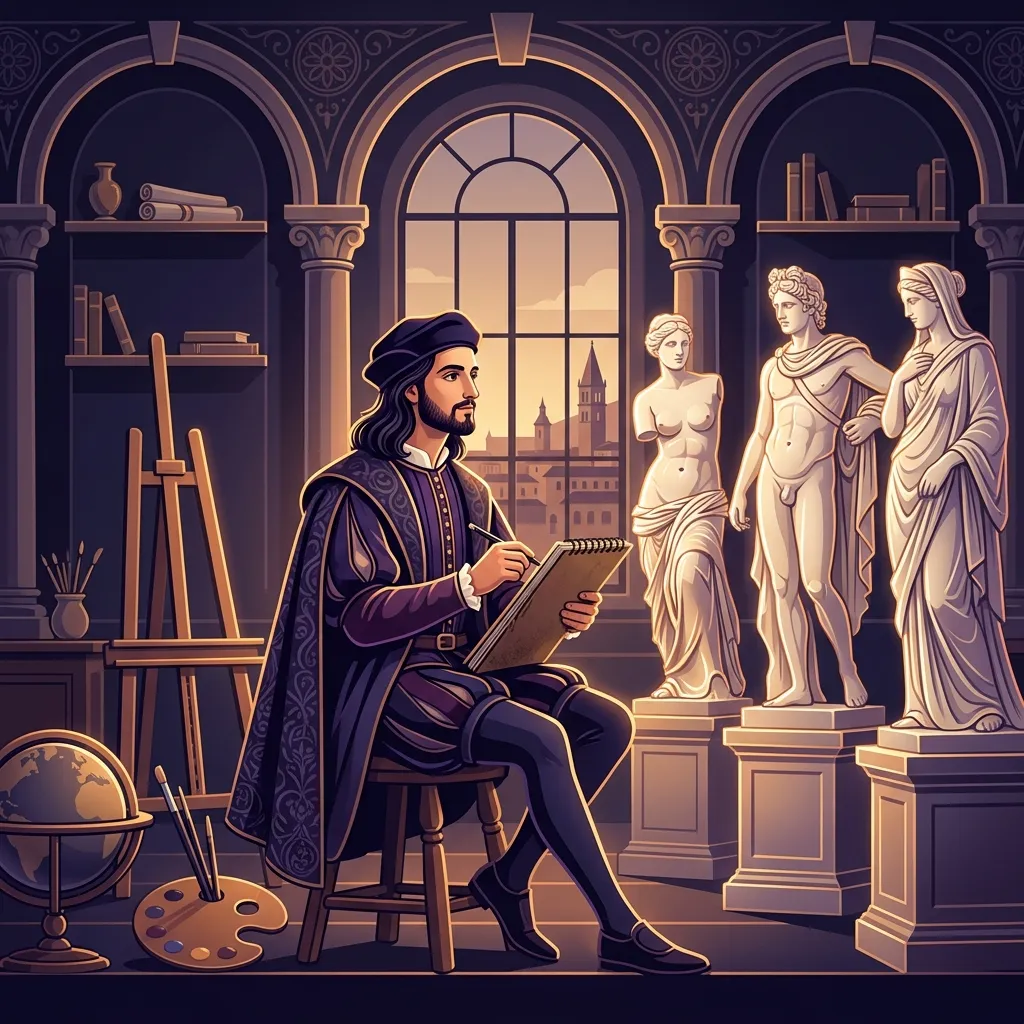
Upon arriving in Florence, young Raphael set aside his ego and took his sketchbook directly in front of the masterworks of his predecessors every day. He tirelessly copied Leonardo’s graceful pyramidal compositions and sfumato shading, as well as Michelangelo’s dynamic anatomical tension and contrapposto poses. Raphael’s sketchbook was not a place of mere imitation, but a cognitive crucible where he absorbed the finest elements of masters to forge his own signature style. Through this humble sketching routine, he eventually created timeless masterpieces like ‘The School of Athens’.
In today’s post, we examine the cognitive working mechanisms behind Raphael’s master technique sketching habit and explore how modern individuals can apply others’ excellence to spark original creativity.
Historical & Academic Evidence
This content is based on Giorgio Vasari, *Le Vite* (1550) & British Museum / Ashmolean Museum Drawing Archives & *Cognitive Science*.
 BuildSelf
Inspired by historical greats? Make it your daily habit!
BuildSelf
Inspired by historical greats? Make it your daily habit!

















1. The Mirror Neuron System and ‘Combinatorial Creativity’
True creativity rarely springs from thin air; it is born when the brain recombines existing superior elements into novel patterns. In cognitive science, this is known as ‘Combinatorial Creativity’. Directly copying and sketching masterworks engages the brain’s Mirror Neurons, imprinting high-level spatial and motor techniques deeply into Procedural Memory through Observational Learning. Raphael’s habit was a brilliant neuroscientific method for turning external excellence into internal cognitive capital.
2. 3-Step Practical Routine for Modern Professionals
Select Masterworks and Benchmark Targets
Identify premier benchmarks in your domain (design, writing, coding, or strategy) that represent the highest standards of execution.
Anatomize Structure Through Hands-On Copying
Go beyond passive observation by manually copying, transcribing, or redrawing the masterwork into your notebook to internalize its core mechanisms.
Recombine Elements to Craft Your Unique Style
Extract distinct strengths from two or more master sources, then synthesize them into your current project to produce an original, elevated output.
3. Rule: Move Beyond Blind Copying to Anatomize Structure and Intent
The greatest pitfall in master copying is mindless replication—merely tracing surface aesthetics without thought. When sketching his predecessors’ works, Raphael analyzed intent as if dissecting it: ‘Why was this line drawn here?’ and ‘How was light positioned to create 3D depth?’ When benchmarking superior work, focus on deciphering the underlying principles and structural logic rather than superficial appearances.
📌 Frequently Asked Questions (FAQ)
Doesn't copying someone else's work lead to plagiarism? ▼
Replicating a single person's work and claiming it as your own is plagiarism. However, synthesizing structural strengths from multiple masters to evolve a new perspective is the essence of 'combinatorial creativity'. Practice copying during the learning phase is a necessary bridge to true originality.
Can this sketching habit be applied to non-visual fields like writing or business strategy? ▼
Yes, exceptionally well. Transcribing masterfully written prose by hand or rebuilding exemplary code line-by-line stimulates procedural memory, allowing you to absorb an expert's cognitive schema far faster than passive reading.