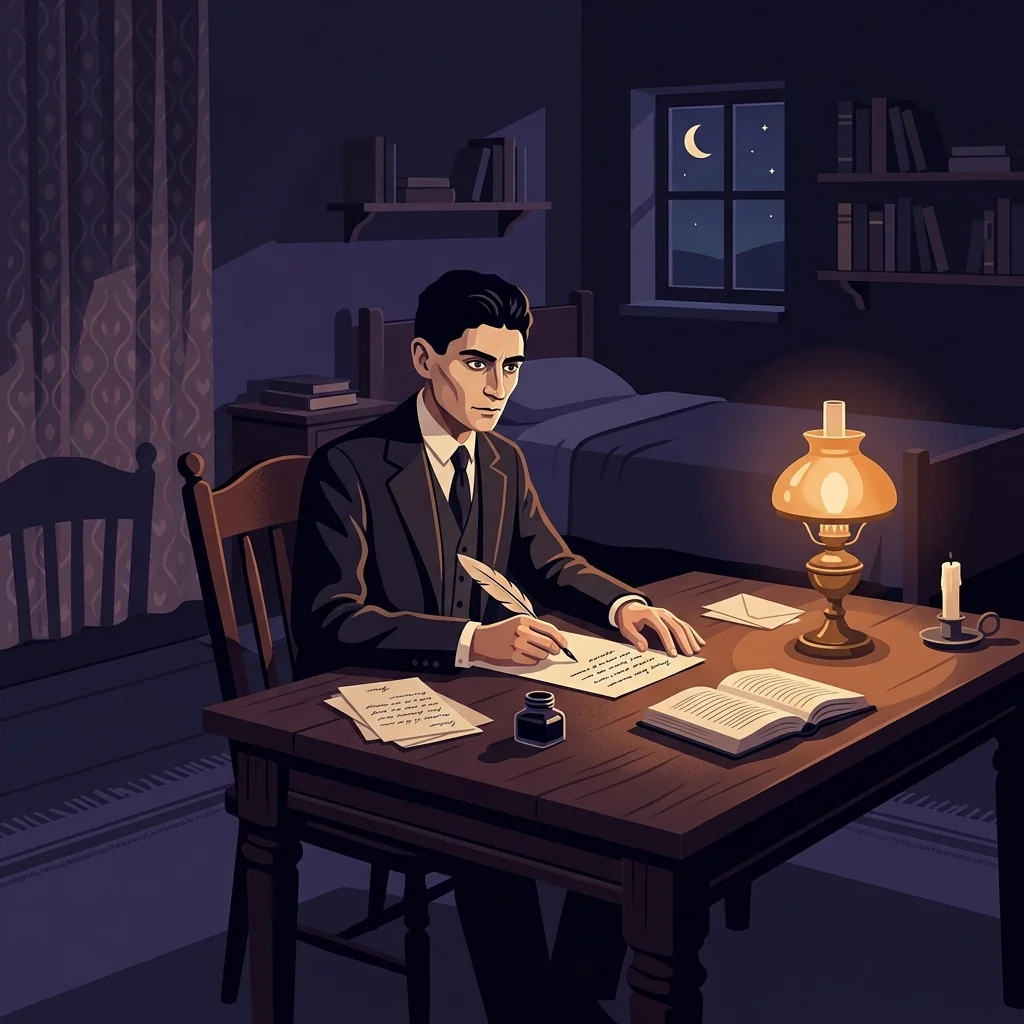
“My room’s door is locked, total silence surrounds me, and this profound quiet sustains my soul. Writing is a form of prayer.” 🕯️
Franz Kafka (1883–1924) was the iconic Czech-born German-language novelist whose haunting masterworks—including The Metamorphosis (Die Verwandlung), The Trial (Der Process), and The Castle (Das Schloss)—profoundly articulated the absurdity, alienation, and existential anxiety of modern humanity. Remarkably, his visionary literary universe was unlocked only in the dead of night, after the daytime world fell completely dormant.
By day, Kafka worked dutifully as a legal officer at the Workers’ Accident Insurance Institute in Prague. However, as documented in Max Brod’s biography and Kafka’s personal letters to Felice Bauer, he initiated his true life’s work at 11:00 PM, once his family slept and street noises vanished. From 11:00 PM until 2:00 or 3:00 AM—and occasionally until dawn at 6:00 AM—Kafka wrote in extreme silence. Stripped of external sensory stimulation, his brain disengaged top-down executive filtering, allowing raw subconscious associations to pour effortlessly onto the blank page.
In today’s post, we unpack the cognitive neuroscience behind Franz Kafka’s ‘late-night writing’ routine and present a modern 3-step action guide to harness frontal down-regulation and establish a golden hour of distraction-free focus.
Historical & Academic Evidence
This content is based on Historical Verification from Max Brod's *Franz Kafka: A Biography*, Kafka's Diaries & Cognitive Neuroscience Research.
 BuildSelf
Inspired by historical greats? Make it your daily habit!
BuildSelf
Inspired by historical greats? Make it your daily habit!

















1. Frontal Down-Regulation and the Cognitive Neuroscience of Absolute Silence Immersion
During daylight hours, the Prefrontal Cortex expends immense cognitive energy maintaining top-down inhibitory control, social compliance, and logical filtering. In late night hours, circadian fatigue relaxes this prefrontal control filter—a state known in cognitive neuroscience as Frontal Down-regulation. Freed from top-down censorship, the brain gains direct access to subconscious associations, emotional depth, and unorthodox creative synthesis. This physiological shift empowered Kafka to write haunting, highly original prose. Concurrently, late-night acoustic silence eliminates ambient auditory interference in Working Memory buffers, creating an optimal neurochemical environment for deep single-topic focus.
2. 3-Step Practical Routine for Modern Professionals
Step 1: Eliminating External Noise & Establishing a Physical Immersion Sanctuary
Secure a timeframe when notifications settle (late night or early morning), or equip noise-canceling headphones in a quiet space to systematically eliminate ambient auditory noise.
Step 2: Minimizing Visual Stimuli & Blue Light Using Soft Warm Lighting
Turn off bright overhead lights, illuminating your workspace exclusively with a dim, warm desk lamp. Distance yourself from smartphones and blue-light emitting screens to reduce processing load in the visual cortex.
Step 3: Immersing Intensely in a Single Core Objective on Blank Paper
Write down a single clear target—a key sentence to draft, a complex design challenge, or a strategic solution—on a blank sheet of paper. Spend 30 minutes in total silence focusing exclusively on that topic until clarity emerges.
3. Caution: Securing a Golden Hour of Silence Without Disrupting Circadian Sleep Health
Replicating Kafka’s routine by staying up late blindly risks chronic sleep deprivation and physical burnout. The core mechanism is not sleep loss, but intentionally carving out 1 hour where external auditory and visual noise is completely eliminated. Rather than pulling all-nighters, use noise-canceling headphones or leverage quiet early morning hours to construct your personal golden hour of silence.
📌 Frequently Asked Questions (FAQ)
Doesn't working late at night like Kafka disrupt natural circadian sleep cycles? ▼
Yes, excessive all-nighters damage physical health. The core mechanism is not the late hour itself, but securing '1 hour of absolute silence' devoid of external interruptions. Achieving this via noise-canceling technology or quiet early morning hours delivers identical cognitive benefits without compromising sleep health.
How can I adapt Kafka's silence immersion routine during daylight hours? ▼
During daytime hours, wear noise-canceling earplugs or headphones to block acoustic chatter, dim overhead lighting, or draw blackout curtains. Minimizing environmental visual and auditory inputs artificially constructs a 'golden hour of silence' for your brain.